Pacific News-Review
pp. 3-77 · Read in the full issue
Notes And Comment On
The Progress Of The War
From April 15 To May 14
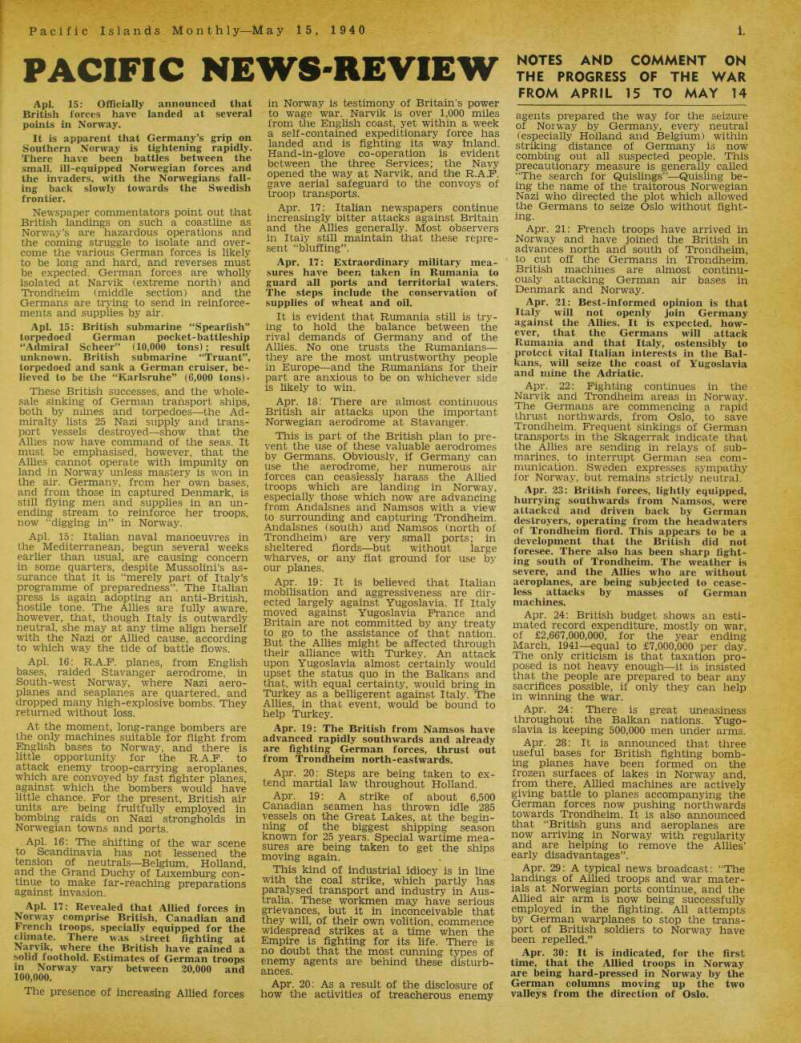
Apl. 15: Officially announced that British forces have landed at several points in Norway.
It is apparent that Germany’s grip on Southern Norway is tightening rapidly.
There have been battles between the small, ill-equipped Norwegian forces and the invaders, with the Norwegians fall ing back slowly towards the Swedish frontier.
Newspaper commentators point out that British landings on such a coastline as Norway’s are hazardous operations and the coming struggle to isolate and over come the various German forces is likely to be long and hard, and reverses must be expected. German forces are wholly isolated at Narvik (extreme north) and Trondheim (middle section) and the Germans are trying to send in reinforce ments and supplies by air.
Apl. 15: British submarine “Spearfish” torpedoed German pocket-battleship “Admiral Scheer” (10,000 tons); result unknown. British submarine “Truant”, torpedoed and sank a German cruiser, be lieved to be the “Karlsruhe” (6,000 tons).
These British successes, and the whole sale sinking of German transport ships, both by mines and torpedoes—the Ad miralty lists 25 Nazi supply and trans port vessels destroyed—show that the Allies now have command of the seas. It must be emphasised, however, that the Allies cannot operate with impunity on land in Norway unless mastery is won in the air. Germany, from her own bases, and from those in captured Denmark, is still flying men and supplies in an un ending stream to reinforce her troops, now “digging in” in Norway, Apl. 15: Italian naval manoeuvres in the Mediterranean, begun several weeks earlier than usual, are causing concern in some quarters, despite Mussolini’s as surance that it is “merely part of Italy’s programme of preparedness”. The Italian press is again adopting an anti-British, hostile tone. The Allies are fully aware, however, that, though Italy is outwardly neutral, she may at any time align herself with the Nazi or Allied cause, according to which way the tide of battle flows.
Apl. 16: R.A.F. planes, from English bases, raided Stavanger aerodrome, in South-west Norway, where Nazi aero planes and seaplanes are quartered, and dropped many high-explosive bombs. They returned without loss.
At the moment, long-range bombers are the only machines suitable for flight from English bases to Norway, and there is little opportunity for the R.A.F. to attack enemy troop-carrying aeroplanes, which are convoyed by fast fighter planes, against which the bombers would have little chance. For the present, British air units are being fruitfully employed in bombing raids on Nazi strongholds in Norwegian towns and ports.
Apl. 16: The shifting of the war scene to Scandinavia has not lessened the tension of neutrals—Belgium, Holland, and the Grand Duchy of Luxemburg con tinue to make far-reaching preparations against invasion.
Apl. 17: Revealed that Allied forces in Norway comprise British, Canadian and French troops, specially equipped for the climate. There was street fighting at Narvik, where the British have gained a solid foothold. Estimates of German troops in Norway vary between 20,000 and 100,000.
The presence of increasing Allied forces
in Norway is testimony of Britain’s power to wage war. Narvik is over 1,000 miles from the English coast, yet within a week a self-contained expeditionary force has landed and is fighting its way Inland.
Hand-in-glove co-operation is evident between the three Services; the Navy opened the way at Narvik, and the R.A.F. gave aerial safeguard to the convoys of troop transports.
Apr. 17: Italian newspapers continue increasingly bitter attacks against Britain and the Allies generally. Most observers in Italy still maintain that these repre sent “bluffing”.
Apr. 17: Extraordinary military mea sures have been taken in Rumania to guard all ports and territorial waters.
The steps include the conservation of supplies of wheat and oil.
It is evident that Rumania still is try ing to hold the balance between the rival demands of Germany and of the Allies. No one trusts the Rumanians— they are the most untrustworthy people in Europe—and the Rumanians for their part are anxious to be on whichever side is likely to win.
Apr. 18: There are almost continuous British air attacks upon the important Norwegian aerodrome at Stavanger.
This is part of the British plan to pre vent the use of these valuable aerodromes by Germans. Obviously, if Germany can use the aerodrome, her numerous air forces can ceaslessly harass the Allied troops which are landing in Norway, especially those which now are advancing from Andalsnes and Namsos with a view to surrounding and capturing Trondheim.
Andalsnes (south) and Namsos (north of Trondheim) are very small ports; in sheltered fiords—but without large wharves, or any flat ground for use by our planes.
Apr. 19: It is believed that Italian mobilisation and aggressiveness are dir ected largely against Yugoslavia. If Italy moved against Yugoslavia France and Britain are not committed by any treaty to go to the assistance of that nation.
But the Allies might be affected through their alliance with Turkey. An attack upon Yugoslavia almost certainly would upset the status quo in the Balkans and that, with equal certainty, would bring in Turkey as a belligerent against Italy. The Allies, in that event, would be bound to help Turkey.
Apr. 19: The British from Namsos have advanced rapidly southwards and already are fighting German forces, thrust out from Trondheim north-eastwards.
Apr. 20: Steps are being taken to ex tend martial law throughout Holland.
Apr. 19: A strike of about 6,500 Canadian seamen has thrown idle 285 vessels on the Great Lakes, at the begin ning of the biggest shipping season known for 25 years. Special wartime mea sures are being taken to get the ships moving again.
This kind of industrial idiocy is in line with the coal strike, which partly has paralysed transport and industry in Aus tralia. These workmen may have serious grievances, but it in inconceivable that they will, of their own volition, commence widespread strikes at a time when the Empire is fighting for its life. There is no doubt that the most cunning types of enemy agents are behind these disturb ances.
Apr. 20; As a result of the disclosure of how the activities of treacherous enemy
agents prepared the way for the seizure of Norway by Germany, every neutral (especially Holland and Belgium) within striking distance of Germany is now combing out all suspected people. This precautionary measure is generally called “The search for Quislings”—Quisling be ing the name of the traitorous Norwegian Nazi who directed the plot which allowed the Germans to seize Oslo without fight ing.
Apr. 21: French troops have arrived in Norway and have joined the British in advances north and south of Trondheim, to cut off the Germans in Trondheim.
British machines are almost continu ously attacking German air bases in Denmark and Norway.
Apr. 21: Best-informed opinion is that Italy will not openly join Germany against the Allies. It is expected, how ever, that the Germans will attack Rumania and that Italy, ostensibly to protect vital Italian interests in the Bal kans, will seize the coast of Yugoslavia and mine the Adriatic.
Apr. 22: Fighting continues in the Narvik and Trondheim areas in Norway.
The Germans are commencing a rapid thrust northwards, from Oslo, to save Trondheim. Frequent sinkings of German transports in the Skagerrak indicate that the Allies are sending in relays of sub marines, to interrupt German sea com munication. Sweden expresses sympathy for Norway, but remains strictly neutral.
Apr. 23: British forces, lightly equipped, hurrying southwards from Namsos, were attacked and driven back by German destroyers, operating from the headwaters of Trondheim fiord. This appears to be a development that the British did not foresee. There also has been sharp fight ing south of Trondheim. The weather is severe, and the Allies who are without aeroplanes, are being subjected to cease less attacks by masses of German machines.
Apr. 24: British budget shows an esti mated record expenditure, mostly on war, of £2,667,000,000, for the year ending March, 1941 —equal to £7,000,000 per day.
The only criticism is that taxation pro posed is not heavy enough—it is insisted that the people are prepared to bear any sacrifices possible, if only they can help in winning the war.
Apr. 24: There is great uneasiness throughout the Balkan nations. Yugo slavia is keeping 500,000 men under arms.
Apr. 28: It is announced that three useful bases for British fighting bomb ing planes have been formed on the frozen surfaces of lakes in Norway and, from there, Allied machines are actively giving battle to planes accompanying the German forces now pushing northwards towards Trondheim. It is also announced that “British guns and aeroplanes are now arriving in Norway with regularity and are helping to remove the Allies’ early disadvantages”.
Apr. 29: A typical news broadcast: “The landings of Allied troops and war mater ials at Norwegian ports continue, and the Allied air arm is now being successfully employed in the fighting. All attempts by German warplanes to stop the trans port of British soldiers to Norway have been repelled.”
Apr. 30: It is indicated, for the first time, that the Allied troops in Norway are being hard-pressed in Norway by the German columns moving up the two valleys from the direction of Oslo.
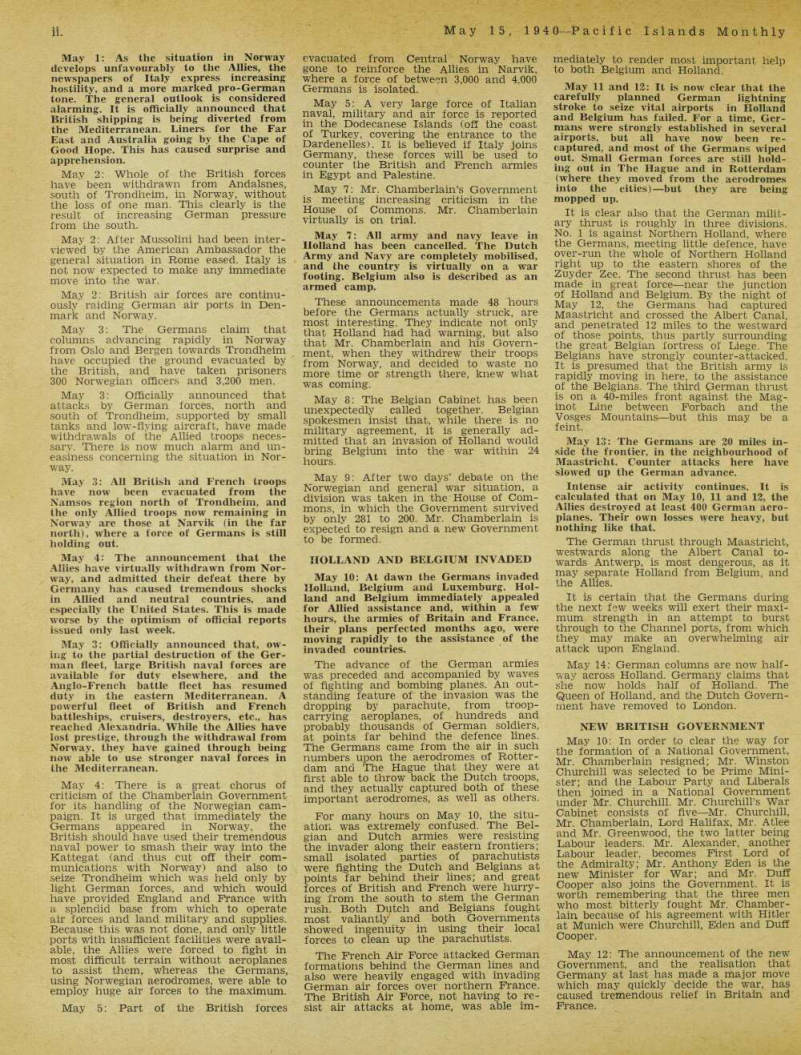
May 1: As the situation in Norway develops unfavourably to the Allies, the newspapers of Italy express increasing hostility, and a more marked pro-German tone. The general outlook is considered alarming. It is officially announced that British shipping is being diverted from the Mediterranean. Liners for the Far East and Australia going by the Cape of Good Hope. This has caused surprise and apprehension.
May 2: Whole of the British forces have been withdrawn from Andalsnes, south of Trondheim, in Norway, without the loss of one man. This clearly is the result of increasing German pressure from the south.
May 2: After Mussolini had been inter viewed by the American Ambassador the general situation in Rome eased. Italy is not now expected to make any immediate move into the war.
May 2: British air forces are continu ously raiding German air ports in Den mark and Norway.
May 3: The Germans claim that columns advancing rapidly in Norway from Oslo and Bergen towards Trondheim have occupied the ground evacuated by the British, and have taken prisoners 300 Norwegian officers and 3,200 men.
May 3: Officially announced that attacks by German forces, north and south of Trondheim, supported by small tanks and low-flying aircraft, have made withdrawals of the Allied troops neces sary. There is now much alarm and un easiness concerning the situation in Nor way.
May 3: All British and French troops have now been evacuated from the Namsos region north of Trondheim, and the only Allied troops now remaining in Norway are those at Narvik (in the far north), where a force of Germans is still holding out.
May 4: The announcement that the Allies have virtually withdrawn from Nor way, and admitted their defeat there by Germany has caused tremendous shocks in Allied and neutral countries, and especially the United States. This is made worse by the optimism of official reports issued only last week.
May 3: Officially announced that, ow ing to the partial destruction of the Ger man fleet, large British naval forces are available for duty elsewhere, and the Anglo-French battle fleet has resumed duty in the eastern Mediterranean. A powerful fleet of British and French battleships, cruisers, destroyers, etc., has reached Alexandria. While the Allies have lost prestige, through the withdrawal from Norway, they have gained through being now able to use stronger naval forces in the Mediterranean.
May 4: There is a great chorus of criticism of the Chamberlain Government for its handling of the Norwegian cam paign. It is urged that immediately the Germans appeared in Norway, the British should have used their tremendous naval power to smash their way into the Kattegat (and thus cut off their com munications with Norway) and also to seize Trondheim which was held only by light German forces, and which would have provided England and Prance with a splendid base from which to operate air forces and land military and supplies.
Because this was not done, and only little ports with insufficient facilities were avail able, the Allies were forced to fight in most difficult terrain without aeroplanes to assist them, whereas the Germans, using Norwegian aerodromes, were able to employ huge air forces to the maximum.
May 5: Part of the British forces
evacuated from Central Norway have gone to reinforce the Allies in Narvik, where a force of between 3,000 and 4,000 Germans is isolated.
May 5: A very large force of Italian naval, military and air force is reported in the Dodecanese Islands (off the coast of Turkey, covering the entrance to the Dardenelles). It is believed if Italy joins Germany, these forces will be used to counter the British and French armies in Egypt and Palestine.
May 7: Mr. Chamberlain’s Government is meeting increasing criticism in the House of Commons. Mr. Chamberlain virtually is on trial.
May 7: All army and navy leave in Holland has been cancelled. The Dutch Army and Navy are completely mobilised, and the country is virtually on a war footing. Belgium also is described as an armed camp.
These announcements made 48 hours before the Germans actually struck, are most interesting. They indicate not only that Holland had had warning, but also that Mr. Chamberlain and his Govern ment, when they withdrew their troops from Norway, and decided to waste no more time or strength there, knew what was coming.
May 8; The Belgian Cabinet has been unexpectedly called together. Belgian spokesmen insist that, while there is no military agreement, it is generally ad mitted that an invasion of Holland would bring Belgium into the war within 24 hours.
May 9: After two days’ debate on the Norwegian and general war situation, a division was taken in the House of Com mons, in which the Government survived by only 281 to 200. Mr. Chamberlain is expected to resign and a new Government to be formed.
Holland And Belgium Invaded
May 10: At dawn the Germans invaded Holland, Belgium and Luxemburg. Hol land and Belgium immediately appealed for Allied assistance and, within a few hours, the armies of Britain and France, their plans perfected months ago, were moving rapidly to the assistance of the invaded countries.
The advance of the German armies was preceded and accompanied by waves of fighting and bombing planes. An out standing feature of the invasion was the dropping by parachute, from troop carrying aeroplanes, of hundreds and probably thousands of German soldiers, at points far behind the defence lines.
The Germans came from the air in such numbers upon the aerodromes of Rotter dam and The Hague that they were at first able to throw back the Dutch troops, and they actually captured both of these important aerodromes, as well as others.
For many hours on May 10, the situ ation was extremely confused. The Bel gian and Dutch armies were resisting the invader along their eastern frontiers; small isolated parties of parachutists were fighting the Dutch and Belgians at points far behind their lines; and great forces of British and French were hurry ing from the south to stem the German rush. Both Dutch and Belgians fought most valiantly and both Governments showed ingenuity in using their local forces to clean up the parachutists.
The French Air Force attacked German formations behind the German lines and also were heavily engaged with invading German air forces over northern France.
The British Air Force, not having to re sist air attacks at home, was able im
mediately to render most important help to both Belgium and Holland.
May 11 and 12: It is now clear that the carefully planned German lightning stroke to seize vital airports in Holland and Belgium has failed. For a time, Ger mans were strongly established in several airports, but all have now been re captured, and most of the Germans wiped out. Small German forces are still hold ing out in The Hague and in Rotterdam (where they moved from the aerodromes into the cities) —but they are being mopped up.
It is clear also that the German milit ary thrust is roughly in three divisions.
No. 1 is against Northern Holland, where the Germans, meeting little defence, have over-run the whole of Northern Holland right up to the eastern shores of the Zuyder Zee. The second thrust has been made in great force —near the junction of Holland and Belgium. By the night of May 12, the Germans had captured Maastricht and crossed the Albert Canal, and penetrated 12 miles to the westward of those points, thus partly surrounding the great Belgian fortress of Liege. The Belgians have strongly counter-attacked.
It is presumed that the British army is rapidly moving in here, to the assistance of the Belgians. The third German thrust is on a 40-miles front against the Mag inot Line between Forbach and the Vosges Mountains—but this may be a feint.
May 13: The Germans are 20 miles in side the frontier, in the neighbourhood of Maastricht. Counter attacks here have slowed up the German advance.
Intense air activity continues. It is calculated that on May 10, 11 and 12, the Allies destroyed at least 400 German aero planes. Their own losses were heavy, but nothing like that.
The German thrust through Maastricht, westwards along the Albert Canal to wards Antwerp, is most dengerous, as it may separate Holland from Belgium, and the Allies.
It is certain that the Germans during the next few weeks will exert their maxi mum strength in an attempt to burst through to the Channel ports, from which they may make an overwhelming air attack upon England.
May 14: German columns are now half way across Holland. Germany claims that she now 7 holds half of Holland. The Queen of Holland, and the Dutch Govern ment have removed to London.
New British Government
May 10: In order to clear the way for the formation of a National Government, Mr. Chamberlain resigned; Mr. Winston Churchill was selected to be Prime Mini ster; and the Labour Party and Liberals then joined in a National Government under Mr. Churchill. Mr. Churchill’s War Cabinet consists of five —Mr. Churchill, Mr. Chamberlain, Lord Halifax, Mr. Atlee and Mr. Greenwood, the two latter being Labour leaders. Mr. Alexander, another Labour leader, becomes First Lord of the Admiralty; Mr. Anthony Eden is the new Minister for War; and Mr. Duff Cooper also joins the Government. It is worth remembering that the three men who most bitterly fought Mr. Chamber lain because of his agreement with Hitler at Munich were Churchill, Eden and Duff Cooper.
May 12: The announcement of the new Government, and the realisation that Germany at last has made a major move which may quickly decide the war, has caused tremendous relief in Britain and Prance.
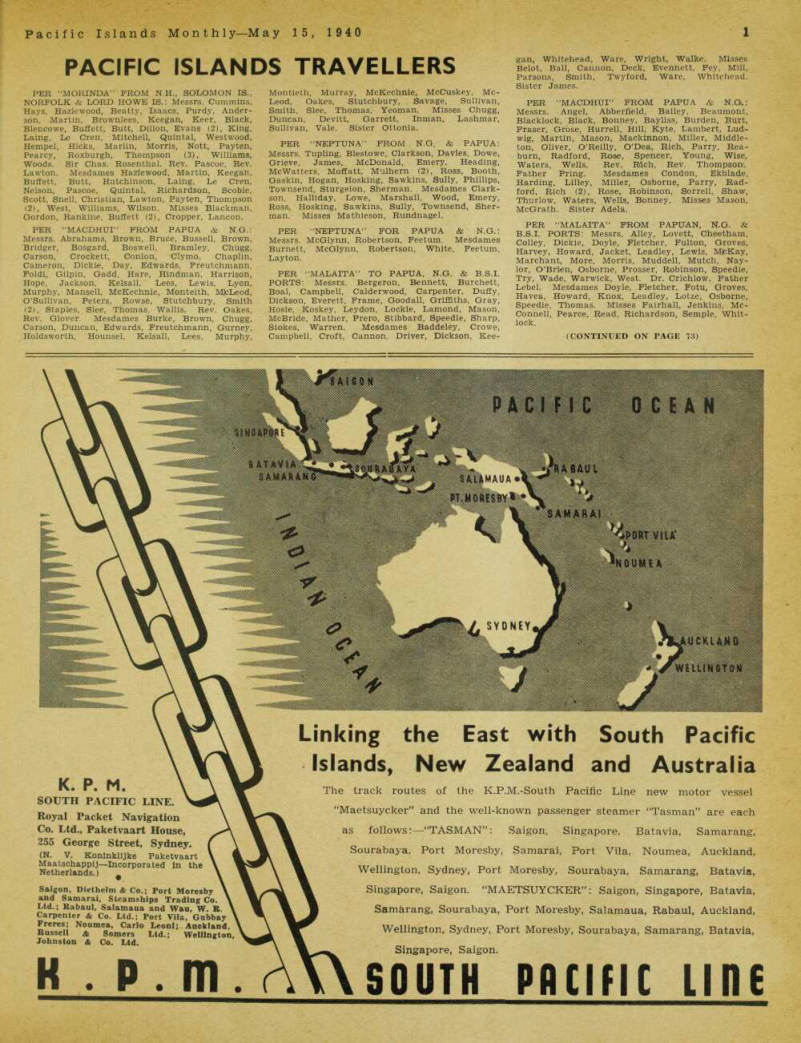
PER “TASMAN" TO PAPUA: Messrs. Bozier, Edwards, Gloe, Grant, Gray, Middleton, Mill ward, Paterson, Timperley, Wilmot. Mesdames Gloe, Gray, Hinds, Millward. Misses Gray, Hinds, Vaughan.
PER “MARIPOSA” FROM FIJI: Messrs. Allard, Curphey, Marks, Patel, Robertson, Thompson (2), Yamasaki, Afa Aso, Clarke, Faslin, Dayram, Gulam, Hargoran, Jamal, Leather, Manilal, Motiram, Nagindas, Pilcher. Rev. Roe, Rev.
Brocard. Mesdames Eastment, Fenner, Marks, Suckling. Misses Kerkham. From Pago Pago: Mr. Evans. Mesdames Evans, Walker, Martin.
PER “AORANGI” FROM FIJI: Messrs. Craigie, Hardy, Piper, Buksh, Haling, Naiker, Emery, Kini, Mesdames Curry, Piper, Craigmyle, Knevitt, Anderson, Kini. Miss Carter.
PER AIRLINER FROM N.G. & PAPUA: Messrs.
Hope, Sellen, Herald, Richardson, Karius. Mes dames Sellen, Hayles, Mitchell. - PER AIRLINER TO PAPUA & N.G.: Messrs.
Allen, Bannon, Cameron, Yamazaki, Temple- Watts. Mrs. Temple-Watts.
PER AIRLINER FROM N.G. & PAPUA: Messrs.
Hore-Lacy, Shaw, Irvin, Cook, Bliss, Pentland, Grahamshaw.
PER AIRLINER TO PAPUA & N.G.: Messrs.
De Rusett, Lee, Hanrshan, Broad. Mrs. De Rusett, PER AIRLINER FROM N.G. & PAPUA: Messrs.
Pasalow, Blake, Bedser, Avery, Gibson. Sisters Germain, De La Croix.
PER AIRLINER TO PAPUA & N.G.: Messrs.
Babb, Chapman, Collins, Bartlett. Mesdames Keogh, Fox. Miss Stevens.
PER AIRLINER FROM N.G. & PAPUA: Messrs.
Dunt, Waderhofe, Bayliss, Zoffman. Mesdames Bayliss, Degiovanni. Miss Hamilton.
MR. H. R. CRAIGIE, Government Printer in Fiji, will leave Suva at the end of this month on transfer to Tan ganyika, British East Africa, as Assist ant Superintendent of the Government Printing Office there. Twelve years ago, Mr. Craigie arrived in Suva as foreman
compositor in the Fiji Printing Depart
ment and when Mr. J. J. McHugh re tired four years ago he assumed the post of Government Printer.