History
pp. 36-38 · Read in the full issue
Pot-pourri of Tohiticm History
By W. W. Bolton, M.A.
THE second Pomare, before ever attain ing kingship, had no small opinion of himself, nor allowed his followers to think otherwise. He named his residence the “Clouds of Heaven” (Aorai), his canoe the “Rainbow” (Anuanua), his torch for night the “Lightning” (Uira), his riding on the shoulders of slaves his “Flying” (Mahuta), his drum the “Thunder” (Patiri) and comnleted the list with his title “Otunuiteatua”, which interpreted reads “The great Tu, the god”.
What other high chiefs on Tahiti thought of these grand airs and mighty claims is not recorded.
RATS were indigenous in Tahiti, but not cats. Whence came the cats?
Wallis and Cook were the benefactors.
When the “Duff” arrived in 1797, its cats could not seemingly be spared, for we read in the Journal of the missionaries who came ashore: “Some of the Brethren being troubled with rats last night, we this day applied to the king for some cats”. They were handed over, 4 in num ber. Crook, who was left, alone, in the Marauesas makes an entry in his diarv. dated June 12. 1797. before the “Duff” sailed away: “Went aboard. In the even ing returned on shore with some goods and 2 cats ”. The Captain was open handed this time. We have here—unless Mendana dropped some in 1595 —the pro genitors of Marquesan cats of to-day.
TAHITIANS of the past were a light fingered gentry, from the highest chiefs down. Theft was a natural instinct and habit of the entire island, and they had a special god of theft, named Hiro. to bless them on their enterprise and success. To be caught red-handed, how ever, the penalty was death.
To guard their possessions the pioneer white folk had a hard time. It was well nigh a hopeless struggle. Here is one entry out of many: “December 27, 1798. Otuu, hearing Brother Broomhall had in his possession a large Bible with cuts, demanded to see it. The book was brought. After awhile, ho sent Brother Broomhall to fetch an other picture book. While absent, Otuu dexterously removed the plate that re presented Adam and Eve in Paradise in a state of innocency, and returned the Book without any intimation of what he had done. He unfortunately had been previously informed that the persons in the plate represented the parents from whom Englishmen, Otaheitean and all men did originally come.” There was no return of stolen goods.
ROADS had to wait: trails were good enough through the bush. Jefferson writes in 1798: “The roads are the sea beach, and narrow footpaths inland are seldom wide enough to admit 2 persons to walk abreast.”
It was so till the 1830’s, when Queen Pomare reigned. She delighted in rid ing—not slaves, but horses —and deter mined on connecting the villages round the coast into one continuous run for both horse and vehicle.
In an Australian newspaper dated in March. 1833.. one reads: “Round the island, for a distance of 120 miles, is a raised road, which goes by the name of the Broom Road. It is formed by the natives who are sent there as a punish ment for any offence they might have committed.”
There is no such bush on Tahiti as
Broom, hence the name has largely re mained a mystery, with wildest guesses attached. Yet the solution seems clear enough to those who dig into the past.
Orders were issued that all owners of property fronting the highway, through out its entire length, should keep their
portion swept clear of leaves. The locally made brooms (from the rib of the coco nut leaf) were much in use and evi dence. Hence white folk facetiously de signated the nameless highway as the Broom Road, and the name stuck.
THE “cloth” so often mentioned in con nection with gifts of olden times was manufactured from the inner bark of the banyan and paper-mulberry trees, which underwent a long process of softening in water, and was then beaten with wooden pounders against a pre pared wooden log until all the fibres had closely knit. The different grooves in the pounders gave a variety of textures to the material. The cloth was stained in patterns from various juices extracted from trees, bushes, plants, bark and nuts.
FOR long-winded names of individuals, Tahitians are still famous —even Wales is left well behind. The latter has its unpronounceable consonants, but with
Tahitian every vowel has to be sounded separately, which is little less a difficulty to the outsider. Here are a few names gathered haphazardly—some of the dead, some of the living:
“Moeterauritetupaiahauviri”.
“Haamanahiaamaheanuuamai”.
The champion, however, so far found, most surely is: “Hinaariitetuanuiiteraipoiaiterataliafaa nuievau”.
Try to call her to your side in a single breath!
THE second Pomare opened these notes; let him close them. He was an avid penman and as avid in requests. Here with a sample to the Directors of the Missionary Society in London: “Matavae, Otahete, January 1, 1807: Friends—l hope you will consent to my request, which is this: I wish you to send a great number of men. women and children here. Friends, send also property and cloth for us. Friends, send also plenty of musquets and powder, for wars are freauent in our country. This also I wish, that you would send me all the curious things you have in England. Also send me evervthing necessary for writing, paper, ink and pens in abundance; let no writing material be wanting. Friends,
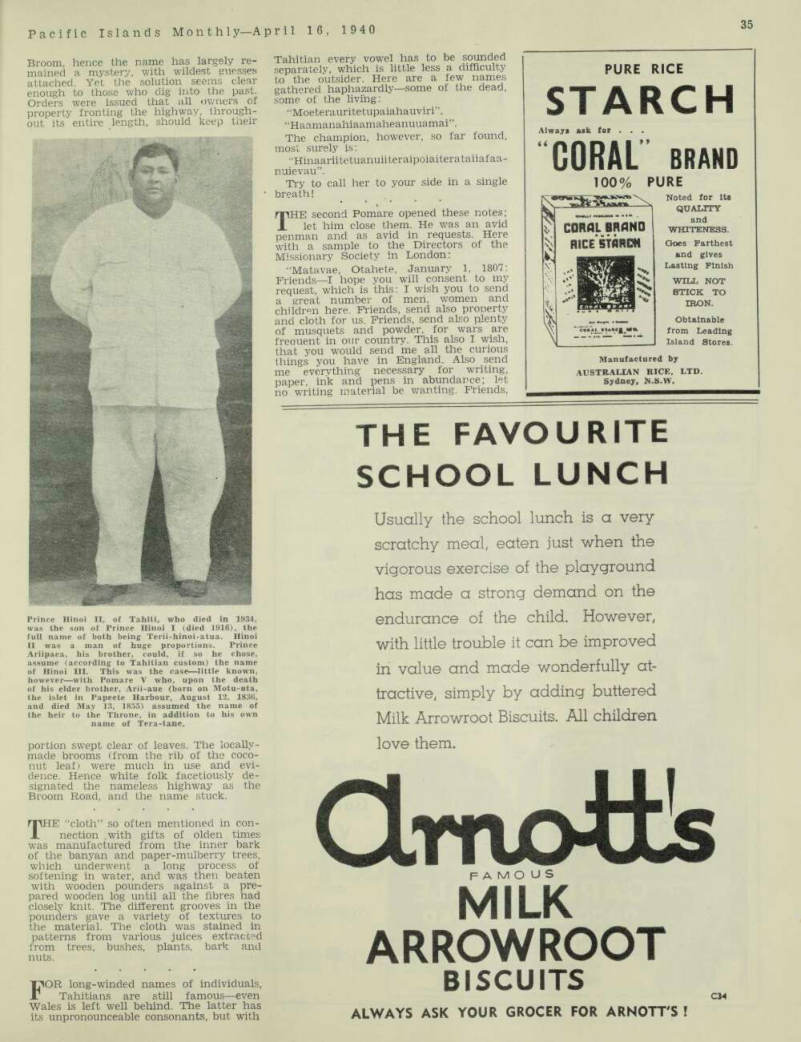
Prince Hinoi II, of Tahiti, who died in 1934, was the son of Prince Hinoi I (died 1916), the full name of both being Terii-hinoi-atua. Hinoi II was a man of huge proportions. Prince Ariipaea, his brother, could, if so he chose, assume (according to Tahitian custom) the name of Hinoi III. This was the case—little known, however—with Pomare V who, upon the death of his elder brother, Arii-aue (born on Motu-uta, the islet in Papeete Harbour, August 12, 1836, and died May 13, 1855) assumed the name of the heir to the Throne, in addition to his own name of Tera-tane.
I have done and have nothing at all more to ask you for.” He clearly lacked any saving grace of modesty and those religious folk in London must have re ceived Quite a shock over so prodigious an order, including the guns for slaughter.