Ariki Nui
p. 34 · Read in the full issue
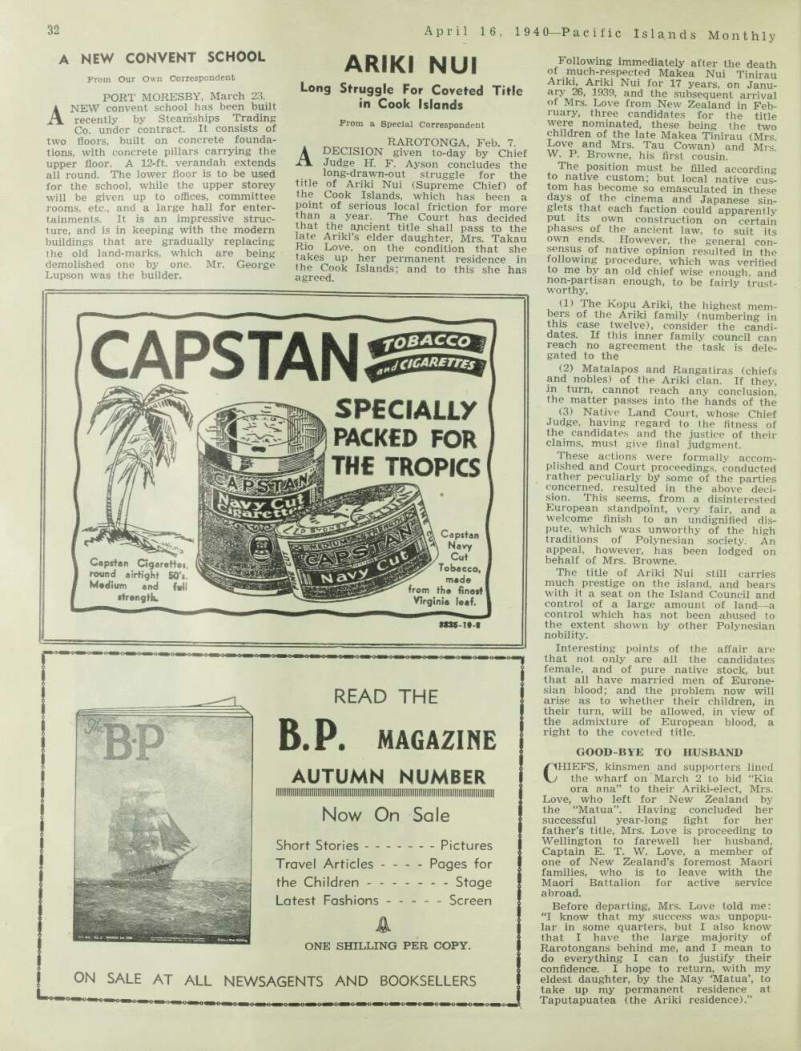
Long Struggle For Coveted Title in Cook Islands
From a Special Correspondent
„ Rarotonga, Feb. 7.
DECISION given to-day by Chief Judge H. F. Ayson concludes the long-drawn-out struggle for the title of Ariki Nui (Supreme Chief) of the Cook Islands, which has been a point of serious local friction for more than a year. The Court has decided that the ancient title shall pass to the late Ariki’s elder daughter, Mrs. Takau Rio Love, on the condition that she takes up her permanent residence in the Cook Islands; and to this she has agreed.
Following immediately after the death of much-respected Makea Nui Tinirau Anki, Ariki Nui for 17 years, on Janu ary 26, 1939, and the subsequent arrival of Mrs. Love from New Zealand in Feb ruary, three candidates for the title were nominated, these being the two children of the late Makea Tinirau (Mrs.
Love and Mrs. Tau Cowan) and Mrs. w. P. Browne, his first cousin.
The position must be filled according to native custom; but local native cus tom has become so emasculated in these days of the cinema and Japanese sin glets that each faction could apparently put its own construction on certain phases of the ancient law, to suit its own ends. However, the general con sensus of native opinion resulted in the following procedure, which was verified to me by an old chief wise enough, and non-partisan enough, to be fairly trust worthy. (1) The Kopu Ariki, the highest mem bers of the Ariki family (numbering in this case twelve), consider the candi dates. If this inner family council can reach no agreement the task is dele gated to the (2) Mataiapos and Rangatiras (chiefs and nobles) of the Ariki clan. If they, in turn, cannot reach any conclusion, the matter passes into the hands of the (3) Native Land Court, whose Chief Judge, having regard to the fitness of the candidates and the justice of their claims, must give final judgment.
These actions were formally accom plished and Court proceedings, conducted rather peculiarly by some of the parties concerned, resulted in the above deci sion. This seems, from a disinterested European standpoint, very fair, and a welcome finish to an undignified dis pute, which was unworthy of the high traditions of Polynesian society. An appeal, however, has been lodged on behalf of Mrs. Browne.
The title of Ariki Nui still carries much prestige on the island, and bears with it a seat on the Island Council and control of a large amount of land—a control which has not been abused to the extent shown by other Polynesian nobility.
Interesting points of the affair are that not only are all the candidates female, and of pure native stock, but that all have married men of Eurone sian blood; and the problem now will arise as to whether their children, in their turn, will be allowed, in view of the admixture of European blood, a right to the coveted title.
Good-Bye To Husband
CHIEFS, kinsmen and supporters lined the wharf on March 2 to bid “Kia ora ana” to their Ariki-elect, Mrs.
Love, who left for New Zealand by the “Matua”. Having concluded her successful year-long fight for her father’s title, Mrs. Love is proceeding to Wellington to farewell her husband, Captain E. T. W. Love, a member of one of New Zealand’s foremost Maori families, who is to leave with the Maori Battalion for active service abroad.
Before departing, Mrs. Love told me; “I know that my success was unpopu lar in some quarters, but I also know that I have the large majority of Rarotongans behind me, and I mean to do everything I can to justify their confidence. I hope to return, with my eldest daughter, by the May ‘Matua’, to take up my permanent residence at Taputapuatea (the Ariki residence).”