Tropicaoties
pp. 13-14 · Read in the full issue
QUEER fatalities! Natives in West ern Samoa play cricket matches in their villages. High-spirited young members of the fielding team, unable to stay quiet, frequently turn hand-springs between the deliveries of the ball. One young man, recently, in attempting a hand-spring, slipped and fell on his head, and dislocated his neck. He was given urgent medical treatment, but he died. About the same time, a Samoan lad was sent up a coconut tree to obtain drinking nuts. Before climbing the tree, he placed an iron bar upright in the ground, so that he might use it in husking the coconuts. But he lost his hold in the top of the tree, and fell, and was impaled on the iron bar. He died in hospital. * * * IT was in the saloon of the old inter island steamer “Malinoa”, in the days before Democracy ruined the New Hebrides.
Mr. Fitz-Kafoops, the official, had steered the conversation to the subject of “blood”. “Bleud,” said Mr. Fitz-K., “will tell! Take a fellah that can trace his ancestry back a bit: always comes eought on top, what!”
Said Sol Abrahams, old-time recruiter and trader, “How far can you trace your ancestry back, Mr. Fitz-Kafoops?”
“Eough! Abeought fowah or faive hundred yahs,” replied the official, mod estly.
“That all?” said Sol. “Why, my ancestors were big cattle and sheep ranchers along the Jordan over four thousand years ago.”
Mr. Fitz-K. fixed Sol with the haughty official stare, according to section 13, sub-section B (a) and continued; “Fellah with a bit of bleud an’ breedin’ an’ tradition, got something to hang by, what! Fellah like that ”
“Too right,” interrupted Sol. “About the time my ancestors were counting up their steers and heifers for market, yours were hanging from trees by their tails.”
You can’t keep a good man down! * * * THUS a Rabaul subscriber on the de parture of New Guinea’s quota to join the A.I.F.:— “This exodus from the Territory is all very well, but Hitler is not at all popular in sporting bodies, for he is the cause of cricket and baseball teams being depleted. As a result, the Rabaul Baseball Association, which had arranged to compete in the international baseball snorts competition, has had to cancel the arrangements. Likewise, the other evening, when the spinsters held their Lean Year Ball, there was a marked shortage of eligible young men.” * * * ANSWERING the telephone recently, a sinabada (mistress) in Port Moresby was taken aback by an urgent request from an educated mission boy for the immediate medical services of her cook-boy—it seemed the mission boy’s wife was seriously ill in the village.
Inquiries followed, and it was learned that the alleged cook, more sophisticated than experienced, was not only the vil lage quack, but a witch-doctor of con siderable fame, whose fees on the no cure-no-pay system, ranged from £1 to £3—with even £5 for obstinate cases!
Besides curing ordinary complaints such
as leprosy, pleurisy, and T. 8., his spe cial care lay with victims of sorcery, whom he claimed to cure with embro cations of his own concoction. Appar ently, not overlooking the golden oppor tunity that offered itself in a district where most evils are attributed to black magic, he went into partnership with the local sorcerer; and, cursing one another in public ,and dividing the pro fits in secret, they did remarkably well during a short epidemic that swept through the village.
The calls on the telephone during this period became so insistent, and the cooking so bad, that it was felt that it would be a generous gesture to dispense with the cook’s services for the benefit
of mankind.
M.L.
“TF ever you have watched a ‘lamp 1 walk-about’ (hurricane lantern) dying, from want of kerosene, you will appreciate the humour of this inci dent,” writes a New Guinea planter.
“One of our boys, a mission-reared native, stood watching a lunar eclipse.
Finally, as the eclipse became complete, and darkness came down, he burst out: ‘Goddam yer! I tink kerosene belong Jesus ’e finish now!’” * • * rREE gentlemen in succession, who called upon the editor of the “Rabaul Times”, moaned about the war, and so forth. So the editor let go, in this fashion; — “Can’t we take it? Has the old blood of the British bulldog turned to water?
Are we going to drop our bundle because we get a few knocks in the cash regis ter, or have to dodge the bank manager round the corner?
“And yet . . . people still manage to tootle around in their motor cars with benzine at 2/3 a gallon, and a good programme at the local picture-palace always draws a full house; one can still hear the metallic flop of beer-bottle tops, falling on the floors of pubs and
clubs; and the women of Rabaul still maintain their reputation for being the best-dressed in the Pacific, north of Sydney and west of Honolulu.” * * • TO-DAY, in the Pacific, if you want to learn something of a planter’s vocabulary, say “copra bags” to him. Copra bags, of course, swing on the tail of the jute market; and the following “story about jute” has been sent to us by a valued correspondent in New Guinea: — Jute is the product of a seed that is planted and grown in India to keep the producer broke and the buyer crazy.
The fibre varies in colour and length, and the man who can guess nearest the grade of the fibre is called a jute man by the public, a fool by the farmer, and a poor business man by his creditors.
The price of jute is determined in London, and goes up when you have sold and down when you have bought.
A buyer working for a group of mills was sent to London to watch the jute market, and after a few days’ delibera tion, cabled his firm to this effect: “Some think it will go down, and some
think it will go up. Whatever you do will be wrong. Act at once.”
Jute is planted in the spring, mort gaged in the summer, and left in the field in the winter. * ♦ * I AM sick of reading, here and there in different magazines, of the sup posed origin of the expression “0.K.”; I saw it again only recently in a well-known American monthly, and the usual unimaginative theory was given of somebody spelling “All Correct” with an “O” and a “K” I am certain it owes its derivation to the following: Years ago, and for many years, the
island of Haiti (West Indies) used to ship to Great Britain large quantities of cotton, and this cotton was recognised in England as some of the world’s very best. Bales of cotton would be arriving from other parts of the world at the same time. Now, when this cotton came to be examined and graded, the bales of fine cotton from Haiti would be chalk-marked “0.K.”, as it had been shipped from Haiti’s port of Aux Cayes (pronounced, near enough in English, “OKs”). And, subsequently, any other cotton coming up to the standard of that received from Aux Cayes (Haiti) would also be passed and marked as “0.K.”, signifying that it was first-grade cotton. Hence, the origin of the now world-wide expression of “0.K.”, which, after all, is a very similar expression to “A.l,”—which, of course, is derived from Lloyds.—T.C.W.
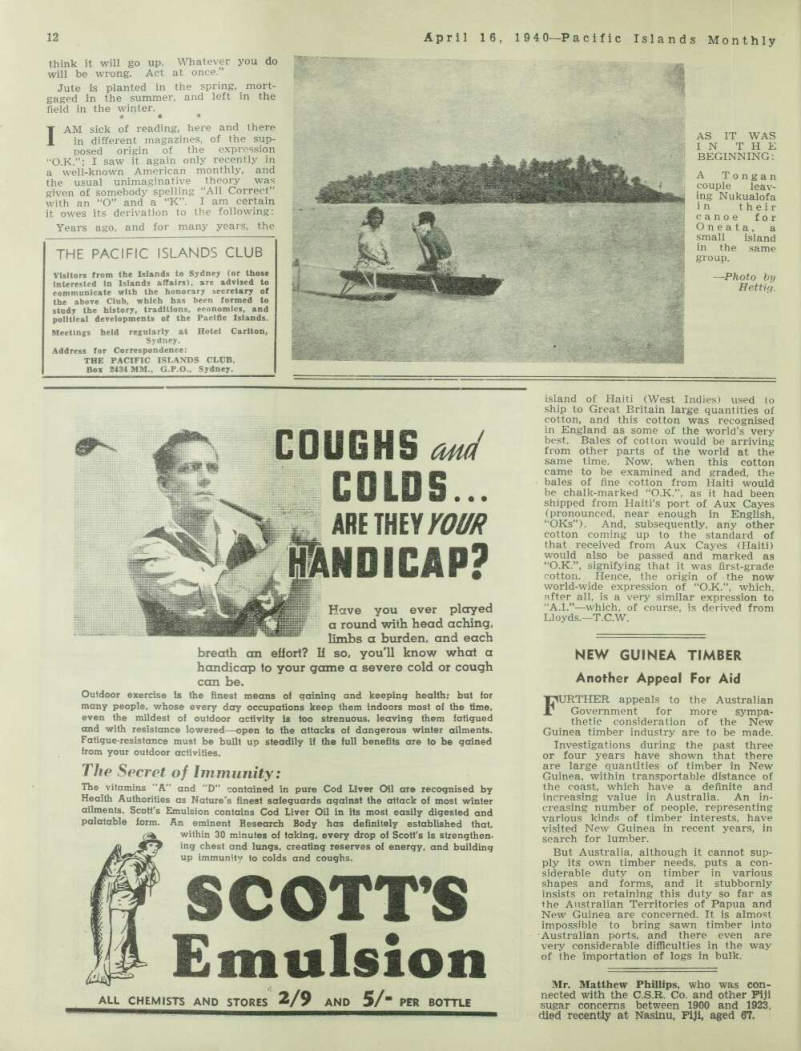
As It Was
In The
Beginning:
A Tongan couple leav ing Nukualofa in their canoe for Oneata, a small island in the same group. —Photo by Hettig.