Possibilities Of European
pp. 41-46 · Read in the full issue
Settlement
This was the final section of Mr. Taylor’s report; but, on account of its importance, it has been published first.
AS to the possibilities of white settle ment, much of the area in ques tion (between Mt. Hagen and the head waters of the Sepik) is extremely moun tainous, and too rough for this purpose.
There are areas available, however, which may be suitable for the growing of tea and pyrethrum, and other pro ducts, and there is a tremendous re serve of water-power which, in the
future, will enable great industrial de velopment.
The interior should, however, be con sidered as a whole —that is, the plateau country from the Markham River to Mt. Hagen and the Dutch border. The eastern half is the more suitable for European settlement—at least in the first instance —and what will most likely happen is that, when we establish in dustries in the eastern area, people will come from all over the western side to work there and to gain experience.
On this recent journey, when travel ling between Mt. Hagen and Bena Bena.
I met bands of young men walking 60 miles to Mt. Hagen, seeking work. As we bring the western half under con-
trol, the movement will be in the other direction, easterly.
The future of the interior, as I see it, is that there will take place, firstly’ native development; secondly, European development. The native will grow, in addition to his ordinary foods, quinine, coffee, soya beans and European vege tables. He will also raise pigs—he is, incidentally, a specialist in this art— which will be cured at a Government or co-operative bacon factory. The native will also work on European plantations in the highlands, and some may work the numerous poor gold-bearing streams, for their own benefit.
Europeans will grow quinine, coffee, tea, pyrethrum and European vegetables for supply to people living on the coast and lowlands, where these vegetables will not grow. They will raise cattle, not on huge ranches, after the Ameri can or Australian pattern, but in a smaller way, as in the more closely set tled European countries. There will also be some dairying, if only as a con comitant of agricultural pursuits.
The country will lose some of its charm by this development: but that has been the history of colonisation, I suppose, since Roman legions infested Britain, and European governments be gan the emancipation and westernisa tion of the African.
The savage charm and fascination of pristine New Guinea is not for later gen erations. This is something to be sorry for, but I believe the advantages to be gained by extending? the Pax Brittannica to these regions will more than make np for that regrettable and irreparable loss.
The almost uninhabited lowlands may be settled by natives from over-crowded areas of the very distant future, or per haps by native-born Chinese, who, it is said, are increasing at a prodigious rate, and will in future demand agricultural areas upon which to settle. The land awaits them and, though it needs much closer examination than I could give it, it apnears to be fair qualitv land which the European does not require or desire, because of its remoteness and its hot climate.
I think that we should adopt the pol-
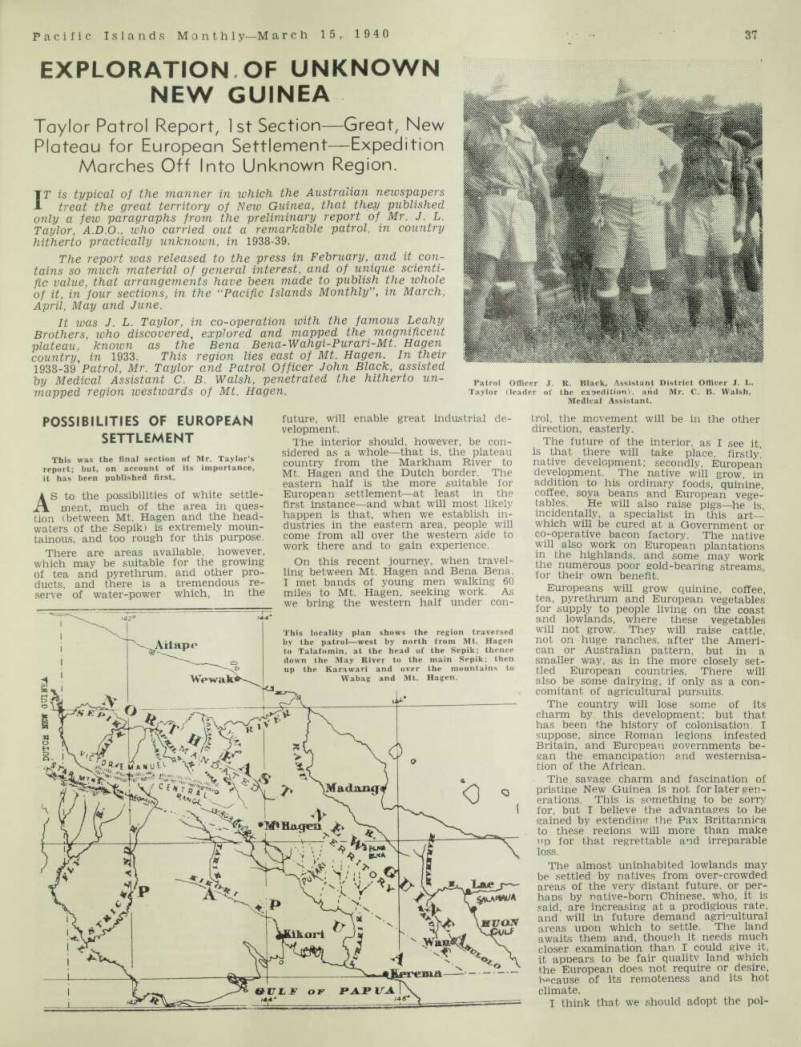
This locality plan shows the region traversed by the patrol—west by north from Mt. Hagen to Talafomin, at the head of the Sepik; thence down the May River to the main Sepik; then up the Karawari and over the mountains to Wabag and Mt. Hagen.
ISL™ ? f A ? eny ?.’ - and reserve the highlands of New Guinea for Europeans, where climatic conditions are temperate and suitable for the European manner of living. Asiatics
flourish exceedingly in the warm climate of the lowlands and the coast.
The existence of these highland areas makes New Guinea, normally a land of moist tropical conditions, something be tween a second Java and a second New Zealand. That is the opinion of John Black, my colleague and companion, who has had some experience in agricultural matters.
In order that the interests of the native people of the area should be con served, I should like to see, as officers administering the area, men with a bias towards anthropology. So many people regard anthropology as an academic study, and perhaps do not realise how applicable it is to the host of problems which beset administrators in native matters, and I might add European matters in and out of Europe. Unfor tunately, I am not an anthropologist.
It will be seen from this that New Guinea is a much greater country than most of us have believed hitherto. That it has a golden future I have no doubt, and I trust that we may see it in our time.
Report of the Patrol
THE patrol, which covered the period from March 9, 1938, to June 19, 1939, consisted of three European offi cers, two non-commissioned officers of the New Guinea native police. 18 native constables, and 230 carriers. The objects of the patrol were:— (1) The examination of both water sheds of the upland territory, westerly
and north-westerly from Mt. Hagen to the intersection of the Sepik River and the Dutch border. (2) The careful examination of the watershed of the Sepik tributaries which head in the mountains between Mt Hagen and the Dutch border. (3) The establishment of friendly rela tions with the tribes on the watersheds of the Papuan rivers and the Sepik tributaries. (4) Locating a site or sites for a new Government outpost or outposts on the headwaters of the Sepik tributaries ac cessible by water transport, if possible, from which it would be practicable for the Sepik staff to administer native populations and supervise the activities of miners and others when the area south of the Sepik is opened for the entry of European expeditions and par ties prospecting for oil and gold.
Earlier Explorations
rE area to be examined had been penetrated from several directions in the past;— By members of BehTmann’s expedition operating in 1914, who examined the southern tributaries of the Sepik, at their lower levels, and reached the high lands in the vicinity of the Sepik head waters, and the crest of the central range above the head of the April River; By Karius and Champion, who made their memorable journey from the Fly to the Sepik in 1928; By the brothers Leahy, who discov ered the valleys of the Lai and Ambum in 1934; By those intrepid Englishmen, the Fox brothers, who with their small party made a remarkable journey along the Papuan and New Guinea boundary dur ing the same year—they did not go as far as they imagined, but they went a long way; By the Ward Williams mining expe dition, which carried out a search for gold in the region of the Fly and Sepik headwaters in 1937; By William MacGregor, a resident of New Guinea (not the famous Sir Wil liam), who visited the lower Maramuni (Yuat) as far back as 1928 or 1929, and discovered the outlying inhabitants of the great tribe which occupies the plateau region drained by the head ways of the great Papuan river, the Purari.
Hadden, doyen of New Guinea ethno logists, suggested some years ago, just after Karius and Champion’s journey, if I remember, that exploration be car ried out between the 142nd and 144th meridian, in the cause of science. The area in question covers more than 10,000 sq. miles; and, despite the earlier exploration, very little was known and recorded about this interior, the last of unexplored New Guinea under Australian jurisdiction.
In 1937. prospectors for oil and gold were clamouring to be allowed to exam ine the area; and, some years before, the Commonwealth Government had promised the League of Nations to take steps to brine the whole of the Terri tory under political control with all pos sible speed. The Permanent Mandates Commission, only recently, had asked to be assured that no non-official interest would be permitted to onerate in narts of the Territory where that control did not exist in real and effective form.
In the face of this steadily growing interest in the interior, it became appar ent that it could not remain untouched
much longer, and that it was of first importance that the Executive Govern ment at Rabaul should acquire such in formation as would enable it to plan the administration of the area when the time came to extend Government and European influence westward from Mt. Hagen.
The Administrator also wished to know if a pass, or route, existed, by which the mountain regions were con nected with the Sepik plain, so as to enable us to use a cheaper method of transport than aeroplanes in the open ing up and developing of the New Guinea highlands.
Preparations.
MY second in command was Patrol Officer John Black, a student of
anthropology and a patrol officer of seven years’ experience in the moun tains of Morobe. on the New Guinea mainland.
The third officer selected was C B.
Walsh, an officer of the Department of Public Health. He had many years of service to his. credit in New Guinea, par ticularly in the fen country of the Sepik, and was renowned as a bush man.
Preparations began at Rabaul—the patrol might take a year or more.
In 1933, I had stood on the summit of Mt. Hagen and gazed westward at the blue mountain forests rolling on to the horizon 60 or 70 miles away—it was rough country.
Stores were required—tents, suitable
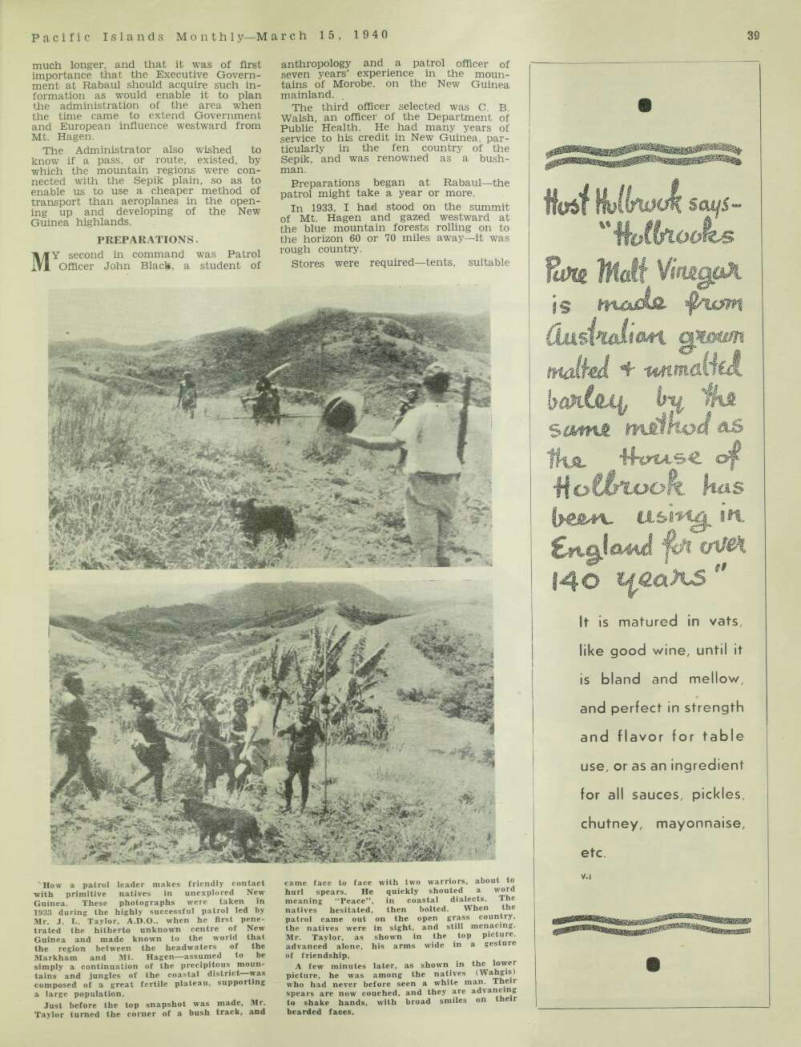
How a patrol leader makes friendly contact with primitive natives in unexplored New Guinea. These photographs were taken in 1933 during the highly successful patrol led by Mr. J. L. Taylor, A.D.O., when he first pene trated the hitherto unknown centre of New Guinea and made known to the world that the region between the headwaters of the Markham and Mt. Hagen—assumed to be simply a continuation of the precipitous moun tains and jungles of the coastal district was composed of a great fertile plateau, supporting a large population.
Just before the top snapshot was made, Mr.
Taylor turned the corner of a bush track, and
came face to face with two warriors, about to hurl spears. He quickly shouted a word meaning “Peace”, in coastal dialects. The natives hesitated, then bolted. When the patrol came out on the open grass country, the natives were in sight, and still menacing.
Mr. Taylor, as shown in the top picture, advanced alone, his arms wide in a gesture of friendship.
A few minutes later, as shown in the lower picture, he was among the natives (Wahgis) who had never before seen a white man. Their spears are now couched, and they are advancing to shake hands, with broad smiles on their bearded faces.
“| and bedding, cooking utensils, portable rations for police and carriers, and ton l ahawk J’. and a vari " wo l h f money f( T tradm e Purposes We had to carry, also, European food supplies, scientific instruments, collectmg gear wireless and photographic equipment and medical supplies.
The tents chosen were 14 x 12 ft., and made of Japara, an Egyptian cotton material about one-third the weight of ordinary duck. A tent fly 16 x 18 ft. accompanied each, but no poles. We relied on cutting our own These tents and flys were obtained from a Brisbane sailmaker and stood up well to the work, though in the hurry I forgot to have them rot-proofed, and the lower part of the walls rotted away quickly.
I used a compactum canvas stretcher from Benjamin Edgington, and my companions hammocks. These ham-
mocks are tubes of heavy canvas about 7 ft. long and 3 ft. in diameter A triangle made from two stout sticks driven well into the ground about 5 ft. apart, and fastened at the anex is set up at the head and foot of the bed.
Two poles are passed through the ham mock, pulled outwards, placed over the triangles, and forced downwards until a level couch is obtaind. The poles are then secured with bush rope This makes a very satisfactory bed, but is not convenient where timber is scarce Boots were a problem, as it is difficult to find a boot that is comfortable, and strong enough to stand up to continu ous patrolling in New Guinea. Alpine spikes are necessary, and knee boots with 16-inch uppers are to be preferred.
Flannel shirts and good blankets are required for the carriers, for in New Guinea, as elsewhere the higher the
colder, and we expected to be working at high altitudes.
Portable rations consisted of rice, bis cuits, marmite, salt, sugar and cocoa.
English knives and Swedish axes were taken for use and for trade.
Nearly every variety of shell which I knew to be valuable in the interior was purchased from the coastal people—the gold-lip and green-snail mother-of pearl from the Admiralty and Thursday Islands: the annulus cowrie from the coral reefs of the New Guinea coast; the tiger cowrie, and the conus, from the Manus lagoons; and the nassa, or tambu shell, from the black beaches and estuaries of New Britain, where it is still much treasured, though now rivalled after 60 years of European influence by English money.
European food supplies were bought locally, the principal items being flour, sugar, tea, coffee, bacon, cheese and dried fruit.
We were well equipped with mapping instruments. A theodolite was lent us by the Secretary for Lands, an aneroid reading to 2,500 ft. by Guinea Airways Ltd., chronometer from the Government vessel “Leander”, a prismatic compass and Zeiss binoculars by Mr. Leahy. I also had cranial calipers, a stature mea suring rod, and prismatic compass.
The Administrator, who is keenly in terested in wireless by which he keeps in close touch with every part of the Territory, equipped us with a radio telephone sending and receiving set from Amalgamated Wireless. It was power-driven by a small petrol engine, and, though heavy,, it carried well, and gave excellent results throughout the patrol.
For photographs we had a splendid set of gear, Graflex 5x4, Rolleiflex, Leica and Cine-Kodak 16 mm. The de velopment of the films was done in the bush, the printing in Sydney.
Mr. Proggatt, of the Agricultural De partment, supplied us with collecting gear for insects and other specimens, and the Public Health Department issued a complete field outfit. Special attention was given to beri-beri pre vention, and a preparation, abidon (a. b and d vitamins), was included. Walsh packed his supplies in portable medical chests of his own design, made of light deal timber, and much superior to those usually supplied to patrols.
On December 31, 1937, the Administra tor sent for me, and I received my in structions. They were simple and ex plicit: To examine the country and establish friendly relations with the in habitants. He spoke kindly, and wished us success. The details were left to me,
Transport
I PROPOSED to fly our stores and equipment to Mt. Hagen and set out from there on foot to a point about 90 miles west north-west, and make a base camp, from where the examination of the country surrounding would be carried out. Then to move on another 40 miles or so. and do the same agairf.
Lastly, a third camp at the Sepik head waters, in the vicinity of Kelafomin (or Telafomin), A new Government Police Post was to be established at Mt. Hagen and this simplified matters a lot. Mt. Hagen was our rendezvous.
I was free to choose what members of the Native Constabulary I wished, and Lieut.-Col. Walstab gave me every assistance. Two non-commissioned ofli
cers, Sergeants Lopangom and Fokinau, had belonged to my detachment at Chimbu, and Constables Bungi. Übom and Serak had worked under me for several years in the high country, Bungi and Übom since 1932. These men were attached to police posts in various parts of the Territory, but were placed at my disposal, and they served throughout the patrol. Without them the patrol would have accomplished much less than it did—might have failed.
The question of carriers was of vital importance. Upon them much would depend, particularly on their spirit. A patrol with discontented carriers might soon end in disaster.
I knew where to get them. I had been working on the Purari plateau for several years, and had confidence in the people there. I proposed to fly to Bena Bena, and march from there to Mt.
Hagen, collecting carriers on the way. I should then have some from various groups, which would be all to the good.
It would produce a healthy spirit of rivalry, which would make for smoother working.
On January 29. the journey from Bena Bena to Mt. Hagen began. It was marked by the great enthusiasm of the people along the route, and hundreds of volunteers to join the party.
I quote from my diary of February 3: “At Chuave about 2,000 people at the station. Visitors greeted me with cheers of welcome, outstretched hands and smiling faces. Every here and there a prominent man and sometimes a little child would kiss my hand. Hundreds asked to be allowed to go with us. Un fortunately, I could only take a few from each. Food in abundance.”
On February 20, 1938, with about 100 selected carriers. I arrived at Mt. Hagen.
Black and Walsh were there and also Edwards (the Patrol Officer who had been appointed to take charge of the new Mt. Hagen Police Post). There was a lot of work to be done checking and re-packing stores, writing to people, final preparation of the personnel, lectures to police, the delegation of duties, in structions to carriers and medical examinations.
Ready To Start
BY March 8, all was ready. An ad vance party of police, guides and interpreters had gone on ahead to pre pare the first three camps at places where the people were known to be friendly to us. Constable Bungi was in charge of them and could be relied upon to do a good job.
My plans were to proceed to the valley of the Gai (I discovered later that the name of this river in the language of the people who live on its banks is Ive Lai —Ive meaning water, or river), a tributary of the Yuat, where there was known to be a high population, and move westerly from there across the main cordillera, and make my first base camp in a populous area in the vicinity of the 143rd meridian.
Two years previously, I had flown with Messrs. Hides and Champion, as a guest of the Papuan authorities, across country to the south, and had observed as closely as was possible, from an aero plane travelling at 100 miles an hour, the headwaters of the western Purari and Kikori, and the southern slopes of the central watershed.
The march to the locality of the pro
posed base camp would be about 90 miles, as the crow flies, but perhaps more than 200 miles across country, intended to march steadily but not h * and maintain an advance ai is where Considered thl small party would be L f C p 0n ? n d d ere £ e from attack h^till k was mv aim Tit is the S
- officlr of Administration
g °ffl cel pe^ le °” nd A “ Imong them peaceably. If we were attacked, we were strong enough to defend our selves. But I always have felt, and always shall feel, a sense of failure when I find it necessary to use force against the warriors of primitive New Guinea.
T had discU ssed every aspect of the work with my companions. They knew every detail of my plan and I impressed upon them that no one could lay down a definite scheme. Try as I might to adhere to plans, New Guinea might decree otherwise. one tter T held a very defin ite view-that was, that we should de- P end on native tracks, and not attempt to cut our way through trackless jungle, it had been my opinion for a long time that ’ though New Guinea is IT V p a rts covered with dense, uninhabited forests (perhaps impenetrable as in South America and other tropical lands, but still extremely dense), it would be possible to travel by native track from Samarai, at the extreme south-eastern end of Papua, to the Birds Head, at the north-western end of Dutch New Guinea. The art of travelling is the art of finding the existing tracks by making
friendly contact with the people and using them as guides.
A chain of interpretation is almost unobtainable. After a few days’ march ing, sometimes after a few hours only, a new language is met with. Guides and interpreters are afraid to proceed fur ther, and one has to fall back on the language of signs. (To be Continued) Mr. A. E. J. Werman arrived in Thurs day Island from Boonah, Queensland, in February, to take charge of the State School, replacing Mr. J. Anderson, who has gone to Townsville. Mr. A. Kelly, of Childers, Queensland, is his new assistant, Mr. Robert Elmes having been transferred to the mainland.
Mr. Kenneth Allsop, of Rabaul, New Guinea, married Miss Millicent Netta Pearce, of Merrylands, N.S.W., at Rabaul Methodist Church on February 17.