Christmas Island For America?
pp. 18-20 · Read in the full issue

Interesting Moves Behind The Scenes
By John Williams, Of Honolulu
OFFICIALLY. Washington is denying it to the U.S. news agencies which inquire, but Christmas Island, in mid- Pacific, in the near future, will be occu pied and developed by American navy and army forces.
This move will greatly strengthen the American front, which runs down the Pacific, all the way from Alaska to Samoa.
This fact was learned from high American authorities who. for more'than a year, have been planning the move — and considering the temporary obstacles to it.
Christmas Island lies south of Hawaii and near Britain’s cable outpost on Fanning. Both these islands possess ex cellent water and land areas, suitable for army and navy planes. Fanning’s possibilities were inspected and reported upon, just after the World War. by Admiral Lord Jellicoe; and, later, Brit ish admiralty engineers spent some time there.
Both Britain and America claim rights to Christmas, as they did to Can ton Island (just over the equator to the south-west) which now is being iointlv occupied by them. * Both sides, particularly the amateur experts who fill magazine columns about it, present convincing arguments. Simi lar arguments, of course, made little impression when Canton’s occupation was decided upon.
The two nations shook hands and established a precedent which has dis turbed some American writers.
Britain and America have been carry ing on conversations for a long time about Christmas Island. There is a greater frankness in Washington to-day about suggesting that the island be turned over to America, in part payment of Britain’s World War debt to Amer ica, which to-day stands at some 5 i billion dollars.
This exchange of land for the debt is no new argument, of course, because it was first mentioned 20 years ago, but never was officially recognised. In the case of Christmas, Washington feels that Britain’s occupation of nearby Fanning, which has all of Christmas Island’s pos sibilities, should be sufficient for Britain in that area, and that Britain’s stand there would be better reinforced if America is allowed to develop Christ mas alone, and not jointly, as is the case with Canton Island.
In recent years, American experts have made several visits to Christmas. rERE are countless arguments about what should and should not be done. Britain’s and America’s spheres of influence dovetail not only in the Pacific. Precedents established long ago
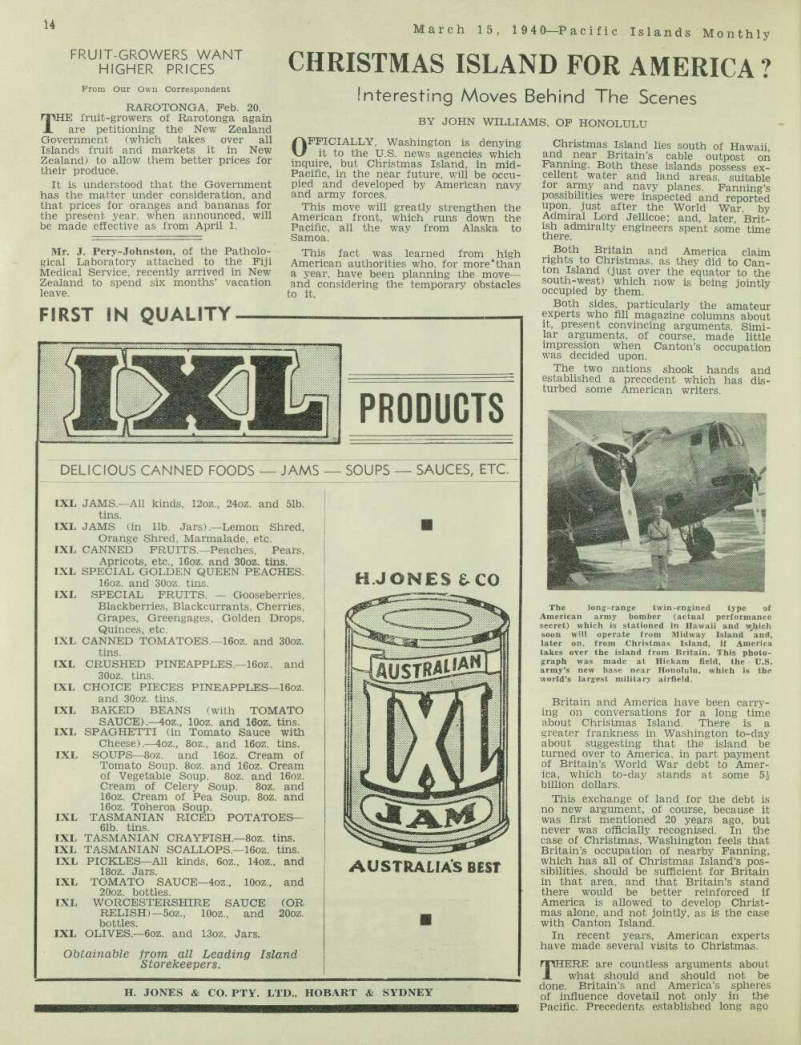
The long-range twin-engined type of American army bomber (actual performance secret) which is stationed in Hawaii and which soon will operate from Midway Island and, later on, from Christmas Island, if America takes over the island from Britain. This photo graph was made at Hickam field, the U.S. army’s new base near Honolulu, which is the world's largest military airfield.
in the north Atlantic confuse the scene.
Britain’s development of bases and air fields in the east Canadian and New foundland sectors, which stand between the U.S. and Europe, naturally please the American defence experts, and the presence of British bases and naval forces in the Caribbean-West Indies present another angle.
The U.S.A. is alert about European in fluences spreading across the Atlantic, and of Japanese expansion across the Pacific, two problems which face the British interests in the Americas, too.
Should America and Britain stand alone in their respective defences against these problems?
There is “good neighbour” British Canada, which President Roosevelt has declared that America will not permit to be invaded. Industrial America depends vastly on the mineral resources of Canada.
The more one delves into the problem of Christmas Island, the more these other very important angles crop up. It is a diplomatic headache for both Lon don and Washington.
BUT setting them aside, this is why America wants to develop Christ mas Island: — The closest Japanese threat to the U.S. defence scheme based on the Hawaiian Islands is Jaluit, most easterly base of Japan’s mandated islands, which spread from the Philippines right along north of the equator. (Jaluit, in cidentally, dominates Britain’s Gilbert Islands, and Nauru and Ocean Island).
Jaluit lies 2,375 miles to the south-west of Hawaii. To take the threat sting out of Jaluit, America, in recent years, has been developing navy bases at Midway, Wake and Johnston Islands, which, in a triangular formation, protect the ap proach from Jaluit to Hawaii.
More recently, America has occupied and started development of other islands in the vicinity, notably Baker, Howland, Enderbury and Canton, which lie just east of Britain’s Gilberts.
Any good football team has a strong and, as a backfield for these outer islands of the Hawaii scheme, America intends to develop major bases at Johnston and Palmyra, and, if all goes well, at Christmas. mo put better “teeth” into the bases, X the navy is burying an old hatchet with the U.S. army. The navy always has argued that the ocean is its baili wick exclusively, and that the army, par ticularly aircraft, must remain over land areas such as the Hawaiian Islands and the U.S. mainland.
Periodically, much to the wrath of the admirals, long-range army planes have made spectacular flights to sea and located steamers, etc., just to show the rover boys that the army knows some thing about navigation. And the army went ahead with its development of super long-range bombers, high-speed bombers which pack terrific wallops.
The navy has long-range patrol bomb ers, but they are essentially for patrol duties. They carry the same bombs and guns.
They must be hauled from the water to load bombs, which are carried under the wings. Navy bombers normally alight in the Islands lagoons and, to create adequate facilities for loading them promptly in an emergency war bombing mission, would mean the crea tion of extensive ramp areas ashore.
The navy is getting around this prob
lem by co-operating with army avia tion. At Midway, there is a land field area being developed for the biggest army bombers, which could fly non-stop from Hawaii with ease, and then take on loads of bombs and fuel for raids far out across the ocean, at points which the navy would locate.
The army bombers, in other words, will put the wallops into the navy’s far flung observation line, and the navy’s pursuit and attack planes will protect these bombers on missions.
This joint army-navy development of the Islands bases is the most important recent move made in America’s long range defence plan against Japan.
Army bomber bases are being con structed right around the American mainland coast, all the way from Pan ama to Alaska, and from any one of these points the central Hawaii base, near Honolulu, may be reinforced over night by non-stop flights of bombers.
The latter then would take off from Hawaii to any one of the outlying isle bases, such as Midway, Wake, Canton and Christmas will be.
The army bombers can be speedily loaded with bombs and gas. Production of these bombers is being hurried on, and bigger and longer ranged types are
being developed. It is noteworthy that none of these bombers have been sold to European powers in the current war America is keeping them up her sleeve.
There is nothing theoretical about this new American strategy. Leading American army and navy strategists, specialists in aviation, have seen all the islands and reported upon their possi bilities.
The only hatchet that remains to be buried is between Washington and Lon don. It is in the process of being buried; and that’s why the U.S. State Department is remaining mum about the impending American development of Christmas Island.