Higher Taxes
p. 10 · Read in the full issue
Fiji Under War-time
Conditions
IN order to provide for higher cost of administration and for special defence expenditure—both made neces sary by the war—the Government of Fiji has increased private income-tax by 25 per cent, to 1/3 in the £, increased company income-tax by 50 per cent., to 1/6 in the f, raised the residential tax from fl to 25/- per annum per indi vidual; and has added 1 per cent, to the Port and Customs Service tax on imports. It is estimated that the higher income taxes will yield £25,000 per annum, and the new tax on imports about £12,000 per annum.
The new taxation was provided for in a series of bills passed by the Legisla tive Council in February.
The Council is almost wholly nomina tive now, and consists of official and non-official members. All non-official members protested very strongly against any increase in the tax burden, in view of the fact that the Government of Fiji, year by year, shows a substantial sur plus. Mr. Alport Barker pointed out that the Colony now has reserves of £137,600 and £141,000, and lately had created another special reserve of £50,000. They had been told, said Mr.
Barker, that these reserves were for emergency—surely it was an emergency which the Colony now was facing, and surely it was reasonable to suggest that extra expenditure of approximately £40,000 per annum could be financed for a while out of reserves totalling £330,000.
The Governor, however, pointed out that Britain was preparing for a long war, and the British people were mak ing colossal sacrifices, while the sacri fice that was now being suggested to the people of Fiji was infinitesimal. It was quite true that the reserves were being held for an emergency, but, from every point of view, it was wise at this stage of the war to conserve all the financial resources of the Colony, and for* the present to provide for the extra expen diture out of taxation. Also, those re serves were invested in Britain, and could not be taken out without embar rassment.
The bills were passed by 16 votes to 14—representing exactly the division be tween official and non-official strength in the Council.
Non-Official Members’ Protest
It was disclosed, a few days later that, on this subject of taxation, unofficial members had transmitted, through the Governor of Fiji, certain urgent repre sentations > to the Secretary of State for the Colonies, and further sittings of the Legislative Council were postponed, pending a reply from London.
The reply came a few days later. It was evident that the representations of the non-official members had received careful examination: but the Colonial Secretary was firm in insisting that Fiji, at once, should meet war expendi ture out of revenue, and protect her reserves.
Mr. Bert Coster, a surveyor, who prac tised in Suva and Sigatoka, Fiji, died recently at the age of 52, following a long illness. He was bom in Suva and at one time was in the service of the Fiji Government. One of his brothers, Mr. Sydney Coster, is manager for the Union Steam Ship Co., at Papeete, Tahiti.
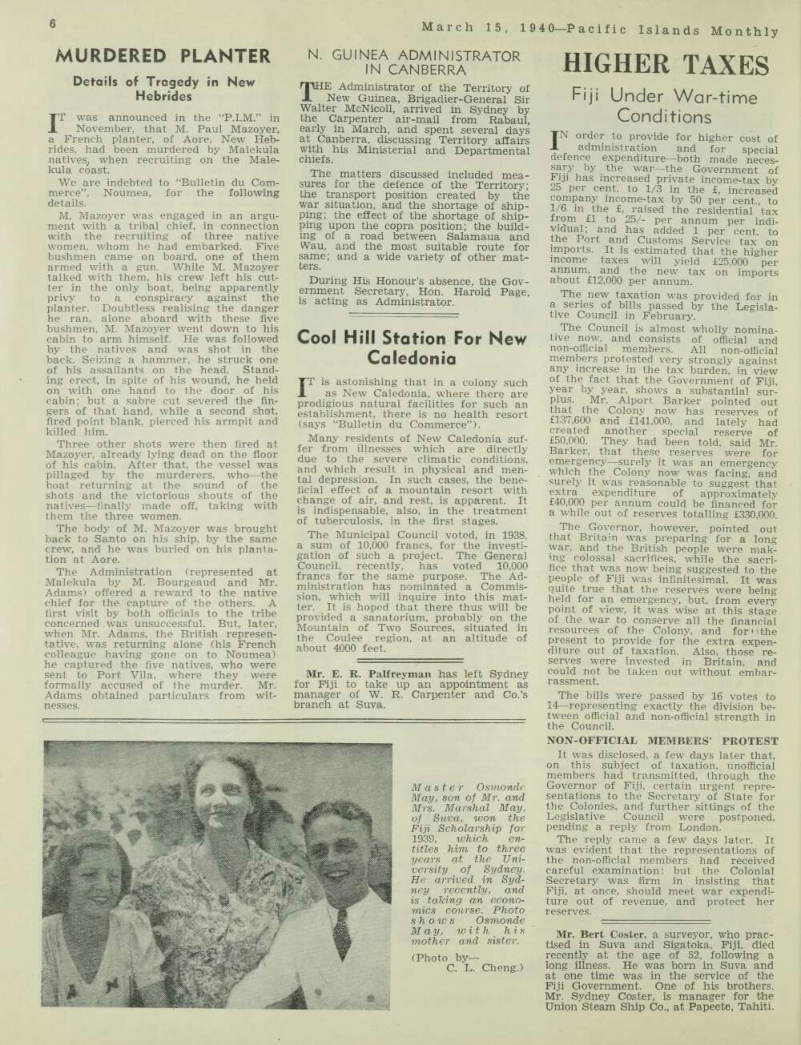
Master Osmonde May, son of Mr. and Mrs. Marshal May, of Suva, won the Fiji Scholarship for 1939, which en titles him to three years at the Uni versity of Sydney.
He arrived in Syd ney recently, and is taking an econo mics course. Photo shows Osmonde May, with his mother and sister. (Photo by— C. L. Cheng.)