Tax Papua!
p. 60 · Read in the full issue
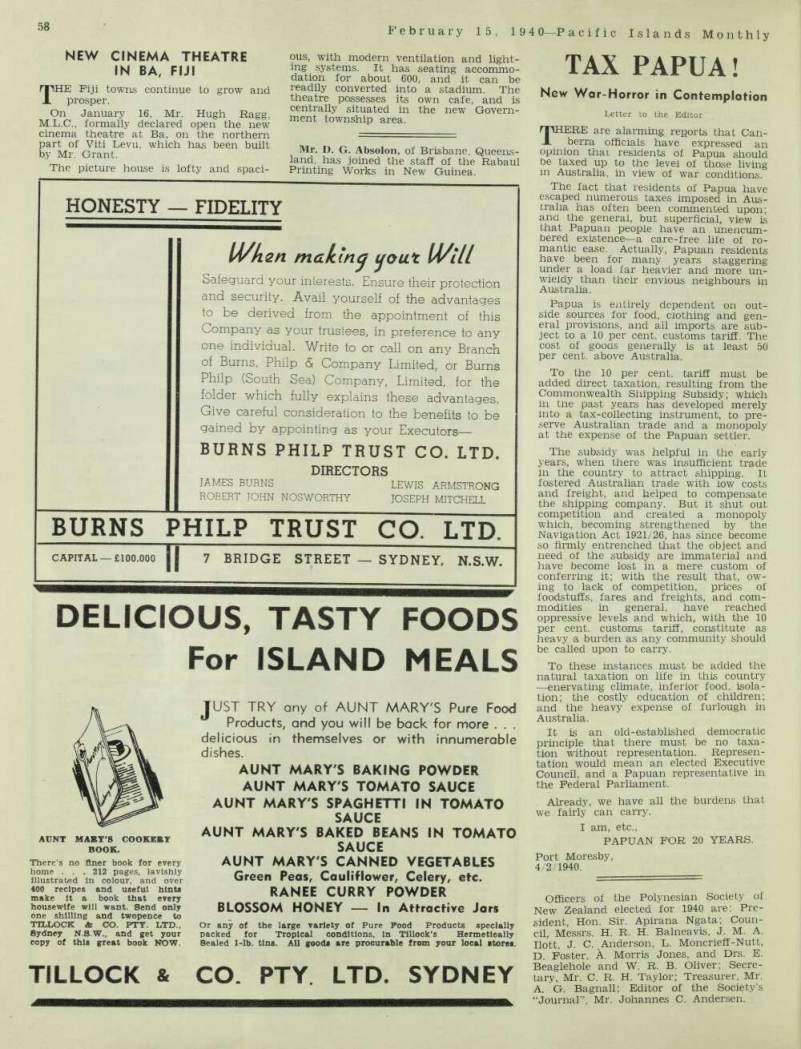
New War-Horror in Contemplation
Letter to the Editor rERE are alarming reports that Can berra officials have expressed an opinion that residents of Papua should be taxed up to the level of those living in Australia, in view of war conditions.
The fact that residents of Papua have escaped numerous taxes imposed in Aus tralia has often been commented upon; and the general, but superficial, view is that Papuan people have an unencum bered existence —a care-free life of ro mantic ease. Actually, Papuan residents have been for many years staggering under a load far heavier and more un wieldy than their envious neighbours in Australia.
Papua is entirely dependent on out side sources for food, clothing and gen eral provisions, and ail imports are sub ject to a 10 per cent, customs tariff. The cost of goods generally is at least 50 per cent, above Australia.
To the 10 per cent, tariff must be added direct taxation, resulting from the Commonwealth Shipping Subsidy; which in the past years has developed merely into a tax-collecting instrument, to pre serve Australian trade and a monopoly at the expense of the Papuan settler.
The subsidy was helpful in the early years, when there was insufficient trade in the country to attract shipping. It fostered Australian trade with low costs and freight, and helped to compensate the shipping company. But it shut out competition and created a monopoly which, becoming strengthened by the Navigation Act 1921/26, has since become so firmly entrenched that the object and need of the subsidy are immaterial and have become lost in a mere custom of conferring it; with the result that, ow ing to lack of competition, prices of foodstuffs, fares and freights, and com modities in general, have reached oppressive levels and which, with the 10 per cent, customs tariff, constitute as heavy a burden as any community should be called upon to carry.
To these instances must be added the natural taxation on life in this country —enervating climate, inferior food, isola tion; the costly education of children; and the heavy expense of furlough in Australia.
It is an old-established democratic principle that there must be no taxa tion without representation. Represen tation would mean an elected Executive Council, and a Papuan representative in the Federal Parliament.
Already, we have all the burdens that we fairly can carry.
I am, etc.,
Papuan For 20 Years.
Port Moresby, 4/2 1940.
Officers of the Polynesian Society of New Zealand elected for 1940 are: Pre sident, Hon. Sir. Apirana Ngata; Coun cil, Messrs. H. R. H. Balneavis, J. M. A.
Hott, J. C. Anderson, L. Moncrieff-Nutt, D. Foster, A. Morris Jones, and Drs. E.
Beaglehole and W. R. B. Oliver; Secre tary, Mr. C. R. H. Taylor; Treasurer, Mr.
A. G. Bagnall; Editor of the Society’s “Journal”, Mr. Johannes C. Andersen.