Bob Boyd Passes On
pp. 54-55 · Read in the full issue
Story of a Pioneer
MR. Robert Boyd, who died in the Samarai Hospital on December 27 (see page 40) was born in Temple Parish, County Antrim, Ireland, on January 23 1857. With his parents he sailed in the Lady Jocelyn” for New Zealand, in 1878. The family took up land at Kati kati, but the soil was poor and farming was not a success.
Young Bob turned to mining and gained experience in New Zealand and Broken Hill . In 1900, he was managing a mine in Charters Towers, Queensland, when he heard of ,rich alluvial finds on Woodlark Island. He sailed for Wood lark, and found that the alluvial was better than reported. His young wife died in Queensland in 1903.
That year, as the alluvial had been well worked over at Woodlark, Mr. Boyd decided to try Misima Island. There he married Miss Isabella Johnson, of Cook town. Mr. and Mrs. Boyd had a tent (6 ft. x 8 ft.) for a home. The ground was sodden (the rainfall on Misima aver ages about 150 inches). Mrs. Boyd often laughed over her experiences of those early days, when she tried to bake bread in an oven made of empty tins. For tunately, they both had a broad sense of humour, and a contented outlook on life.
Mr. Boyd was the actual discoverer on Misima of the Umuna lode, on which Cuthbert’s mine, the richest in the Ter ritory, is now situated.
Some years ago. Mr. Boyd wrote a brief account of the work he had done on Misima. The following extracts show some of the disappointments he met, owing to lack of equipment; and how the Umuna lode was traced and proved.
“. . . Up to this time (1904) no lodes or reefs had been found (on Misima), it all being alluvial, but after prospecting, I found that there were large bodies of ore—in fact, the biggest I have seen any where. There were very large bodies of
low-grade ore. I went to Woodlark, and there formed a small syndicate to put in some drives and tunnels, and on my re turn proceeded with this work. This proved the lode in the Massive to be 80 to 85 feet wide, and samples taken over 40 feet of this width were sent to Char ters Towers for assay. They returned
17 dwt. 23 grs. to the ton, the other portion of the lode being 2to 3 dwt. The gold was remarkably fine and very hard to save, either by sluicing or amalgama tion.
“A start was made to sluice the faces, and, for this purpose, water races were brought in, and an attempt was made to catch the gold in coconut matting, bath towels and ordinary bagging. This was continued for six years and, during that time, 1050 oz. of gold were obtained, the value of the gold being £3 to £3/1/- per ounce.
“I knew that very little of the gold was being saved and I was losing nine-tenths of it. The whole face was being sluiced.
The lode formed a spur and was easily attacked, as the creek cut through it . . .
In 1911, a 5 ft. Huntington Mill was sent up. This was followed by another mill, and a suction-gas plant. Their results were unsatisfactory, and only 1 dwt. out of 8 dwts. were saved. There was no assay plant, and there was some doubt
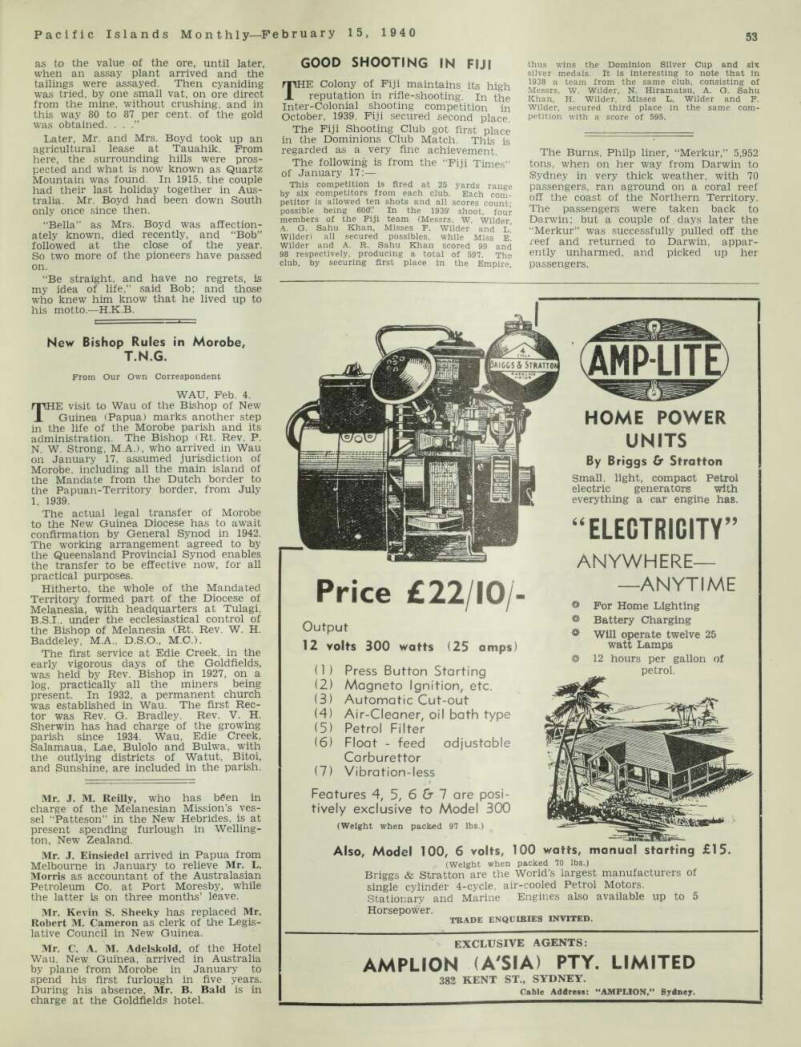
Bob Boyd “on the job” at Misima.
as to the value of the ore, until later, when an assay plant arrived and the tailings were assayed. Then cyaniding was tried, by one small vat, on ore direct from the mine, without crushing, and in this way 80 to 87 per cent, of the gold was obtained. . .
Later, Mr. and Mrs. Boyd took up an agricultural lease at Tauahik. From here, the surrounding hills were pros pected and what is now known as Quartz Mountain was found. In 1915, the couple had their last holiday together in Aus tralia. Mr. Boyd had been down South only once since then.
“Bella” as Mrs. Boyd was affection ately known, died recently, and “Bob” followed at the close of the year.
So two more of the pioneers have passed on.
“Be straight, and have no regrets, is my idea of life,” said Bob; and those who knew him know that he lived up to
his motto.