How Rev. McKean
pp. 48-49 · Read in the full issue
Was Killed Light on a Point of Tahitian History
By W. W. Bolton, M.A.
SHOT at his door during the fight at Point Venus, June 30, 1844”—50 runs the legend on the tombstone of Rev. T.
S. McKean, of Tahiti.
For years, the reason for this unto ward happening puzzled the writer. Was it a pure accident, or done of purpose 9 Was it a French bullet or a Tahitian that ended his short career?—for he was but 37. Was he an impediment to the
J 2 a determi ned backing up of was h r fellow missionary, the accomplished but erratic a traitor to their own cause.
There was none locally, of to-day, who could throw light upon the matter.
There was a running fight amid the heavily timbered promontory, and a stray bullet from an unknown source found its billet on an onlooker who should have been elsewhere when bullets were flying— this was the only comment obtainable.
Then, haply, one day, there came into the writer’s hands a book with an en gaging title, “Rovings in the Pacific”, its date 1851, written by one who refers to himself as “a merchant long resident on Tahiti”, but who was clearly Edward Lucett, by much unmistakeable evidence therein. It was he who, respected by
both sides, made a gallant though in effectual effort to bring about peace two ye^rs after the tragedy now dealt with, gomg to the patriots’ camp at Papenoo argulng for settlement an Englishman to the core (his birthplace Ealing. Middlesex), and he saw Sf® hopelessness of the situation. He and his Tahitian wife, Mary, now sleep their i? ng al ! e P, ? ide side - in p a Uranie, fce .l Picturesque cemetery, their St w* st - t0 be x met Wlth as one enters the lofty iron gates, and passes to the right hand, an English surgeon, lying hard by.
Tt , X, , A
• F nder ’ .the date, 1844, the long-sought information was clear, and the incident 15 vmdly described as follows: “The French Governor had marched to
Point Venus, intelligence having been given by a renegade native that his coun trymen were assembling in that quarter The Governor proceeded to the house of the Rev. Mr. McKean, and remained some time conversing with him and another of the missionaries who hap suade them *? er "
French ° f a drunk^n nor keen ht wth ei ? er Walk ep hls on horseback, “A boat was in readiness to convey the reverend gentlemen to Papeete, and the Governor urged .them to take his man that the klll I*? 11 . lf hG x was left a £ d he ™ ould be no trouble to S +i? ru ? k ’x e wou i d lie t ll bottom of the boat like a log’.
“The missionaries gave their consent, and, the noise of firing being heard, the
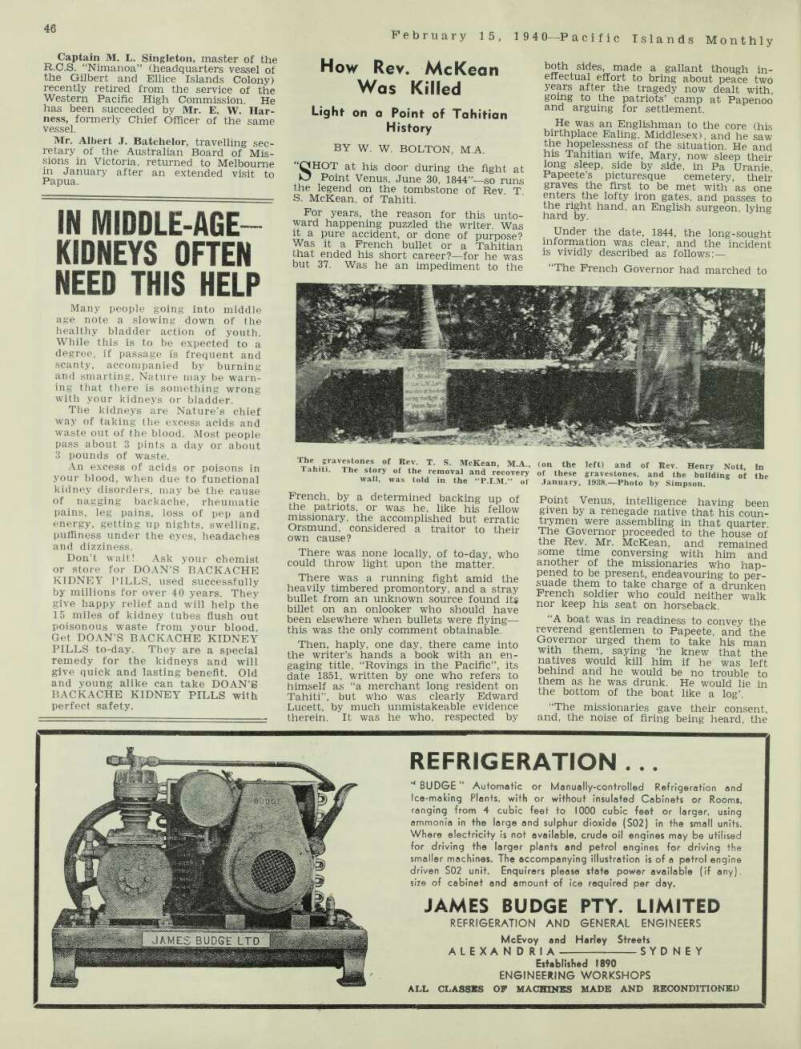
The gravestones of Rev. T. S. Mekean, M.A., (on the left) and of Rev. Henry Nott. In Tahiti. The story of the removal and recovery of these gravestones, and the building of the wall, was told in the P.I.M.” of January, 1938.—Photo by Simpson.
Governor mounted his horse to join his party; but, ere doing so, he rode to the fence and again called out to Mr. Mc- Kean, repeating his instructions respect ing the care of the man. With eager politeness, Mr. McKean hastened to the end of the verandah and raised his hat
in acknowledgment.
“As the Governor rode off. and Mr. Mc- Kean was in the act of re-entering his house, a musket ball struck him in the back of the head, behind the ear. He expired without uttering a syllable. The ball lodged below the socket of the eye.
It is acknowledged that it was fired by a native, although no one grieves more for the unhappy occurence than the natives.”
Lucett goes on to say that McKean’s house was converted into a hospital and barracks for the French soldiers “with the destruction of his stock and appro priation of any convenient articles of property”. He accompanied sailors of the British ketch, the “Basilisk”, which was then in Papeete Harbour, who conveyed the body in their boat across Matavai Bay to bury it “shrouded in its bloody vestments”, alongside Nott, who had died the month before.
There seems no reason to doubt that the sharpshooter took aim at Bruat who, on horseback, would be on a level with Mc- Kean on his verandah, and that the natives placed Bruat and his party as the cause of the tragedy.
This latter point seems evident from an incident, little known even locally, but recorded by the French historian, Caillot as occuring that same day. With the French soldiers eight miles away to the north, the patriots, hovering on the south of Papeete, saw their chance and entered the little town. 11l news ever travels fast.
That afternoon and night, revenge for all and sundry wrongs was had by commit ting to the flames the entire Catholic Mission buildings in its centre. Every thing went up in smoke —altars and vest ments, furniture and clothing, books and Mss. This latter was indeed a loss, for the then ailing Father Caret (he, with Father Laval, being the cause of all the trouble) had compiled dictionaries of both the Marquesan and Tahitian lan guages in his heyday, and his death was evidently not far off. He died in October of that year, aged 42. Those were strenu ous days on Tahiti.