Scuttled
p. 45 · Read in the full issue
Suva Sees the End of a Familiar Barque
THE old “Woodburn,” which was towed to sea and sunk on October 31, had been moored in Suva harbour for 12 years, and used as a coal hulk.
Originally, she was one of Shackland’s ships; a steel barque, built by Russell and Company, Glasgow, for the “Burn”
Line. That was about 45 years ago.
Termed by seamen a “bald-header”, like most of Shackland’s vessels, she was the smallest of their fleet. When, eventually, the fleet was sold in 1904, the “Wood burn” went to the Germans, and sailed under their flag for many years. With no published records, or anything out standing in any of her passages, the “Woodburn” was just a typical, flat-bot tomed cargo-carrier.
On the morning that she was towed to sea, a Suva engineering firm, Messrs.
Bish Ltd., cut several holes in the ship’s sides, around the water-line, and tem porary plates were attached to each one.
More holes were cut higher up, and these were left open.
At 1 p.m. all preparations were com plete. The tow-boat was the “Matafele” (B.P.’s new island motor vessel).
Once clear of the harbour, the old barque felt the heave of the sea again, and rose gracefully to the swell. But no yards crossed the fore and main masts, no spanker was hauled out on the mizen, no sails unfurled up aloft, no mate yelled “Lee fore brace!”. The ship was strip ped, from stem to stem, except for the very rusty lighthouse towers and capstan
on the forecastle head. On the main deck, the iron frame of the galley and of the half deck (where the apprentices were housed) still remained.
Manning the ship for the burial ceremony were two officers and five Fijians.
Chief Officer J. Hills was on the fore castle-head, keeping an eye on the tow line and watching for signals from the
tow-boat. Hulk-master C. Lees was aft, in charge of the steering. One Fijian was at the wheel, and two engineer-boys were ready to unscrew the plates at the water line.
When a mile out at sea, and 15 miles to go, the beam wind freshened, and the large hull of the sailing ship began to toss about. The “Woodburn’s” grave was meant to be near the island of Beqa, clear of submarine cables.
But the fore-derrick guy ropes carried away, and the great boom swung wildly out to leeward, listing the light ship con siderably. A few minutes later the after derrick followed suit. The tow-boat plug ged away, however. Then, three miles out, the tow-line parted, and the old “Woodburn”, helplessly adrift, began to roll alarmingly. The wind was blowing her onto the reef.
The two engineer-boys hopped down into the hold and had all temporary plates unscrewed in double-quick time. In treble-quick time they climbed the lad ders again! No job on shore was ever done with such alacrity. Gushing into the “Woodburn’s” empty hold were great streams of green water. All hands got clear away in their boat.
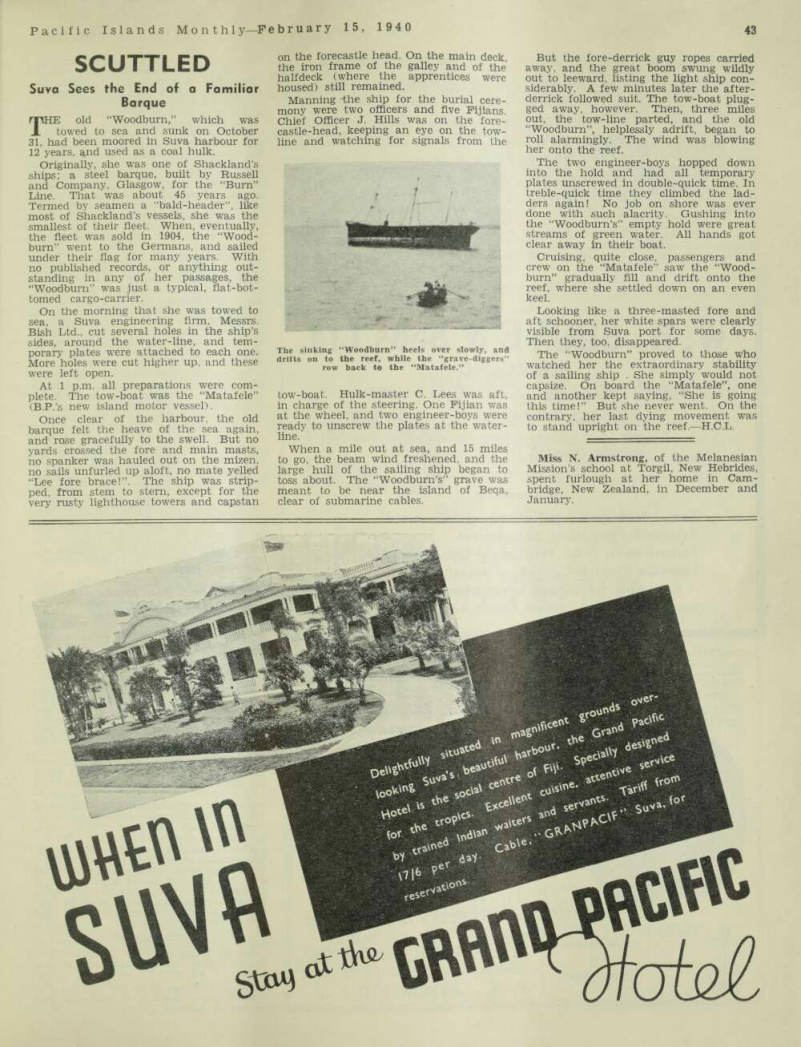
Cruising, quite close, passengers and crew on the “Matafele” saw the “Wood burn” gradually fill and drift onto the reef, where she settled down on an even keel.
Looking like a three-masted fore and aft schooner, her white spars were clearly visible from Suva port for some days.
Then they, too, disappeared.
The “Woodburn” proved to those who watched her the extraordinary stability of a sailing ship. She simply would not capsize. On board the “Matafele”, one and another kept saying, “She is going this time!” But she never went. On the contrary, her last dying movement was to stand upright on the reef.—H.C.L.
Miss N. Armstrong, of the Melanesian Mission's school at Torgil, New Hebrides, spent furlough at her home in Cam bridge, New Zealand, in December and January.
The sinking “Woodburn” heels over slowly, and drifts on to the reef, while the “grave-diggers” row back to the “Matafele.”