Tapu
p. 43 · Read in the full issue
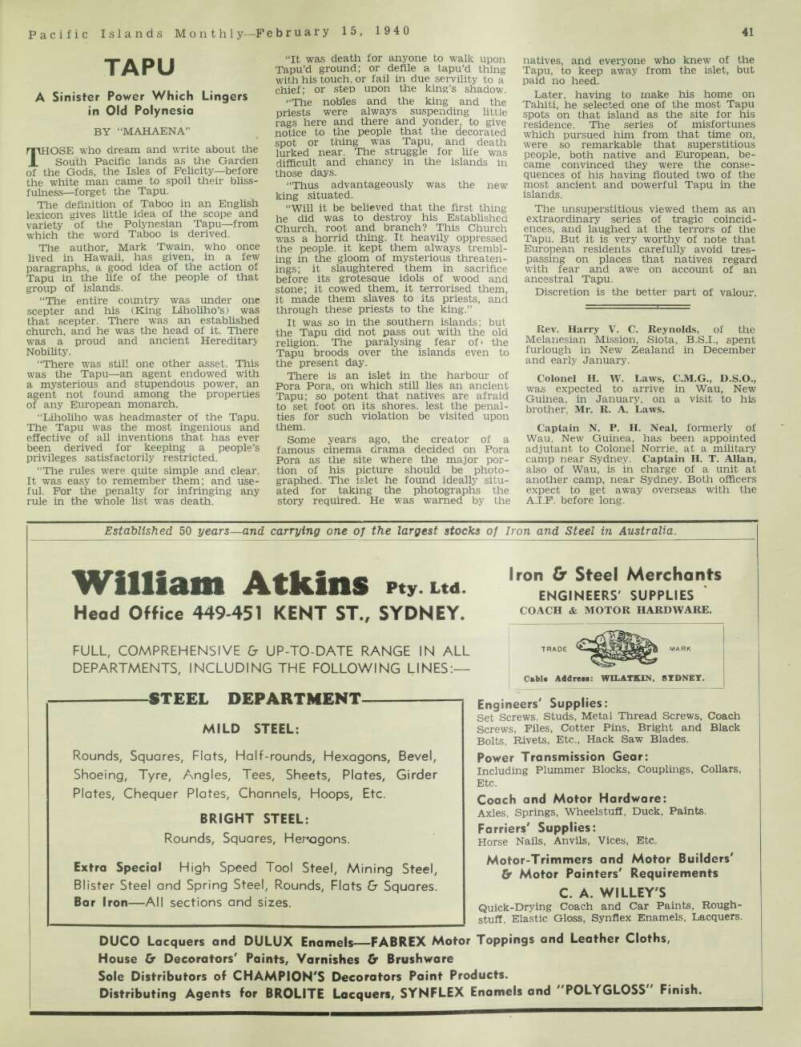
A Sinister Power Which Lingers in Old Polynesia
By “Mahaena”
rIOSE who dream and write about the South Pacific lands as the Garden of the Gods, the Isles of Felicity—before the white man came to spoil their bliss fulness—forget the Tapu.
The definition of Taboo in an English lexicon gives little idea of the scope and variety of the Polynesian Tapu—from which the word Taboo is derived.
The author, Mark Twain, who once lived in Hawaii, has given, in a few paragraphs, a good idea of the action of Tapu in the life of the people of that group of islands.
“The entire country was under one scepter and his (King Liholiho’s) was that scepter. There was an established church, and he was the head of it. There was a proud and ancient Hereditary Nobility.
“There was still one other asset. This was the Tapu—an agent endowed with a mysterious and stupendous power, an agent not found among the properties of any European monarch.
“Liholiho was headmaster of the Tapu.
The Tapu was the most ingenious and effective of all inventions that has ever been derived for keeping a people’s privileges satisfactorily restricted.
“The rules were quite simple and clear.
It was easy to remember them; and use ful. For the penalty for infringing any rule in the whole list was death.
“It was death for anyone to walk upon Tapu’d ground; or defile a tapu’d thing with his touch, or fail in due servility to a chief; or step upon the king’s shadow.
“The nobles and the king and the priests were always suspending little rags here and there and yonder, to give notice to the people that the decorated spot or thing w T as Tapu, and death lurked near. The struggle for life was difficult and chancy in the islands in those days.
“Thus advantageously was the new king situated.
“Will it be believed that the first thing he did was to destroy his Established Church, root and branch? This Church was a horrid thing. It heavily oppressed the people, it kept them always trembl ing in the gloom of mysterious threaten ings; it slaughtered them in sacrifice before its grotesque idols of wood and stone; it cowed them, it terrorised them, it made them slaves to its priests, and through these priests to the king.”
It was so in the southern islands: but the Tapu did not pass out with the old religion. The paralysing fear of' the Tapu broods over the islands even to the present day.
There is an islet in the harbour of Pora Pora, on which still lies an ancient Tapu; so potent that natives are afraid to set foot on its shores, lest the penal ties for such violation be visited upon them.
Some years ago, the creator of a famous cinema drama decided on Pora Pora as the site where the major por tion of his picture should be photo graphed. The islet he found ideally situ ated for taking the photographs the story required. He was warned by the
natives, and everyone who knew of the Tapu, to keep away from the islet, but paid no heed.
Later, having to make his home on Tahiti, he selected one of the most Tapu spots on that island as the site for his residence. The series of misfortunes which pursued him from that time on, were so remarkable that superstitious people, both native and European, be came convinced they were the conse quences of his having flouted two of the most ancient and powerful Tapu in the islands.
The unsuperstitious viewed them as an extraordinary series of tragic coincid ences, and laughed at the terrors of the Tapu. But it is very worthy of note that European residents carefully avoid tres passing on places that natives regard with fear and awe on account of an ancestral Tapu.
Discretion is the better part of valour „ „ „ „ „ „ „ Hev. Harry V. C. Reynolds, of the Melanesian Mission, Siota, 8.5.1., spent furlough in New Zealand in December an d early January, colonel H w Laws CM G DSO W as exnected to arrive in Wan New Guinea, in January, on a visit to his brother Mr. R. A. Laws.
Captain N. P. H. Neal, formerly of Wau, New Guinea, has been appointed adjutant to Colonel Norrie, at a military camp near Sydney. Captain H. T. Allan, also of Wau, is in charge of a unit at another camp, near Sydney. Both officers expect to get away overseas with the A.I.F. before long.