40 Years In The New Hebrides
pp. 38-42 · Read in the full issue
Remarkable Changes Among Natives Australia Affected by Condominium's Strange Political Condition (SPECIALY WRITTEN BY REV. MAURICE FRATER WHO HAS JUT COMPLETED 40 TEARS' SERVICE AS A MISSIONARY IN NEW HEBRIDES)
IT would require a book, rather than an article, to deal adequately with the changes that have taken place in the New Hebrides during the life-time of a missionary who has just retired after 40 years’ residence in the group—years that have been momentous alike in the his tory of the South Seas and the world.
Even since the close of the World War, 25 years ago, residents wonder at the astonishing contrast between the world-wide communications enjoyed by the Islands to-day, compared with the restricted intercourse which marked the years of the Great War.
In 1914, the marvel of radio still lay in the lap of the future, and, outside of Vila, with its cable station, foreign resi dents learned of the outbreak of war from the haphazard reports of passing cutters. Not until the arrival of news papers from Australia, several weeks later, did they know of the hazards and vicissitudes of the early stages. During the long-drawn-out years of the conflict, the only source of information was the two-monthly steamer service from Syd ney, supplemented by an occasional call from the British Resident Commissioner who, in his yacht, made periodical tours
through the Group and circulated the latest bulletins from Vila.
But, in 1940, settlers in the most re mote islands of the Group are as well informed as city-dwellers of world events.
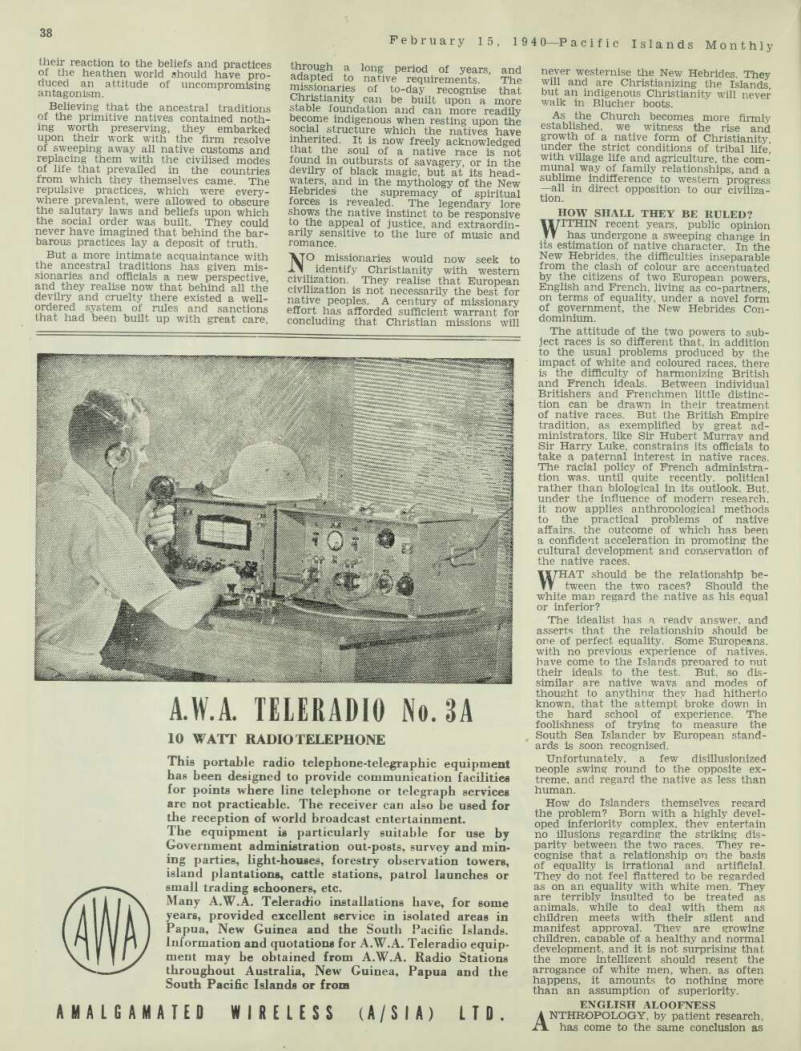
Nearly every settler possess a radio re ceiver, while a few have transmitting sets.
The daily broadcasts from London and Continental capitals are clearly heard • while, from the Vila Radio, issue not only local news, but regular daily bulle tins from all parts of the world. No social innovation has so closely affected the residents, and in the future broad casting is going to exert a unique and incalculable influence in the New Heb rides.
Radio And The Natives
IT can also be truthfully said that no innovation has caused such a fun damental reconstruction of native policy as radio. Missions and commerce have each, in its own way, been exercising a disturbing but salutary influence for over 100 years; but, wherever wireless pene trated, it produced a violent reaction and overthrew long-established beliefs, re placing a hoary insularity by a world wide outlook, and an old self-contained communism by a new individualism.
When wireless was first introduced, and the natives heard voices coming through the air from over the sea, they imagined that the sounds were produced by the same means that they themselves em ployed.
From time immemorial, the natives have had a radio system of their own, and were able to convey wireless mes sages from tribe to tribe. Broadcasting in the New Hebrides was accomplished by means of drums, the messages being relayed over long distances with great rapidity. It was called Drum Talk. By the staccato notes of the drum the news of the death of a chief, and warnings of approaching danger, were broadcast. A code, akin to the dots and dashes of telegraphy, was employed; and, though the various tribes spoke different dia lects, the language barrier did not pre vent them from having intelligent com munication with each other.
The white man’s wireless caused great surprise among the natives, and intro duced a disturbing factor into their lives. It is a trite remark that it would take generations of education to eradi cate the old beliefs of the natives—if, indeed, it were possible to uproot what had become a virtual prepossession. But radio accomplished with almost magical suddenness what the teaching of the schools was only doing by slow degrees.
Accustomed from time immemorial to believe that the sun revolved round their island domain, the natives were arro gant enough to believe that sunrise and sunset in the New Hebrides determined light and darkness evervwhere. It came as a great surprise to learn, from wire less. that the countries and islands with which they were surrounded had all dif ferent times from them and from each other. With cynical incredulity, they heard from San Francisco that the sun rose there nearly a day behind the New Hebrides; and even the knowledge that
they were so far ahead of America did not make the news more acceptable.
When they found that it was possible to flit, by wireless, from a Sunday school in Australia to a Saturday night entertain ment in California, they were convinced that there was either magic or devilry behind it.
But radio has kept up the deception so long, and so persistently, that the truth has at last dawned upon the bewildered native mind, and the self-centred islander is willing to concede that there is some-
thing after all in the white man’s fool ishness. No incredulous people were ever favoured with such a series of convincing proofs of the operation of the Copernican theory.
Weather Magic!
ANOTHER stronghold, hitherto deemed impregnable, was soon to fall before the onset of radio. Universal through out the islands was the belief that the sacred men controlled the forces of nature and made wind and rain accord ing as they thought fit. Natives had no conception of the operation of natural law. Cause and effect were the result of magical forces that had nothing to do with the law of sequence in the material world. The spirit of one thing acts on the spirit of another and produces its own result. That is the native law of cause and effect.
It is difficult for people in civilised lands to have anything but a vague idea of the large part played by magic in the life of the native. Again, wireless stepped in and upset their ideas about
the weather as rudely as it did their con ception of time.
The first intimation by wireless of the approach of a hurricane came from Queensland, and was received with min gled derision and suspicion. It stated that a cyclone was raging in New Cale donia and was travelling towards the New Hebrides.
There was nothing in external nature to indicate the approach of foul weather and with amused incredulity they asked.
“How can people in Queensland know about weather‘conditions in the New Hebrides? Was not the weather of Paama controlled by the sacred men?”
Then, thinking there might be a grand wizard in Australia who had charge of the weather, they asked, “Who makes the wind and rain over there? Is it the King?”
They could only conceive of wind and rain as purely local affairs, made at the behest of the local magnate.
Smiling at the audacity of radio, and the credulity of the white race, the natives retired to rest with a gentle breeze chanting a soothing lullaby among the breadfruit trees, and with no thought of impending trouble.
During the night the storm broke with unexpected suddenness and, when morn ing dawned, the wind was blowing with hurricane fury and mountainous seas were breaking on the beach with deafen ing noise. The arrival of the storm, with almost time-table exactness, was a stag gering blow to native pretensions, and made them recognise that their tradi tional notions stood woefully in need of revision.
Their smug self-satisfaction, and like wise their faith in the magicians, received a severe shock, but the new outlook has enabled the natives to give wind and rain their proper place in the natural order of things, which is a great step forward in the development of the native race
Europeans And Natives
DUE largely to the impact of anthro pological research, a corresponding change has taken place in the attitude of Europeans—officials, missionaries and settlers —towards the ancestral life of the natives. When the early missionaries arrived in the South Seas, the feature of native life which impressed them most were offensive practices, like headhunting and cannibalism. It was inevitable that
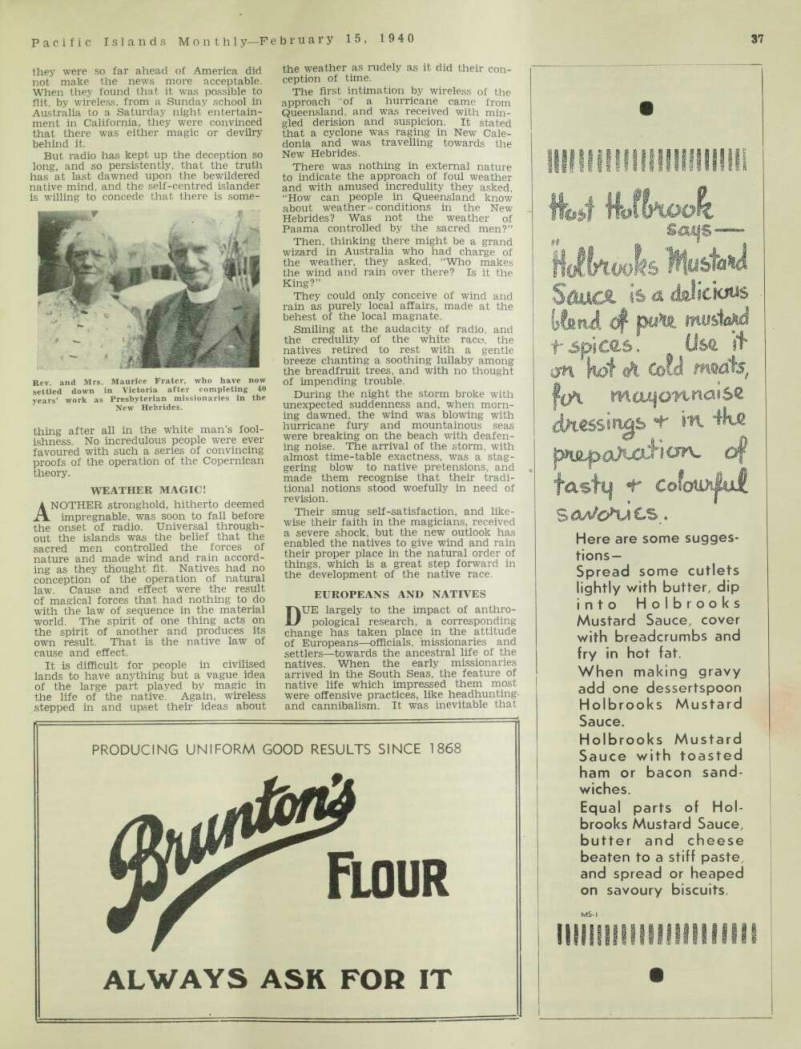
Rev. and Mrs. Maurice Prater, who have now settled down in Victoria after completing 40 years’ work as Presbyterian missionaries in the New Hebrides.
their reaction to the beliefs and practices heath £ n f world should have proantagonism ° f uncom P romisi "S f . ... . , . J . i .
Believing that the ancestral traditions of the primitive natives contained nothmg worth preserving, they embarked upon their work with the firm resolve of sweeping away all native customs and replacing them with the civilised modes of life that prevailed in the countries from which they themselves came. The repulsive practices, which were everywhere prevalent, were allowed to obscure the salutary laws and beliefs upon which the social order was built. They could never have imagined that behind the barbarous practices lay a deposit of truth.
But a more intimate acquaintance with haS given is " sionanes and officials a new perspective, all the , cruelt y there existed a wellrU^6S sanctions that had been built up with great care,
through a long period of vears and adapted to native requireLnte The missionaries of to-day recognL flat Christianity can be built upon a more stable foundation and can more readily become indigenous when resting upon the social structure which the natives have inherited. It is now freely acknowledged that the soul of a native race is not found in outbursts of savagery or in the devilry of black magic, but at’ its head waters, and in the mythology of the New Hebrides the supremacy of spiritual forces is revealed. The legendary lore shows the native instinct to be responsive to the appeal of justice, and extraordin arily sensitive to the lure of music and romance. \TO missionaries would now seek to identify Christianity with western civilization. Thev realise that Fnmnean civilization is not necessarily the best for native peoples. A century of missionary effort has afforded sufficient warrant for concluding that Christian missions will
never westernise the New Hebrides. They will and are Christianizing the Islands, but an indigenous Christianity will never walk in Blucher boots.
As the Church becomes more firmly established, we witness the rise and growth of a native form of Christianity, under the strict conditions of tribal life! with village life and agriculture, the com munal way of family relationships, and a sublime indifference to western progress —all in direct opposition to our civiliza tion.
How Shall They Be Ruled?
WITHIN recent years, public opinion has undergone a sweeping change in its estimation of native character. In the New Hebrides, the difficulties inseparable from the clash of colour are accentuated by the citizens of two European powers, English and French, living as co-partners, on terms of equality, under a novel form of government, the New Hebrides Con dominium.
The attitude of the two powers to sub ject races is so different that, in addition to the usual problems produced by the impact of white and coloured races, there is the difficulty of harmonizing British and French ideals. Between individual Britishers and Frenchmen little distinc tion can be drawn in their treatment of native races. But the British Empire tradition, as exemplified by great ad ministrators, like Sir Hubert Murray and Sir Harry Luke, constrains its officials to take a paternal interest in native races.
The racial policy of French administra tion was, until quite recently, political rather than biological in its outlook. But, under the influence of modern research, it now applies anthropological methods to the practical problems of native affairs, the outcome of which has been a confident acceleration in promoting the cultural development and conservation of the native races.
WHAT should be the relationship be tween the two races? Should the white man regard the native as his equal or inferior?
The idealist has a readv answer, and asserts that the relationship should be one of perfect equality. Some Europeans, with no previous experience of natives, have come to the Islands prepared to nut their ideals to the test. But, so dis similar are native wavs and modes of thought to anything they had hitherto known, that the attempt broke down in the hard school of experience. The foolishness of trying to measure the South Sea Islander by European stand ards is soon recognised.
Unfortunately, a few disillusionized people swing round to the opposite ex treme, and regard the native as less than human.
How do Islanders themselves regard the problem? Born with a highly devel oped inferiority complex, thev entertain no illusions regarding the striking dis parity between the two races. They re cognise that a relationship on the basis of equality is irrational and artificial.
They do not feel flattered to be regarded as on an equality with white men. They are terribly insulted to be treated as animals, while to deal with them as children meets with their silent and manifest approval. Thev are growing children, capable of a healthy and normal development, and it is not surprising that the more intelligent should resent the arrogance of white men, when, as often happens, it amounts to nothing more than an assumption of superiority.
English Aloofness
ANTHROPOLOGY, by patient research, has come to the same conclusion as
the Islanders have reached, by native intuition. Science relegates the inhabi tants of the South Seas to a place among the child races of the world.
The brown man is only awakening out of a sleep that has lasted thousands of years. The eyes of the people are dim, and their ears dull of hearing. In spite of their big strong bodies, their mind is that of a child. By showing that the difference between the races is largely one of training, and not of mental structure, anthropology has compelled public opinion to revise its estimate of native character.
Why is it that British rule over native races, which is universally regarded as the most enlightened, has been, on the whole, a failure, if judged from the stand point of winning the affection of subject peoples?
Natives show a greater affinity with Chinese and Japanese. That, by itself, need occasion no surprise, because in thought and action the Eastern races ap proximate more closely to the Islanders, and there is no clash with native preju dices. The French, likewise, adopt a more accommodating attitude. Their repugnance to inter-racial intimacy is much less marked.
Natives cannot fail to be impressed by the contrast between the easy, complai sant view of the French, and the strength of British prejudice. The average Brit isher is born with a superiority complex, sees no need for understanding the native, and does not concern himself about violating cherished notions. Con sequently, there is a disposition on the part of the native to regard him as more arrogant and overbearing. In spite of the harsh usage that frequently accom
pahies the regime of the French their method of approach does not offend native susceptibilities as do the coldness and aloofness of the British attitude.
IN the smoke room of the BP. boats the sentiment is freely expressed that Europeans must maintain their author ity. That may be quite right, provided such authority is not maintained in an unnatural and offensive manner. Cour tesy and authority may go hand in hand.
Friendliness may be combined with insist ence on certain, external forms which meet with mutual approval.
But real authority is only possible if the European commands the respect of the native. There is no question about the superiority of the white man. “Belong white man" is the native formula for expressing their sense of wonder over some achievement which is beyond their comprehension. The Islander does not understand that this superiority in mechanical construction is really an in dication of mental and spiritual attain ment.
But one thing the Islander does com prehend is whether a particular white man is better or worse than himself. He falls back on the most elementary stan dard of judgment—the moral standard If he recognises an inherent superiority of character, then submission becomes easy and natural.
But when he finds indolence, selfish ness and a reluctance to assume the white man’s burden, the native remains unimpressed by the white skin, and in wardly feels that the European is no better than himself. The relations be tween the races become embittered, and it is more difficult for the white man to
hold aloft the torch of truth and be a standard bearer of civilization.
France? Australia? Or Both?
NEEDLESS to relate, there have also been far-reaching changes in the political arena during the past 40 years.
Until the beginning of the century Brit ish influence had been paramount, but the entry of colonists from New Cale donia gave a great fillip to French ag grandisement: and when, in 1906, the New Hebrides Convention was proclaimed, the two nations embarked on the novel experiment of Joint Control on a basis of equality.
But it soon became evident that Britain did not contemplate permanent occupa tion. The main purpose of government amongst an aboriginal people consists in the encouragement of industry and the development of the native race by foster ing health and educational services. But, beyond nominal grants to mission hospi tals, nothing was done to promote the welfare of the native race or encourage British colonisation. The persistent atti tude of Britain to the New Hebrides was one of apathy and neglect.
The Island Group was the Ishmael of British colonial possessions and there is no likelihood that this policy will be amended. As was to be expected, British interests steadily deteriorated, while French influence advanced by leaps and bounds, until France became the pre dominant partner in the Condominium.
The opinion of British residents in the New Hebrides is pretty well divided about the continuance of Dual Control, and a considerable section would favour sole and undivided French control.
Due to the policy of drift and intran
sigeance that has so long marked the Commonwealth’s relations with the Islands, these settlers do not favour a partnership with Australia. On the other hand, the Missions, to whom the inter ests of the native race are paramount, would welcome the entry of the Commonwealth, in joint control with France, as a step designed to promote the industrial and educational development of the native races. Hailing with satisfaction the change that in recent years has come over the policy of Australia towards the islands lying on her border, the Missions recognise that not only is the Commonwealth now exhibiting a salutary interest in the South Sea Islands, but a remarkable aptitude for dealing with the native race The close of the war will doubtless see a further re-adjustment of the political complexity. A recent visitor, com-
petent to express an opinion, writes, “I suppose no place in the world is so badly governed in the interests of the natives as the New Hebrides.”
To Australia the ownership of the New Hebrides is a matter of vital importance, as the Islands lie too near the eastern border to be in foreign hands, no matter how friendly. The proposal has accord ingly been made that Britain should re linquish her interest in favour of Austra lia. Certainly, the present Quixotic part nership between Britain and France has outlived its usefulness and, if Australia, linked as she is commercially with the Islands, were to undertake the joint ad ministration. the Group would enter upon a new era of prosperity. But, if Aus tralia declines the responsibility, there appears to be no alternative but a disso lution of the Condominium and the establishment of French sovereignty.