"Cheeky Natives"
p. 26 · Read in the full issue
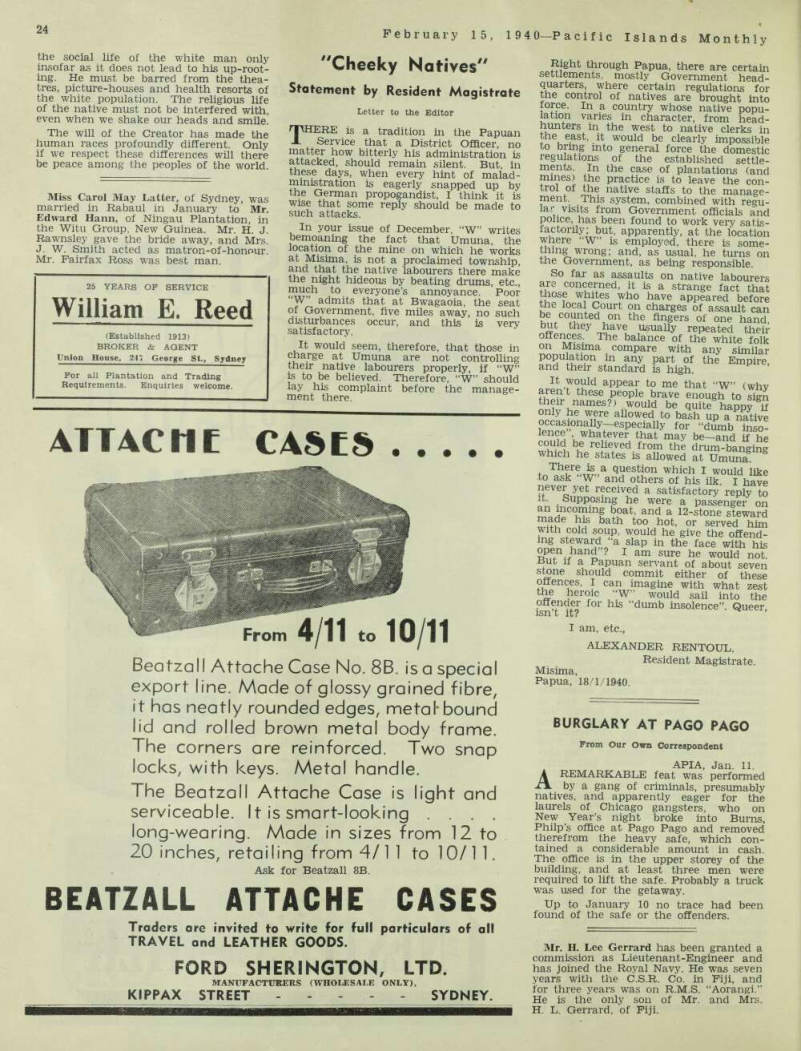
Statement 1 by Resident Magistrate
Letter to the Editor rERE is a tradition in the Papuan Service that a District Officer, no matter how bitterly his administration is attacked, should remain silent. But, in these days, when every hint of malad ministration is eagerly snapped up by the German propogandist, I think it is wise that some reply should be made to such attacks.
In your issue of December, “W” writes bemoaning the fact that Umuna, the location of the mine on which he works at Misima, is not a proclaimed township, and that the native labourers there make the night hideous by beating drums, etc,, much to everyone’s annoyance. Poor ‘W” admits that at Bwagaoia, the seat of Government, five miles away, no such disturbances occur, and this is very satisfactory.
It would seem, therefore, that those in charge at Umuna are not controlling their native labourers properly, if “W” is to be believed. Therefore, “W” should lay his complaint before the manage ment there.
Right through Papua, there are certain settlements, mostly Government head quarters, where certain regulations for the control of natives are brought into force. In a country whose native popu lation varies in character, from head hunters in the west to native clerks in the east, it would be clearly impossible to bring into general force the domestic regulations of the established settle ments. In the case of plantations (and mines) the practice is to leave the con trol of the native staffs to the manage ment. This system, combined with regu lar visits from Government officials and police, has been found to work very satis factorily; but, apparently, at the location where “W” is employed, there is some thing wrong; and, as usual, he turns on the Government, as being responsible.
So far as assaults on native labourers are concerned, it is a strange fact that those whites who have appeared before the local Court on charges of assault can be counted on the fingers of one hand, but they have usually repeated their offences. The balance of the white folk on Misima compare with any similar population in any part of the Empire, and their standard is high. ovP >wS ld appear to me that “W” (why arent these people brave enough to sign ™?^ names?) would be Quite happy g S only he were allowed to bash up a native ip C n?P’> ona i ly r espe . clally for “ dum b inso lence that may be—and if he couid be relieved from the drum-banging which he states is allowed at Umuna S 8 q ” es H° n which I would like to ask W and others of his ilk. I have never yet received a satisfactory reply to it. Supposing he were a passenger on h £ at l and a 12-stone steward made bath too hot, or served him with cold soup, would he give the offend ing steward “a slap in the face with his open hjmd”? I am sure he would not.
But if a Papuan servant of about seven stone should commit either of these offences, I can imagine with what zest the heroic “W” would sail into the offender for his “dumb insolence”. Queer, isn t it.
I am, etc.,
Alexander Rentoul,
Resident Magistrate.
Misima, Papua, 18/1/1940.