“Fighting Words” From Japan
pp. 42-43 · Read in the full issue
What is Going on in and Around The Philippines
By John Williams, Of Honolulu.
A Honolulu, Dec. 2.
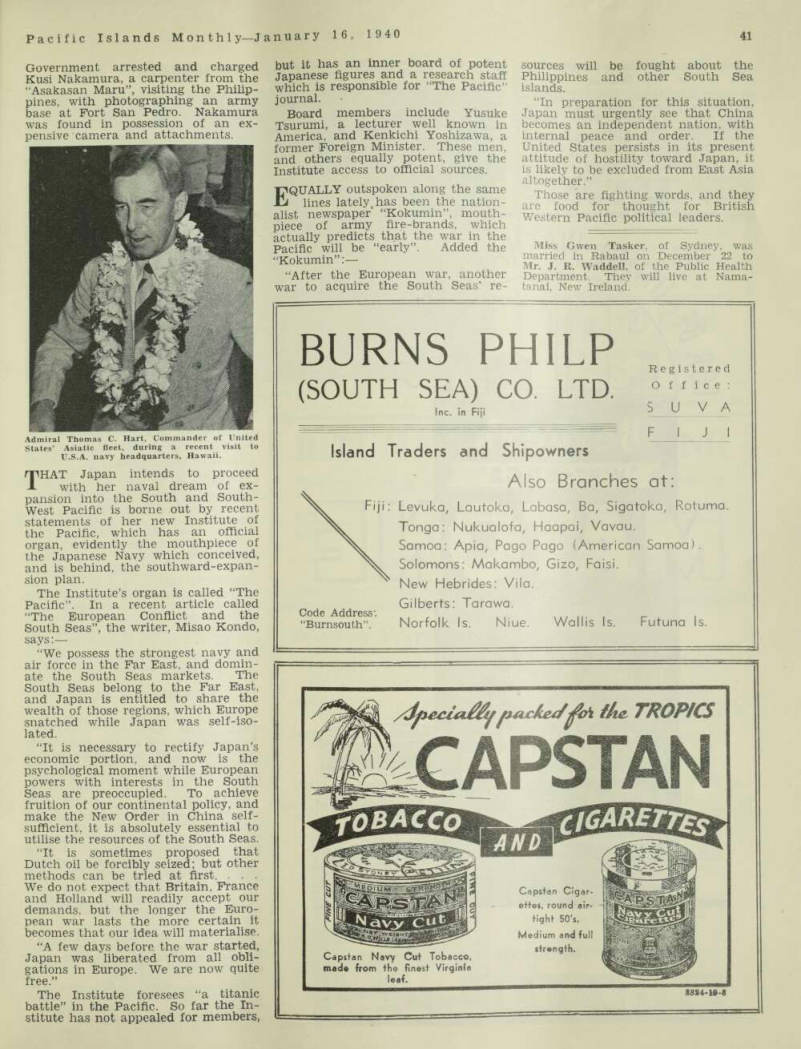
MERICA is not going to make any bones about her defence of the Philippine Islands while the Stars and Stripes fly over them. (Under the terms of the Philippine Independence Act, the U.S. will retire from the isles in 1946.) The recent conference at Manila of U.S. diplomatic chiefs and Admiral Thomas C. Hart, commander of the U.S. Asiatic fleet, who steamed down from his headquarters in Shanghai, has brought to light some potent
facts which must interest British leaders in the Western Pacific.
Admiral Hart visited Davao, in the great island of Mindanao, south of Manila, where in recent years Japan has established a colony of at least 25,000 Japanese “farmers” and “fishermen”. At the outbreak of the war in Europe, America promptly despatched a squadron of long-range patrol bombers to Manila and, since then, they have been conducting an exhaustive patrol of the Davao sec tion.
They have combed outlying bays, usually the rendezvous of furtive Japanese boats, and really performed fine work in landing, taking off and servicing the huge navy bombers in isolated areas where normal dry docking and other facilities do not exist.
These conditions, of course, ap proximate those under which the crews would have to work in war time.
Because even the U.S. Navy base at Cavite, near Manila, lacks ade quate facilities for handling the all metal bombers, the squadron now at Davao soon will be flown back for complete overhaul at their home base at Pearl Harbour, near Honolulu. They will be replaced by another Pearl Harbour squadron. This idea of shuttling back and forth between Hawaii and the Philippines will fully test the equipment and give the crews admirable experience in long range point to point ocean flying.
More importantly, it will give the U.S. Navy that much more excuse to have their bombers in the Western Pacific and keep flying them across the routes between Japan and the Japanese mandated islands.
COINCIDENT with the secret con ferences of U.S. leaders at Manila—and over the protests of the Chinese community, which controls much of the retail trade—the Manila Municipal Board passed a law limit ing to citizens of the Philippines and the United States the right to en rage in any form of business in pub lic markets. Foreigners having exist ing businesses have been given three months to vacate.
This new law. obviously, is aimed at the tremendous encroachment of Jananese interests, which often use Filipino “dummies” to circumvent other restrictions against aliens.
For example, this month the Secre tary of Agriculture. Benio-mo Aauino, reported to President Manuel Quezon that a special investigation bv his department revealed tbot the Jana nese control deep-sea fishing in Philip pine waters.
He said that Japanese own 80 per cent, of the vessels engaged, often in “dummy” names.
On November 27 the Philippine
Government arrested and charged Kusi Nakamura, a carpenter from the “Asakasan Maru”, visiting the Philip pines, with photographing an army base at Fort San Pedro. Nakamura was found in possession of an ex pensive camera and attachments.
THAT Japan intends to proceed with her naval dream of ex pansion into the South and South- West Pacific is borne out by recent statements of her new Institute of the Pacific, which has an official organ, evidently the mouthpiece of the Japanese Navy which conceived, and is behind, the southward-expan sion plan.
The Institute’s organ is called “The Pacific”. In a recent article called “The European Conflict and the South Seas”, the writer, Misao Kondo, says:— “We possess the strongest navy and air force in the Far East, and domin ate the South Seas markets. The South Seas belong to the Far East, and Japan is entitled to share the wealth of those regions, which Europe snatched while Japan was self-iso lated.
“It is necessary to rectify Japan’s economic portion, and now is the psychological moment while European powers with interests in the South Seas are preoccupied. To achieve fruition of our continental policy, and make the New Order in China self sufficient, it is absolutely essential to utilise the resources of the South Seas.
“It is sometimes proposed that Dutch oil be forcibly seized; but other methods can be tried at first. . . .
We do not expect that Britain, France and Holland will readily accept our demands, but the longer the Euro pean war lasts the more certain it becomes that our idea will materialise.
“A few days before the war started, Japan was liberated from all obli gations in Europe. We are now quite free.”
The Institute foresees “a titanic battle” in the Pacific. So far the In stitute has not appealed for members,
but it has an inner board of potent Japanese figures and a research staff which is responsible for “The Pacific” journal.
Board members include Yusuke Tsurumi, a lecturer well known in America, and Kenkichi Yoshlzawa, a former Foreign Minister. These men, and others equally potent, give the Institute access to official sources.
EQUALLY outspoken along the same lines lately, has been the nation alist newspaper “Kokumin”, mouth piece of army fire-brands, which actually predicts that the war in the Pacific will be “early”. Added the “Kokumin”:— “After the European war, another war to acquire the South Seas’ re
sources will be fought about the Philippines and other South Sea islands.
“In preparation for this situation, Japan must urgently see that China becomes an independent nation, with internal peace and order. If the United States persists in its present attitude of hostility toward Japan, it is likely to be excluded from East Asia altogether.”
Those are fighting words, and they are food for thought for British Western Pacific political leaders.
Miss Gwen Tasker, of Sydney, was married in Rabaul on December 22 to Mr. ,T. R. Waddell, of the Public Health Department. They will live at Nama tanai, New Ireland.
Admiral Thomas C. Hart, Commander of United States’ Asiatic fleet, during a recent visit to U.S.A. navy headquarters, Hawaii.