Sharp Check to Inquisitive Sampans
pp. 19-20 · Read in the full issue
America's Watch On The Northern
Pacific
By John Williams
Honolulu, Dec. 12.
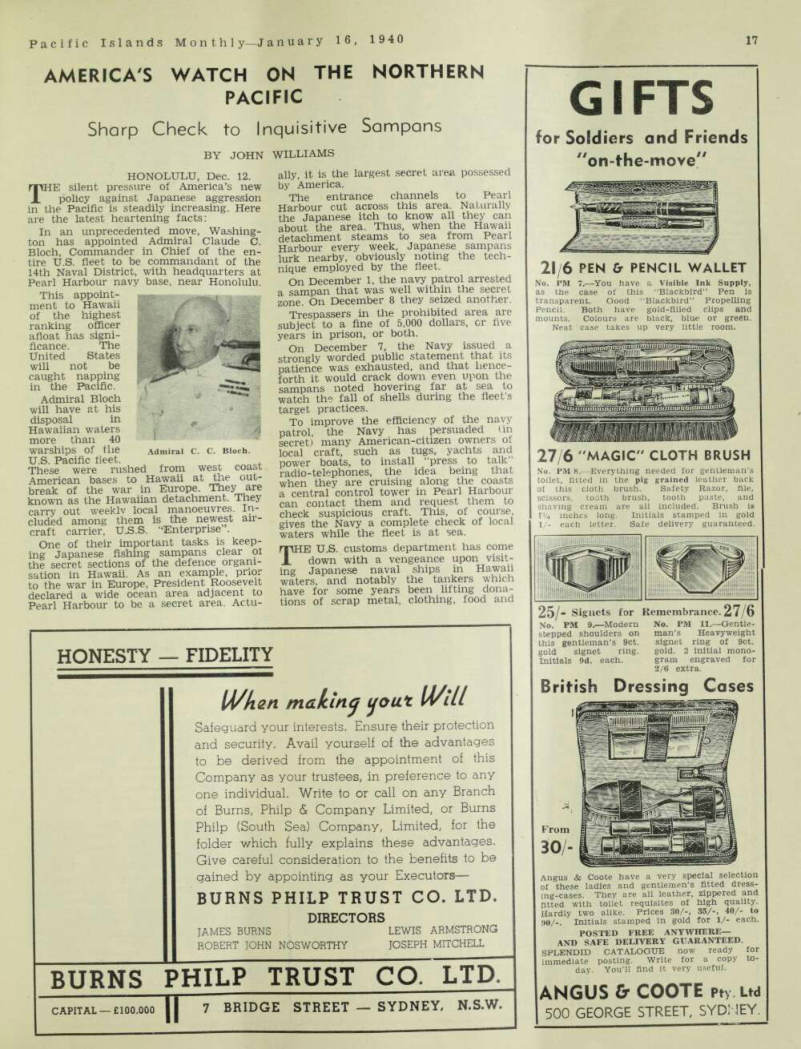
THE silent pressure of America’s new policy against Japanese aggression in the Pacific is steadily increasing. Here are the latest heartening facts: In an unprecedented move, Washing ton has appointed Admiral Claude C.
Bloch, Commander in Chief of the en tire U.S. fleet to be commandant of the 14th Naval District, with headquarters at Pearl Harbour navy base, near Honolulu.
This appoint ment to Hawaii of the highest ranking officer afloat has signi ficance. The United States will not be caught napping in the Pacific.
Admiral Bloch will have at his disposal in Hawaiian waters more than 40 warships of the
U.S. Pacific fleet. , These were rushed from west coast American bases to Hawaii at the out break of the war in Europe. They are known as the Hawaiian detachment. They carry out weeklv local manoeuvres. In cluded among them is the newest air craft carrier, U.S.S. “Enterprise”.
One of their important tasks is keep ing Japanese fishing sampans clear ot the secret sections of the defence organi sation in Hawaii. As an example, prior to the war in Europe, President Roosevelt declared a wide ocean area adjacent to Pearl Harbour to be a secret area. Actu
ally, it is the largest secret area possessed by America.
The entrance channels to Pearl Harbour cut across this area. Naturally the Japanese itch to know all they can about the area. Thus, when the Hawaii detachment steams to sea from Pearl Harbour every week, Japanese sampans lurk nearby, obviously noting the tech nique employed by the fleet.
On December 1, the navy patrol arrested a sampan that was well within the secret zone. On December 8 they seized another.
Trespassers in the prohibited area are subject to a fine of 5,000 dollars, cr five years in prison, or both.
On December 7. the Navy issued a strongly worded public statement that its patience was exhausted, and that hence forth it would crack down even upon the sampans noted hovering far at sea to watch the fall of shells during the fleet’s target practices.
To improve the efficiency of the navy patrol, the Navy has persuaded (in secret) many American-citizen owners of local craft, such as tugs, yachts and power boats, to install “press to talk” radio-telephones, the idea being that when they are cruising along the coasts a central control tower in Pearl Harbour can contact them and request them to check suspicious craft. This, of course, gives the Navy a complete check of local waters while the fleet is at sea. r E U.S. customs department has come down with a vengeance upon visit ing Japanese naval ships in Hawaii waters, and notably the tankers which have for some years been lifting dona tions of scrap metal, clothing, food and
Admiral C. C. Bloch.
money from Hawaii Japanese to the Japanese war machine.
When the Jananese tanker “Shiriya” called at Hilo, second port of Hawaii, on December 2, nobody was permitted aboard until the tanker had been boarded first and cleared by a Customs officer. Further, Customs guards saw that no scrap metal and other donation goods were taken aboard, and they one by one examined every sailor going ashore and every per son visiting the tanker.
This ironclad arrangement has irked the local Japanese. Characteristically thorough, they are attempting to work out some other plan for the circumvention of the American vigilance. As an example, the “Nippu Jiji”, leading Japanese news paper in Hawaii, in an editorial on November 29 said:
... It goes without saying that thf Japanese people who are advancing to establish a new order in East Asia, ex pect to come across numerous difficulties (such as the ban on the tankers) in carrying out their holy war ... It will not be difficult for us to discover some other ways of showing our devotion than the donation of scrap metals, etc., if we exert the same attentiveness and effort shown in collecting the scrap metals, etc.
To do or die is their stubborn, national istic motto.
DEVELOPMENTS in the Western Pacific are snowballing. America is determined that her rights in the Orient must be respected by Japan. Japan is determined that she shah have a free hand with her clumsy “holy war’’. But, for her execution of this policy, Japan depends much upon American goodwill, because America to-day takes the biggest share of Japan’s exports and America now is about the only nation which can sell Japan the war materials and weapons she sorely needs for her fight against China.
American public opinion is being aroused against sales to Japan. A force in developing this opinion is the lately formed American Committee for Non- Participation in Japanese Aggression
Leading members of this body are Henry I. Harriman, former president of the U.S. Chamber of Commerce, and mail fisted Admiral Harry E. Yarnell, recently retired commander of the U.S. Asiatic fleet.
THE U.S. Navy plans another spectacu lar endorsement of the new policy against Japan. Lately it was learned that the Pacific fleet’s annual war games early in 1940 will extend far beyond Hawaii and for the first time will use Philippine waters. The official sources behind this information added that spectacular uses will be made of the Navy’s long-range patrol bombers during the fleet’s far western games.
As these words are being typed, Francis B. Sayre, noted U.S. State Department expert, who now is High Commissioner to the Philippines, is making an inspection tour of the colony of 25,000 Japanese on Mindanao Island, 500 miles south of Manila. He is seeing for himself the ex tent of the Japanese infiltration.
Public opinion in the Philippines against the persistent increase in Japanese influence in the islands is ris ing.
President Manuel Quezon, of the Philip pines, who has been a frequent visitor to Japan, and whose pro-Japanese lean ings have often been questioned by his fellow countrymen and Americans, lost his head on December 8, when he at tended a inter-university oratorical con test at Manila.
One of the student speakers said that Philippine independence should be re examined with a view of retention by the U.S. The fiery President blew up and reiterated with emphasis the statement he has made before: “I prefer a Government run like hell by the Filipinos than a Government run like heaven by the Americans!”