Treasure!
pp. 10-11 · Read in the full issue
Cocos Is. Makes Headlines in Sensational Press Again
DOUBT already is being cast upon the story of the discovery of pirates’ treasure, worth 60,000,000 dollars, on Cocos Island, which was displayed under flaring headlines in the Sydney Sunday newspapers of January 7.
The story was that an archaeological society in California had found the famous Lima treasure. But the thing had all the earmarks of a yellow newspaper canard, and a couple of days later it was announced from San Francisco that the backers of the expedition had no con firmation.
Accounts of various recent efforts to find the treasure on Cocos Island have been published in this journal from time to time since 1933.
The story is that, in 1820, the City of Lima was in danger of being raided; that enormous gold and silver treasure, esti mated at from £8,000,000 to £12,000,000 was placed upon a ship called the “Mary Dier”, commanded by Captain Thompson; that the ship sailed away from the coast of Peru, seeking a refuge; and that Captain Thompson murdered his pas sengers and buried the treasure upon the little island of Cocos, and was un able to go back and recover it.
Ever since then, and especially during the past 20 years, innumerable expedi tions have been organised to seek this treasure. One of the most remarkable was that organised by the English com pany known as Treasure Recovery, Ltd which sent an expedition to Cocos Is land in 1934—which expedition was hunted out by the Government of Costa Rica, which claims that it owns Cocos Island and all the treasure therein. This story was told in detail in the “Pacific Islands Monthly” of May, 1935. Subse quently, this expedition was re-organ-
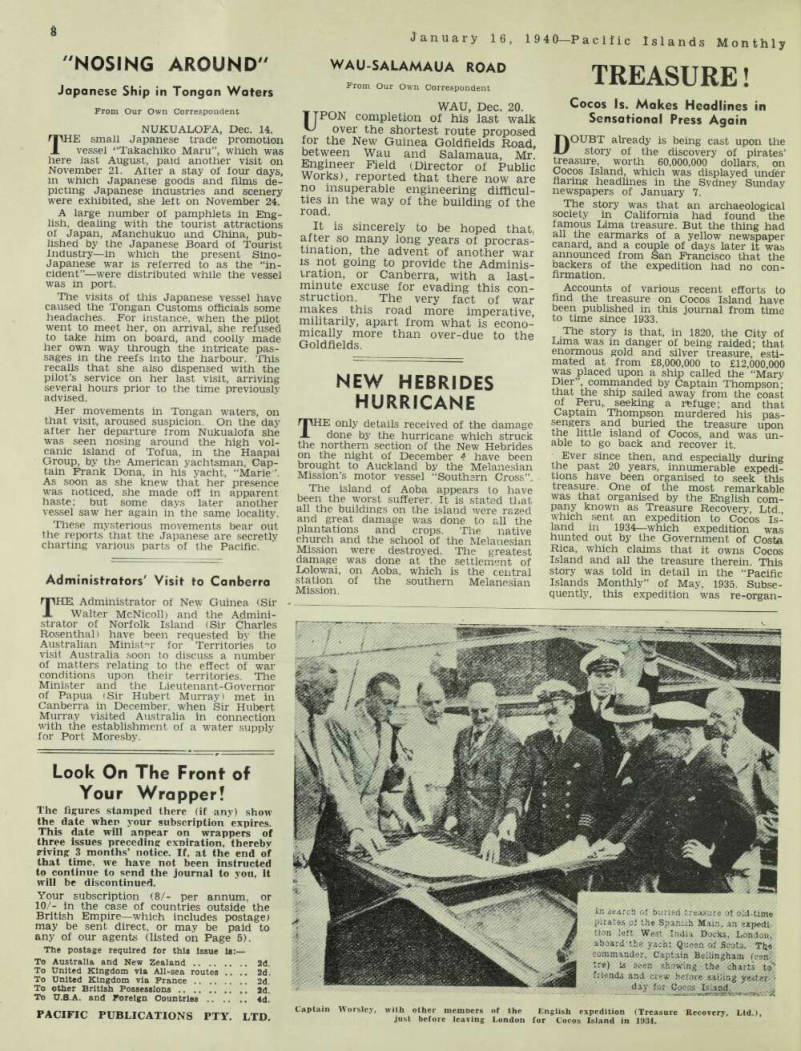
in search of buried treasure of old-time pirates of the Spanish Main, an expedi tion left West India Docks, London, aboard the yacht Queen of Scots. The commander, Captain Bellingham (cen tre) Is seen showing the charts to" friends and crew before sailing yester
day for Cocos Island
Captain Worsley, with other memders of the English expedition (Treasure Recovery, Ltd.), just before leaving London for Cocos Island in 1934.
ised and sent back to Cocos Island where it was operating in 1935 and 1936.
The various expeditions were watched very closely by the Government of Costa Rica, which demanded a portion of any treasure found. It was stated that the English expedition had agreed to give Costa Rica one-third.
The report published on January 7 was released to the newspapers by Mr.
Field, the consul for Costa Rica at Los Angeles, who said that he had been ad vised of the discovery by the curator of the National Museum of Costa Rica.
The expedition of Treasure Recovery, Ltd., was led by Commander Worsley, r.N. Other famous expeditions organised for the same purpose were those led by Admiral Palliser, the Earl of Fitzwilliam, and more recently Sir Malcolm Camp bell.
In the London “Daily Telegraph” of August, 1934, there was a remarkable letter by Admiral B. M. Chambers, who said that he had been in command of warships in South American waters for many years; that he had taken a keen personal interest in this story of the Lima treasure; and that, as a hobby, he had made inquiries in South America and various other places throughout the world, with a view to confirming the story. He described it *as an absolute myth. He could find no confirmation whatever of the story that treasure had been sent away from Lima in the man ner described. There was no record of any ship called the “Mary Dier” or any name resembling that; there was no re cord anywhere of a Captain Thompson having commanded a ship in those waters at about that time; and the little evidence that was available in regard to the threat on Lima about 1820 showed that the treasure of the city was gathered together and taken away Inland, and not towards the sea.
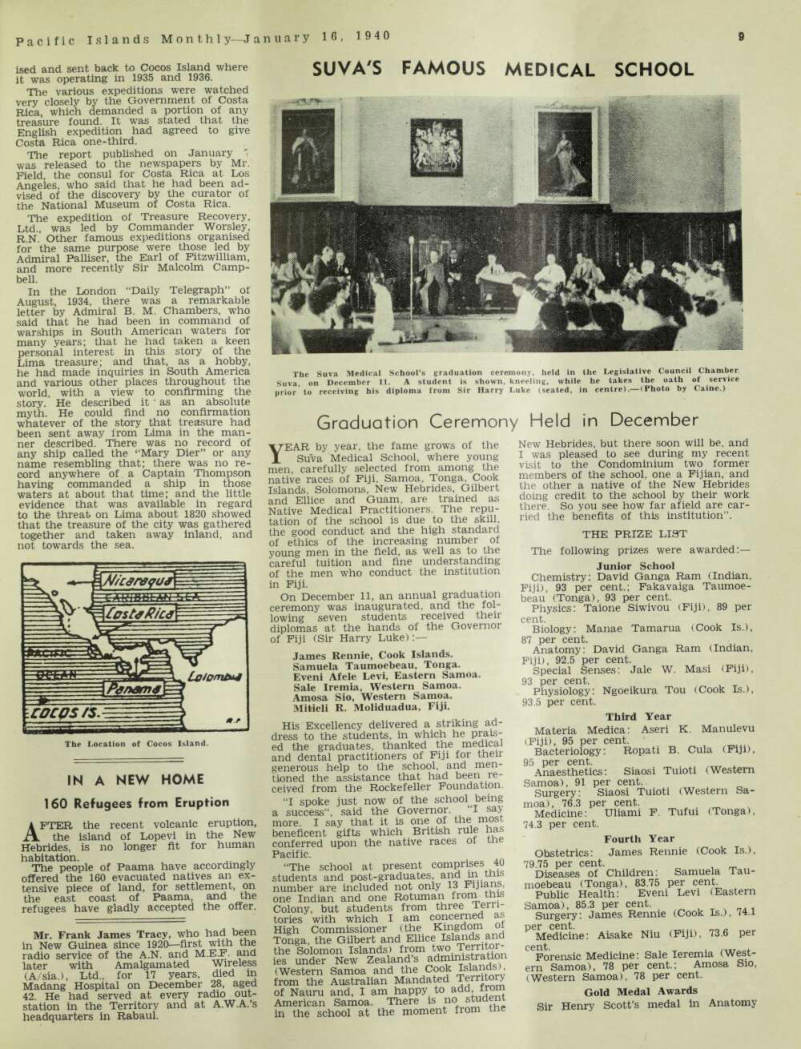
The Location of Cocos Island.