The Curtain Is Rising On 1940
pp. 7-8 · Read in the full issue
A POSITION so extraordinary exists in Europe to-day that only a very ignorant person would confid ently forecast the course or character of the war. The only thing of which we can be certain is that the curtain is about to rise on events which will profoundly affect the condition of the human race and the course of history.
In September, it seemed that the war would be a clean-cut struggle between “rival ideologies”—the Ger man totalitarian system (supported by the Russian totalitarian system, and enjoying the goodwill of the Italian totalitarian system) trying to smash the democratic system of Britain and France.
But there soon entered a new and incalculable factor the marching armies of Soviet Russia. They occupied half of Poland; they seized the little Baltic states; they effectively blocked the Nazi march into the Balkans; and, finally, they attacked Finland.
Hitler was rushed into the German- Russian pact by his Foreign Minister, Ribbentrop (formerly a commercial traveller specialising in champagne!) and there must have been many hours in November and December when Hitler wondered where this amazing alliance was leading him. Finland gave him the answer. The little Finnish David slew the Russian Goliath. Whatever happens now— even if millions of Russians trample over Finland —the bubble reputation
of Moscow’s mighty Red armies is pricked. We—and Germany—know the quality of Russia’s military strength.
To-day, as this is written, the news is that Holland and Belgium stand armed and ready to resist a German attempt to break through the Low Countries upon the Allied left flank; the Scandinavian nations are fever ishly preparing to resist a Russian- German attack; and Italy, still nom inally Germany’s ally, is sending men and munitions to the assistance of Finland, which is fighting Russia, which apparently is also Germany’s ally.
AND, now, which way goes Ger many? Does she now enter a military alliance with Russia, her hereditary foe, and thus automatically bring herself into a position against Finland, Sweden, Norway, Denmark, and probably Holland and Belgium?
Or does she march to the assistance of heroic Finland (always regarded as the protege of Germany) and so put herself on-side with the Scandin avian nations and Italy, and off-side so far as Russia is concerned?
If Germany were to take the latter course, and simultaneously launch a campaign for peace negotiations, through the Pope, through Italy, and through the President of the United States, at the same time offering con cessions regarding Poland and Czecho-
Slovakia, the Allies might find them selves in a difficult and embarrassing position. Important elements in Britain and France ’would staunchly resist such a peace manoeuvre, on the ground that it would be impossible to enter into any peace arrangement with a German Government domin ated by Nazis, who notoriously have no regard for the spoken pledge or the written word.
If, on the other hand, Germany elects- to enter into closer relations with Russia, in which peace between Finland and Russia would be ar ranged, the Scandinavian nations would quieten down, and then we might expect that the full fury of a merciless war would be released in Western Europe in February or March. Germany would keep open her back-door, through Russia, for the receipt of vital supplies, while she would strain every nerve to so severely punish the Allies, on the Western Front, in the summer of 1940 that they would be ready to discuss peace, when winter comes again.
But it is all guesswork.
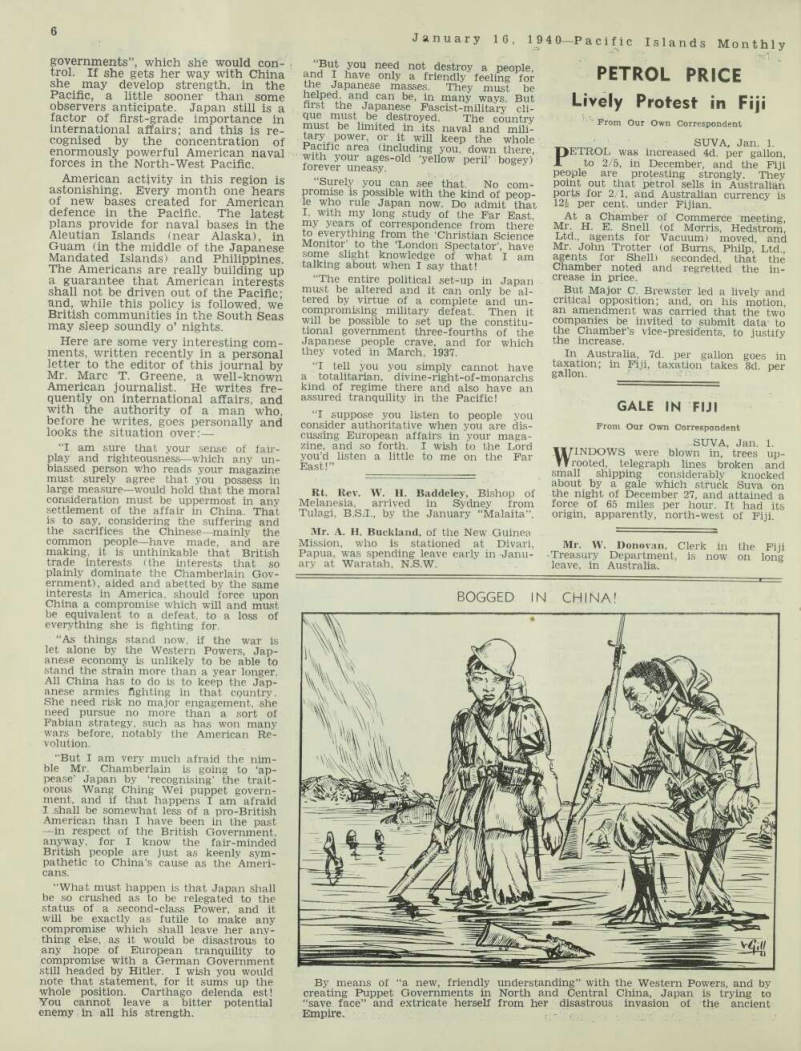
MEANWHILE, another drama is be ing played out, nearer our home. Japan, at the moment, appears to be completely free from all Euro pean alliances or entanglements, and to be concentrating upon what is to her a vital need—namely, the extri cation of her armies from China, and the arrangement of a peace with China, per medium of Chinese “puppet
governments”, which she would con trol. If she gets her way with China she may develop strength, in the Pacific, a little sooner than some observers anticipate. Japan still is a factor of first-grade importance in international affairs; and this is re cognised by the concentration of enormously powerful American naval forces in the North-West Pacific.
American activity in this region is astonishing. Every month one hears of new bases created for American defence in the Pacific. The latest plans provide for naval bases in the Aleutian Islands (near Alaska), in Guam (in the middle of the Japanese Mandated Islands) and Philippines.
The Americans are really building up a guarantee that American interests shall not be driven out of the Pacific; and, while this policy is followed, we British communities in the South Seas may sleep soundly o’ nights.
Here are some very interesting com ments, written recently in a personal letter to the editor of this journal by Mr. Marc T. Greene, a well-known American journalist. He writes fre quently on international affairs, and with the authority of a man who, before he writes, goes personally and looks the situation over:— “I am sure that your sense of fair play and righteousness—which any un biassed person who reads your magazine must surely agree that you possess in large measure—would hold that the moral consideration must be uppermost in any settlement of the affair in China. That is to say, considering the suffering and the sacrifices the Chinese—mainly the common people—have made, and are making, it is unthinkable that British trade interests (the interests that so plainly dominate the Chamberlain Gov ernment), aided and abetted by the same interests in America, should force upon China a compromise which will and must be equivalent to a defeat, to a loss of everything she is fighting for.
“As things stand now. if the war is let alone by the Western Powers, Jap anese economy is unlikely to be able to stand the strain more than a year longer.
All China has to do is to keep the Jap anese armies fighting in that cpuntry.
She need risk no major engagement, she need pursue no more than a sort of Fabian strategy, such as has won many wars before, notably the American Re volution.
“But I am very much afraid the nim ble Mr. Chamberlain is going to ‘ap pease’ Japan by ‘recognising’ the trait orous Wang Ching Wei puppet govern ment, and if that happens I am afraid I shall be somewhat less of a pro-British American than I have been in the past —in respect of the British Government, anyway, for I know the fair-minded British people are just as keenly sym pathetic to China’s cause as the Ameri cans.
“What must happen is that Japan shall be so crushed as to be relegated to the status of a second-class Power, and it will be exactly as futile to make any compromise which shall leave her any thing else, as it would be disastrous to any hope of European tranquility to compromise with a German Government still headed by Hitler. I wish you would note that statement, for it sums up the whole position. Carthago delenda est!
You cannot leave a bitter potential enemy in all his strength.
But you need not destroy a people, and I have only a friendly feeling for the Japanese masses. They must be helped and can be, in many ways. But first the Japanese Fascist-military cli que must be destroyed. The country must be limited in its naval and mili tary power, 0 r it will keep the whole Pacific area (including you, down there, with your ages-old ‘yellow peril’ bogey) forever uneasy.
“Surely you can see that. No com promise is possible with the kind of peop le who rule Japan now. Do admit that I, with my long study of the Far East, my years of correspondence from there to everything from the ‘Christian Science Monitor’ to the ‘London Spectator’, have some slight knowledge of what I am talking about when I say that!
“The entire political set-up in Japan must be altered and it can only be al tered by virtue of a complete and un compromising military defeat. Then it will be possible to set up the constitu tional government three-fourths of the Japanese people crave, and for which they voted in March, 1937.
“I tell you you simply cannot have a totalitarian, divine-right-of-monarchs kind of regime there and also have an assured tranquility in the Pacific!
“I suppose you listen to people you consider authoritative when you are dis cussing European affairs in your maga zine, and so forth. I wish to the Lord you’d listen a little to me on the Far East!”
Rt. R«v. W. H. Baddeley, Bishop of Melanesia, arrived in Sydney from Tulagi, 8.5i1., by the January “Malaita”.
Mr, A. H. Buckland, of the New Guinea Mission, who is stationed at Divari, Papua, was spending leave early in -Janu ary at Waratah, N.S.W.