Native Races
pp. 63-64 · Read in the full issue
What To Do With
Dr. Hogbin's New Book Will Help In Solution of Administrative Problems
Experiments in civilisation—The Effects of European Culture on a Native Community of the Solomon Islands” is a new book by Dr. H. lan Hogbin. M.A., Ph.D., of Sydney. It con tains a great mass of carefully-sifted facts relating to native life in Melanesia, pre sented in a literary style which should give it a wide general appeal.
From the viewpoint of the Pacific resi dent, however, the outstanding value of the book lies in the way in which this
well-trained scientist presents, for Euro pean consideration, the conditions of native life in the Islands to-day in rela tion to the political and economic future of the Pacific Territories. Here, he has done an exceedingly useful job of work.
All Pacific Islands administrations to day are confronted with the same prob lem, or series of problems—thus:— Do we wish to preserve the native populations?—We do.
Is it possible to preserve them in their primitive condition —that is, retaining their old cultures and social structures?— It is not.
Does the change-over, from primitive to European conditions, affect adversely the native races? —Unless properly controlled and directed, it tends to destroy them altogether.
Up to this point, we can answer the logical sequence of questions. But, from here on, the questions are difficult to answer, and they are the sources of pain ful headaches for most Pacific adminis trators. Here they are: What sort of system should control the change-over from primitive to Euro pean conditions?
Having prevented depopulation, what are we going to do with the native races?
Some sort of education system is needed.
What is to be its purpose? Are the
natives to be trained as labourers for Europeans or as technicians, or as farmers of their own lands? Are they to be encouraged to exercise self-govemment? • It is in dealing with these very real problems of administration that a book such as that of Dr. Hogbin is so valuable.
He sought a typical Islands community, still living under primitive conditions, but
re-acting rapidly to “Europeanisation”.
He found it in the north end of Malaita, and he settled in there and lived by him self for many months among the natives, and studied not only their psychological condition, but also the manner in which their material condition was being af fected by the slow, steady change in their daily life.
The conclusions he draws, logically and
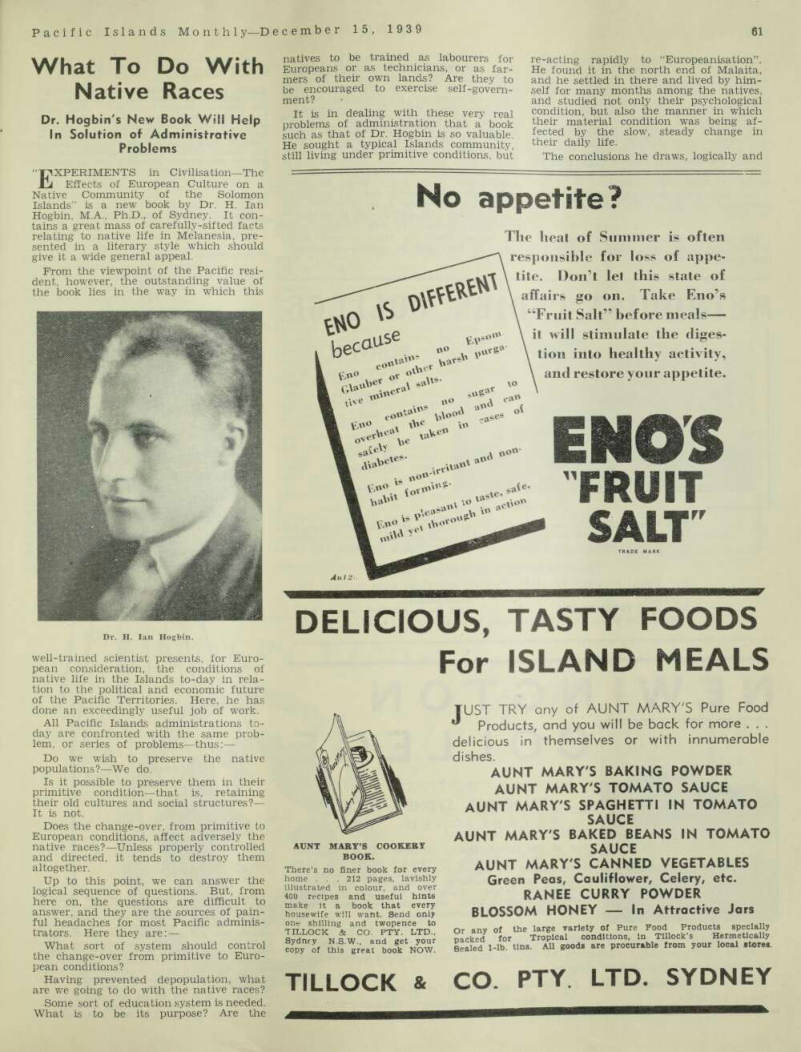
Dr. H. lan Hogbin.
inevitably, are of interest to anyone who may speculate concerning the future of the Pacific races, and unquestionably they are of value to Pacific adminis trators. The book, of course, has its scientific interest also —Dr. Hogbin is an anthropologist of distinction, and learned the work of observation, deduction and connotation under famous masters. That but adds to the practical value of his book—a knowledge of anthropology is now part of the standard equipment of most Pacific administrative officials.
Our copy from the publishers—George Routledge and Sons, Ltd., London. Price 15/- Stg.
Mr. W. V. C. Compton recently arrived in England from New Guinea to join the Royal Air Force.
Rt. Rev. W. H. Baddeley, Bishop of Melanesia, visited New Britain in No vember and, after a short stay in Rabaul. inspected the Mission’s outstations. He Jater returned in the Mission vessel, Southern Cross VII.”, to his headquart e. Solomon Islands. Bishop Baddeley will arrive in Australia from Tulagi by the January “Malaita”. ac companied by Mrs. Baddeley and their infant son. Martin, and after a short visit to Sydney will proceed to South Australia to spend a few weeks in Ade laide. He will leave Sydney at the end of January for New Zealand to attend the Mission’s General Synod in Nelson.
Rev. Baddeley was in New Zealand last September, when the Mission vessel was taken to Auckland to undergo a special survey.