Conquered Tahiti
pp. 51-52 · Read in the full issue
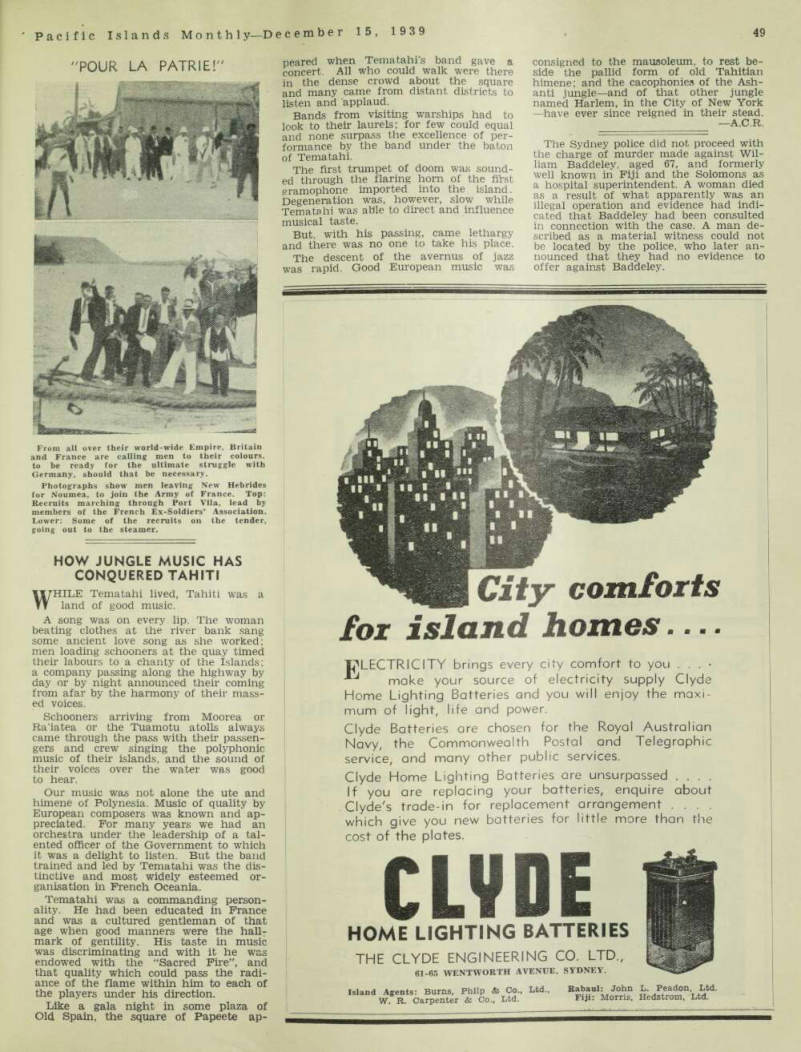

How Jungle Music Has
WHILE Tematahi lived, Tahiti was a land of good music.
A song was on every lip. The woman beating clothes at the river bank sang some ancient love song as she worked; men loading schooners at the quay timed their labours to a chanty of the Islands; a company passing along the highway by day or by night announced their coming from afar by the harmony of their mass ed voices.
Schooners arriving from Moorea or Ra’iatea or the Tuamotu atolls always came through the pass with their passen gers and crew singing the polyphonic music of their islands, and the sound of their voices over the water was good to hear.
Our music was not alone the ute and himene of Polynesia. Music of quality by European composers was known and ap preciated. For many years we had an orchestra under the leadership of a tal ented officer of the Government to which it was a delight to listen. But the band trained and led by Tematahi was the dis tinctive and most widely esteemed or ganisation in French Oceania.
Tematahi was a commanding person ality. He had been educated in France and was a cultured gentleman of that age when good manners were the hall mark of gentility. His taste in music was discriminating and with it he was endowed with the “Sacred Fire”, and that quality which could pass the radi ance of the flame within him to each of the players under his direction.
Like a gala night in some plaza of Old Spain, the square of Papeete ap
peared when Tematahi’s band gave a concert. All who could walk were there in the dense crowd about the square and many came from distant districts to listen and applaud.
Bands from visiting warships had to look to their laurels; for few could equal and none surpass the excellence of per formance by the band under the baton of Tematahi.
The first trumpet of doom was sound ed through the flaring horn of the fiVst gramophone imported into the island.
Degeneration was, however, slow while Tematahi was able to direct and influence musical taste.
But, with his passing, came lethargy and there was no one to take his place.
The descent of the avernus of jazz was rapid. Good European music was
consigned to the mausoleum, to rest be side the pallid form of old Tahitian himene; and the cacophonies of the Ash anti jungle—and of that other jungle named Harlem, in the City of New York —have ever since reigned in their stead.
A.C.R.
The Sydney police did not proceed with the charge of murder made against Wil liam Baddeley, aged 67, and formerly well known in Fiji and the Solomons as a hospital superintendent. A woman died as a result of what apparently was an illegal operation and evidence had indi cated that Baddeley had been consulted in connection with the case. A man de scribed as a material witness could not be located by the police, who later an nounced that they had no evidence to offer against Baddeley.
Sir Brooke Francis, who was at one time Attorney-General in Fiji, arrived in Sydney from England at the end of November. He recently retired after 35 years in the Colonial Service.
Mr. William M. Sutherland, of Suva, collapsed in the street in November and died. He was 71 years of age. Mr. Suth erland, who went to Fiji from New Zea land about 25 years ago, had been living in retirement. Two of his four daughters reside in Suva —Mrs. Inez Bartley and Miss Cynthia Sutherland.
Mr. W. T. Candler, well known Islands travelling representative for a number of Australian commercial firms, returned to Sydney by the “Monterey” at the end of November, after a business visit to Fiji.