Transition Period In Fiji
pp. 46-47 · Read in the full issue
Education
Commendable Effort to Combine New and Old
By E.M.F.
rpHAT the scheme of education for the -■- Fijians, provided by the educational authorities in Fiji, is meeting with the success it deserves was apparent in one instance recently, when a visit to an obscure school, on one of the largest of the Fijian Islands, was made.
Various primary schools, formerly wholly under the control of mission teachers, who were also the village pas tors, are now supplied with properly trained and certified teachers. The Fijian people are gradually being taught to adapt themselves to their changed con ditions, thereby enabling them to absorb, without detriment to themselves, the new order that has come to them.
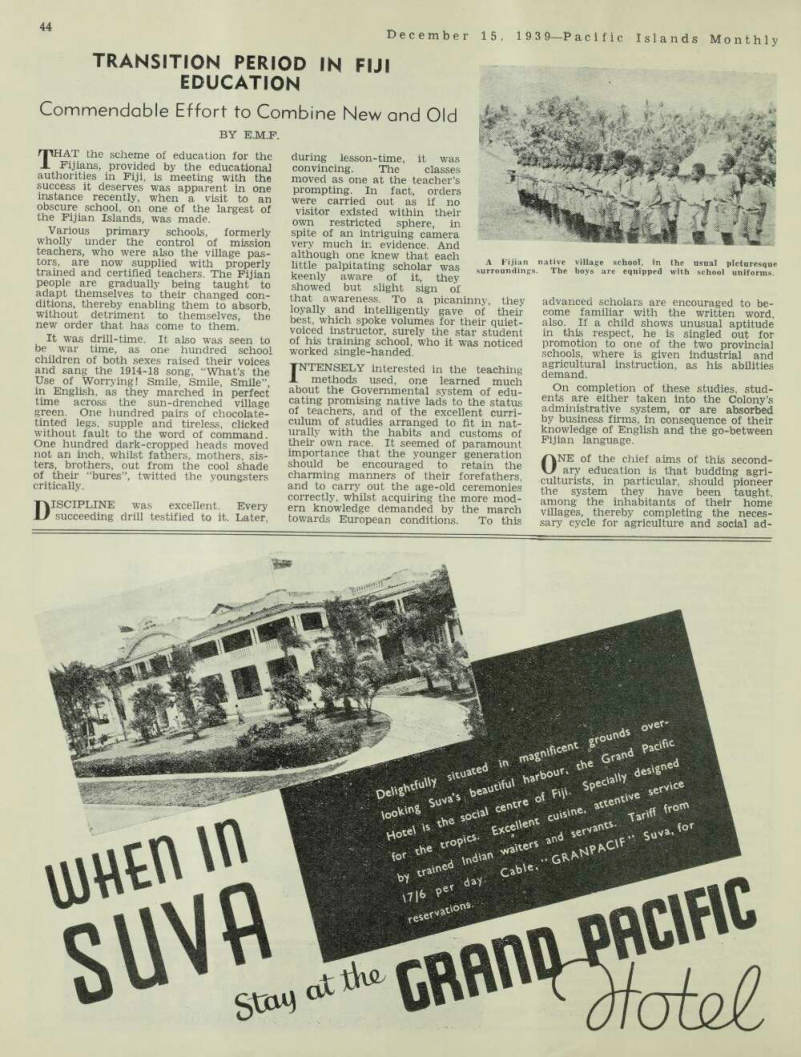
It was drill-time. It also was seen to be war time, as one hundred school children of both sexes raised their voices and sang the 1914-18 song, “What’s the Use of Worrying! Smile, Smile, Smile”, in English, as they marched in perfect time across the sun-drenched village green. One hundred pairs of chocolate tinted legs, supple and tireless, clicked without fault to the word of command.
One hundred dark-cropped heads moved not an inch, whilst fathers, mothers, sis ters, brothers, out from the cool shade of their “bures”, twitted the youngsters critically.
DISCIPLINE was excellent. Every succeeding drill testified to it. Later,
during lesson-time, it was convincing. The classes moved as one at the teacher’s prompting. In fact, orders were carried out as if no visitor existed within their own restricted sphere, in spite of an intriguing camera very much in evidence. And although one knew that each little palpitating scholar was keenly aware of it, they
showed but slight sign of that awareness. To a picaninny, they loyally and intelligently gave of their best, which spoke volumes for their quiet voiced instructor, surely the star student of his training school, who it was noticed worked single-handed.
INTENSELY interested in the teaching methods used, one learned much about the Governmental system of edu cating promising native lads to the status of teachers, and of the excellent curri culum of studies arranged to fit in nat urally with the habits and customs of their own race. It seemed of paramount importance that the younger generation should be encouraged to retain the charming manners of their forefathers, and to carry out the age-old ceremonies correctly, whilst acquiring the more mod ern knowledge demanded by the march towards European conditions. To this
advanced scholars are encouraged to be come familiar with the written word, also. If a child shows unusual aptitude in this respect, he is singled out for promotion to one of the two provincial schools, where is given industrial and agricultural instruction, as his abilities demand.
On completion of these studies, stud ents are either taken into the Colony’s administrative system, or are absorbed by business firms, in consequence of their knowledge of English and the go-between Fijian language.
ONE of the chief aims of this second ary education is that budding agri culturists, in particular, should pioneer the system they have been taught, among the inhabitants of their home villages, thereby completing the neces sary cycle for agriculture and social ad
A Fijian native village school, in the nsual picturesque surroundings. The boys are equipped with school uniforms.
vancement. In this instance, inspection of the school garden was enlightening.
Here, in neat, well-drained plots, were European vegetables growing, while above and beyond, straggling up the hill-sides, were the less intensively cultured na tive foods in abundance. It would seem that our qualified informant had been assistant agricultural officer, at his training school, to some purpose.
Apart from work, sports and games are indulged in. One became rather reminiscent on seeing “twos and threes” being played in such an alien setting.
But the manlier game of football has great appeal for the boys, each fleet footed aspirant hoping, no doubt, to emulate the prowess of members of that victorious Fijian team which recently competed with their Maori cousins in New Zealand. And Maoris are among the world’s best footballers.
School uniform has been provided and, like any other competitive scheme con ducted amongst the Fijians, has met with great appreciation. For the small sum of 5/-, little Israeli or Jakope is solemnly clothed in khaki skirt and pants, the wherewithal having been ob tained from the sale of the prolific coco-
nut, lest shame be upon the paternal head. As girls must now also be edu cated, there is the rather tiresome busi ness of white-collared pinafores for them. But nothing is taken too seri ously by these laughing happy people, except perhaps their native rites and ceremonies—which is as it should be, if they are to remain an individual race.
The dramatic struggle, so creditably car ried out by the early missionaries, and of later years continued in co-operation with the Fijian Government, has already, it will be seen, resulted in a great work being done. Western civilisation may have brought its vices to these simple people, but it also has brought its vir tues and benefits. They are becoming aware of the opportunities at their dis posal to help maintain their identity in the new world, and it is the task of the Government and others in power to help them to save themselves and their ancient domains.
In urging upon native children in Fiji the value of their being members of the British Empire, it might be well to quote
to them the wise counsel of one of their dignified and ageing chiefs, who said: “Education does not consist of copying European manners in the wrong way, or of impudently imitating European cus toms. Native customs and manners are appreciated and respected by the white chiefs and the white people, and if these are observed, and the good, clean habits of the educated Fijian are cultivated, there can be no doubt but that the Fijians will continue to be considered and loved by everyone”.
Rev. Roy McLelland recently relinquish ed the work of superintendent of Ma poon Presbyterian Mission and. accom panied by his wife and two children, re turned to Victoria, where he has taken up parish work again. Mr. McLelland is well known to missionaries in the New Hebrides field.
Miss Myrtle Irene Johnson, daughter of Mr. and Mrs. Thomas Curtin Johnson, of Blakeney, Norfolk, England, was mar ried in Port Moresby on November 11 to Mr, Kenneth Norman Rimington, of Kew, Victoria. The bride was given away by Mr. G. Whittle, and attended by Mrs.
Stach as matron of honour. Mr. A. G.
Creswell was best man. Guests were en tertained afterwards by Mr. and Mrs.
Howard.
Mr. J. B. Macfarlane, founder of the trading firm of J. B. Macfarlane Ltd., Auckland, N.Z., who had many friends in Fiji as a result of his business con nections with the Colony, died in Auck land on November 6, aged 80. He re cently underwent an operation on his eyes, and his health declined rapidly.
One of Mr. Macfarlane’s daughters is the wife of Mr. C. Nott, chief clerk in the Colonial Secretary’s Department, Suva.
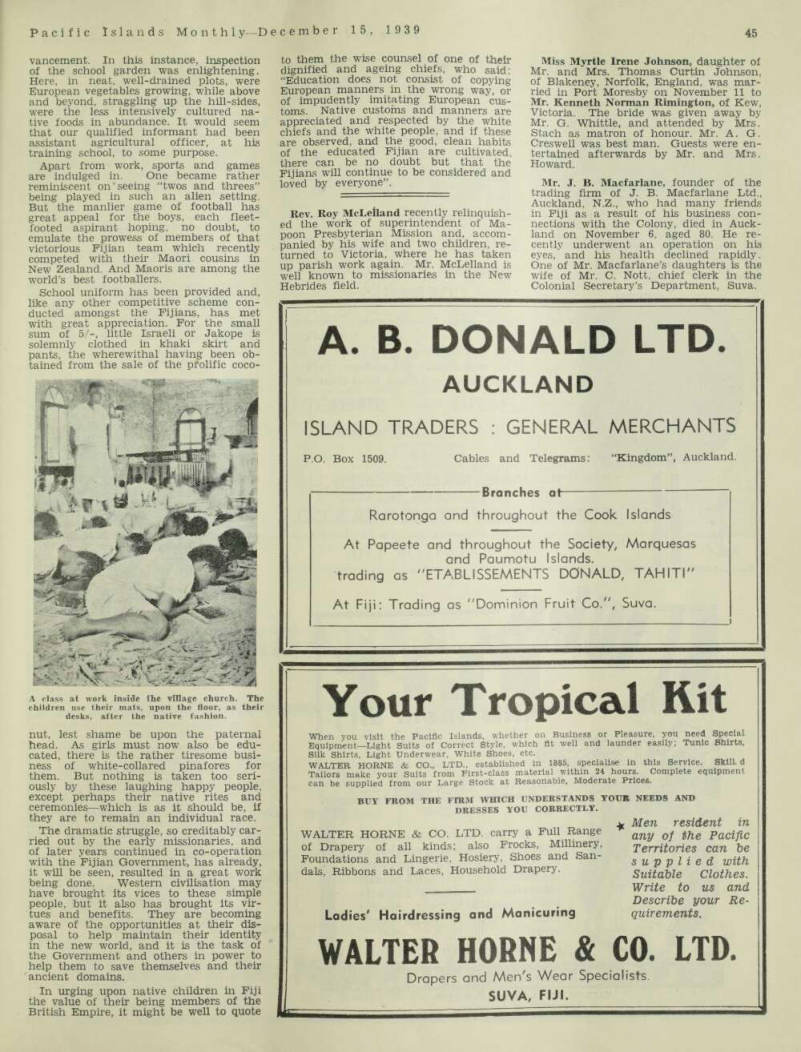
A class at work inside the village church. The children use their mats, upon the floor, as their desks, after the native fashion.