Acquaintance
pp. 41-44 · Read in the full issue
My New Guinea
By Burton W. Collins
I NEVER found out what his name was.
Perhaps I should have. But among the natives he was always known merely as “luluai” (chief). Between ourselves, however, we called each other “friend”.
At least I called him “friend”, and he got as near to it as he could with some thing like “pren”, when addressing me.
But that was only after I had known him for some time. At first, of course, he was naturally very superior and aloof.
Wasn’t he the luluai of Pir? —chief of a village of more than 200 souls? And what was I? An upstart intruder and outsider.
He’d never had much to do with the “Goverman”, anyway. And from all the stories he had heard they were a silly futile race. What could they possibly do with all those hundreds of coconuts they grew and collected? They didn’t even eat them! And then their clothes! Stupid things! During the heat of the day they covered up their bodies as if to keep warm, and, then at night, when it became cool, he’d been told, they took off the covers again. Any native knew a man needed more clothing at night than dur ing the day. Why, sometimes, he himself wore nothing at all, when it was very warm and he was working hard.
Thank goodness, he lived well out of their way, three good days’ journey from the coast, where they went about their senseless ways. He was troubled only once a year, when the “kiap” came to count his people and collect the head tax. That was quite enough.
AND then I arrived on the scene. Late one sultry afternoon I led my line of 20 carriers up the steep rocky trail into his hill-top village. I slept that night in the “house-kiap”—the shelter he had had made for the use of the Govern ment Patrol Officer on his annual visit— and left the next morning.
I didn’t meet him. I don't remember even seeing him. But how intently he must have watched me! How interested he was in all the reports his people brought him—what I was doing, what I was wearing, what I ate, what I said, how I walked along the narrow root-
strewn jungle paths, how I treated my “boys”, how many pipes I smoked, how many coconuts I drank. For I was only the third white man he had ever seen.
Was I as stupid as the others? Did I trip over that pandanas root by the third corner in the track on the way to the river, as the kiap had done, or was I more careful to watch where I was go ing? Did I smoke properly, like a man, or like a piccaninny, as the other ‘‘white master” he had seen had done?
Before I left, though, I had given him presents “Belong luluai’’, I had told the native to whom I gave the knife. It must have reached him. Perhaps the shining steel was the deciding factor that made him my friend.
But I went on again that morning without having met him, I knew he ex isted, of course, because each village has its luluai, and I wanted to leave a good impression, as I knew I should be coming back again later; and it’s just as well to have the chief on one’s side when food has to be bought, or guides or extra carriers obtained. Hence the sixpenny knife.
IT was two months before I was back in Pir. Late in the afternoon I was hav ing a quiet read and rest, after the long day’s walk. My boys, too, were sleep ing in the “house boy”, some distance
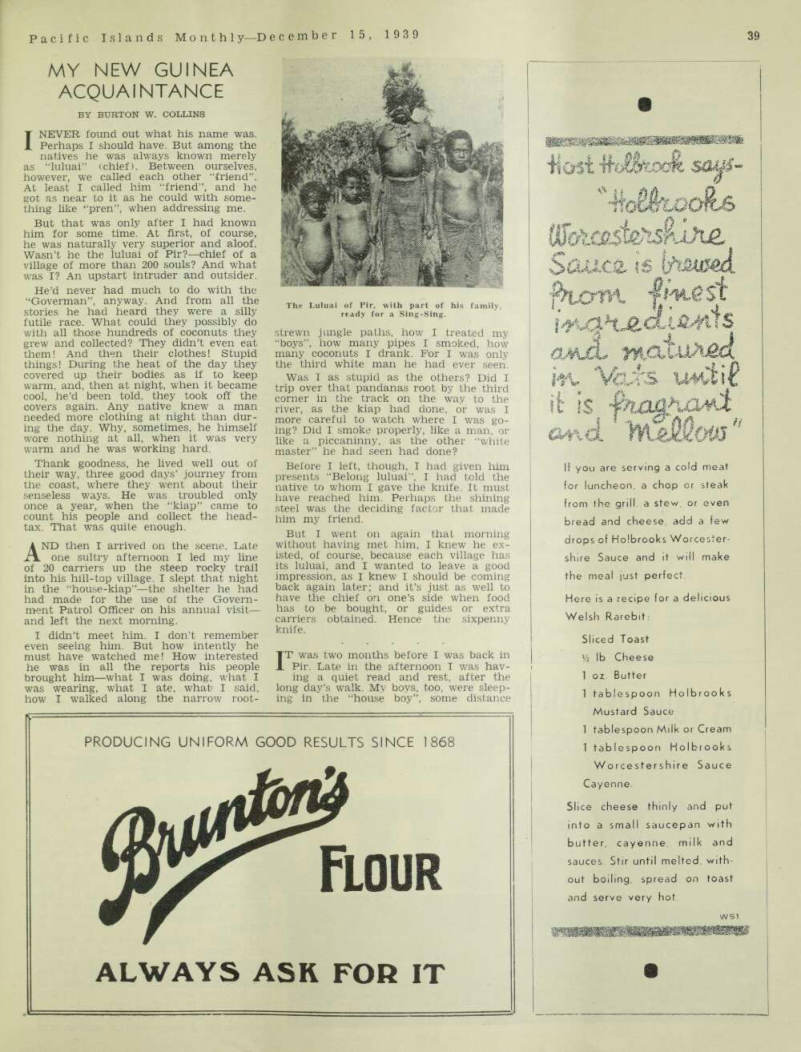
The Luluai of Pir, with part of his family, ready for a Sing-Sing.
away. The village was almost deserted, as the natives had not yet returned from their gardens.
Then, gradually, I became aware of a dark, silent figure squatting on the edge of the verandah, at the top of the wooden ladder leading up from the ground. He was watching me, interestedly; following every movement with piercing black eyes, as I turned the pages, sipped the mug of water at my side, filled my pipe.
About 40 years old, I should say—well past the prime of a native’s life —but still robust and healthy, apparently: skin of chest and limbs sleek and shining, well oiled; wearing besides his many orna ments, only the short work-day “mal” of beaten bark-cloth hung from the waist; he might have been any native from any village within a dozen miles.
And yet, no. There was that nhnnt his bearing, his straight back Ld square shoulders, his grim mouth and shrewd tearless eyes, deep-set for a native— something that proclaimed him a person ln authority.
I had realised this even before I noticed the definite proof at his side There, bright red band somewhat frayed' and blue crown fading lav the official chief’s cap, presented to Y him by tl^ Government in recognition of his status.
Above the peak was a brass number—re corded * n Government archives in Rabaul, hundreds of miles away, with his name an( * the name of his village, He was a “number-man”—the first number-man in his village. Recently on his last trip, the Patrol Officer had given two more “hats”—two more “numbers” -but they weren’t as important as his
His subordinate, the Government-ap pointed interpreter and second-in-com mand, had two narrow red bands in stead of his single broad one. And the “doctor-boy”, who had just come back from six months in the town, learning the white man’s magic with “kinine” and “idine”, -had a bright red cross on a white band. But he knew theirs were quite inferior numbers compared with his. And despite his confirmed contempt for the “Goverman”, and white ways in general, he had a sneaking pride in his position, and the honour accorded him by the white man. 11THEN he saw me looking at him, he TT reached for the cap and slowly and solemnly put it on his head, back to front at first, then, noticing something amiss, the right way round. Folding his arms, he waited. Evidently my turn next, I thought.
“Me savvy finish long you”, I said. “You luluai.”
He nodded gravely, the cap nearly fall ing off. “Luluai”, he repeated.
“You like-im what-name something?”
I asked.
No reply. As I had suspected, he had never learned Pidgin. That was all right for the youngsters who wanted to go and work for the white man, and bring back shining silver “marks” for the “takis”.
But why should he bother his head over the language of the white skin? Besides, his “tul-tul”, with the two red bands on his cap—hadn’t he just been appointed partly on account of his command of Pidgin? Let him make all the necessary dealings with the white skins. After all, he (the luluai) always gave the orders— and that was the main thing.
As I waited for his reply he pointed to his upper left arm. Thrust in an armlet of plaited fibre, near the shoulder, was the knife I had given him two months ago. I smiled; and he, too, unbending a little showed two rows of red, betel-nut stained teeth.
Life was stirring again in the village below. He rose, picked up his cap and fire-stick (inseparable companion of all adult natives), and descended the ladder.
I took out a cigarette and tossed it to him as he turned at the foot.
“Belong luluai”, I said.
“Luluai”, he repeated proudly, stopping to light it on the smouldering stick in his hand, took a few appreciative puffs, and walked slowly away.
That was all I saw of him on that visit. But T left another present before I departed next morning—this time a nine penny trade pipe and a twist of dark tobacco.
MY third and last visit was nearly six months later. I stayed three days, working in the neighbourhood.
The chief and I saw a good deal of each other. I taught him the word “friend”, which, on being explained to him by an interpreter, became very popular with him. He used to follow me round most of the day, counting it, I be lieve, a great privilege to be allowed to carry my geological hammer and bag of specimens.
My work, though, must have been a great mystery to him; indeed, to all his people—although it was explained that I was looking for the white water-like fluid that burnt with a yellow flame in my kerosene lamp. Petroleum, of course, would mean nothing to him.
The last night he arranged a dance and feast—a “sing sing”—in my honour, and
out of politeness I had to stay up until the small hours of the morning, watching their monotonous movements round and round the village totem pole.
Then, last of all, as I was leaving the next morning, the chief, with his two subordinate number-men, and the elders of the village, way-laid me. The tul-tul explained that the luluai wished to make me one of his official friends, and initiate me into his inner circle —a very select group, I was given to understand. I was about to receive a high honour, unique among white men, he said.
How was it done, I inquired.
The doctor-boy then produced two of the long leaves of a reed-like plant known in Pidgin as “tangget”.
“Two feller fasim tangget long ’and”, he explained. “Behind two feller talk talk alia same: You friend belong me be long all time Me no can cross long you.
Me no can gammon more long you”.
Which, I discovered before long, meant that we each tied the tangget leaf round the other’s wrist, forming a special knot and, clasping hands, repeated (I in Pidgin, he in his own tongue): “You are my friend for ever. I will never quarrel with you. I will never again tell you a lie or treat you unfairly,”
Then, in deference to English custom, we shook hands.
Finally, came an exchange of presents.
I gave him a box of matches, and he— it must have been a real sacrifice, too — took the finely-carved shell ornament from the septum of his nose and gravely handed it to me.
I turned to go, down the steep side of the ridge.
‘‘Woa. pren!” he said.
“Friend”, I answered.
And as I turned at the corner in the track, before disappearing with my line 9 f carriers into the darkness of the jungle, I saw him raise an arm and wave his red-banded cap.
“Woa, pren!” he shouted.