Jack Hides's Last And Greatest
pp. 36-38 · Read in the full issue
Adventure
Story of How His Expedition Escaped from the Kubea
TWO men well known in New Guinea, Jack Hides and David. Lyall, left Port Moresby in February, 1937, to lead a gold-seeking expedition up the Strick land River, and on into the unknown country beyond.
In March and April, 1937, they report ed a vast dredging area on the Upper Strickland: and. coming into Port Mores by by aeroplane, they secured mining rights over the area. (It subse quently was found to be quite value less). In late May, 1937, they went on up the Strickland by canoe; marched north over the limestone barrier during the “North-west” (rainy season); and in mid-August, when the rain and mist mo mentarily cleared, they found themselves on the edge of a vast precipice, 4,000 ft. high (obviously, the northern wall of the limestone barrier), and looking out over a vast system of upland valleys, well populated. They were now across the “backbone” of New Guinea, and in the Mandated Territory.
But Lyall had become seriously ill, up there on the terrible limestone, and they were carrying him. Hides, somehow, got his forty natives and his helpless com panion down that precipice, into the nearest valley, and then, using his tele
radio set, he urgently asked that an aero plane be sent to their assistance. The teleradio set had received a bad bumping on the limestone and their last valve collapsed before final arrangements were made.
They waited a week: but as there was no sign of an aeroplane, the now desper ate Hides decided to abandon all stores, except barest necessities, and made a dash southwards with Lyall, in an effort to reach Daru, on the Gulf of Papua, 600 miles away.
They could not face the limestone bar rier (the “Kubea”) again—their desper ate plight is shown in the fact that they decided to attempt a passage through the Juha Gorge, an awful, mile-deep chasm cut through the limestone by the Strick land (or Juha) River on its way from the Mandated Territory southwards into Papua. They crawled painfully along the precipitous sides of the gorge, cutting every foot of their way through dense jungle growth. It was slow, but they were getting there—when the whole party sud denly was stricken with a bad form of beri-beri. For some weeks, while cross ing the Kubea northwards, they had been living on polished rice and canned meat, and they paid the penalty. They had ad vanced for five days into the gorge, aver aging two miles per day; but now four men were dead and 22 were very sick — there were only 12 natives, and the two outstanding Papuans, Pakai and Bije, well enough to be of any use.
THERE they were, clinging to the side of the gorge, cut off from even na tive help by scores of miles of impassible country, being rapidly overwhelmed by disease, reduced to the barest minimum of food. Lyall by now paralysed and al most blind, Hides himself sick and weak ening—can anyone imagine a more des perate situation!
It seemed that they were hopelessly trapped—there was no way out. Yet Hides, always at his superb best in a tight cor ner like this, solved the problem and. literally within a few hours, got his party, without any further loss of life, down onto the Strickland, and thence onto the Lower Fly.
They left that fatal spot in the Juha Gorge on September 1; on September 15, after escaping by a miracle from a dis aster on the Lower Fly; Hides carried his companion, who by now was blind and paralysed and quite helpless, into the surgery of Dr. Vernon, at Daru. But it was too late. Lyall died next day. rriHE story of this incredible adventure X —all the more dramatic because of the quiet simplicity of the author’s lan
guage—is told in detail in “Beyond the Kubea”, by Jack Hides, just published by Angus and Robertson Ltd., at 6/-.
I knew the men, and all the circum stances of this expedition—l went spec ially to Port Moresby to meet Hides and Lyall, when they came in from the Strickland by aeroplane in April, 1937 and I still marvel at this last and great est exploit of Jack Hides. As I re-read this account of their escape from the Juha Gorge, and from the tidal bore on the Fly (I heard it first from Hides himself) I am inclined to describe it as the greatest adventure story that ever came out of New Guinea. To the best of my belief and knowledge (and I know
a great deal about this expedition that has not been published) there is no ex aggeration in this book. The.story is in credible —yet it is true.
I know Hides’s books well —I helped him to write his first, and found a publisher for him. This, the fourth, and his last, is incomparably his best. It grips the reader, from cover to cover, and should rank as an Australian best-seller. It is an inspiration for all young Australians.
Jack, between 1934 and 1938, learned how to write, and to write well. This success only serves to emphasise the tragedy of his untimely death, in June, 1938. Readers of ‘‘Beyond the Kubea” should remember, when the author makes occasional references to his own suffer ings and starvation, he really is describ ing his own death-warrant. He was suf fering from beriberi when he made his supreme physical effort to save Lyall; and those who knew him in his last months knew that he had never recover ed from that body-rending and heart breaking experience.
Why A Plane Was Not Sent
IN fairness to the Sydney company which financed his expedition, I must refer to one section of the book, and supply an explanation.
In August, 1937, Hides had emerged from the limestone, with a helpless and
very sick Lyall on his hands, and he radio’d urgently for assistance by aero plane. For several days, he says, he and Lyall waited, and listened for an aero plane engine.
His friends, in Sydney, got the mess age, and acted quickly. But they did not know how best to proceed they had no idea of Hides’s position, or whether an aeroplane could land. They consulted me. I got together the available maps showing that unexplored region, and we tried to guess the approximate position of the expedition. We assumed that it was somewhere across the border in the unexplored centre of New Guinea. The nearest landing-ground was at Mount Hagen, anything from 200 to 300 miles north-east of Hides’s probable position.
Only the best aeroplane—which would have had to have been sent to Mount Hagen from Lae, hundreds of miles away, with adequate fuel supplies—could have been used. It might have to search over a very wide area of unknown country.
Such a charter was not easily arrang ed.
So we radio’d to Hides to send his approximate position: and the possibil ity of landing: and we indicated the difficulty of quickly getting a suitable plane. We waited for the answer—and
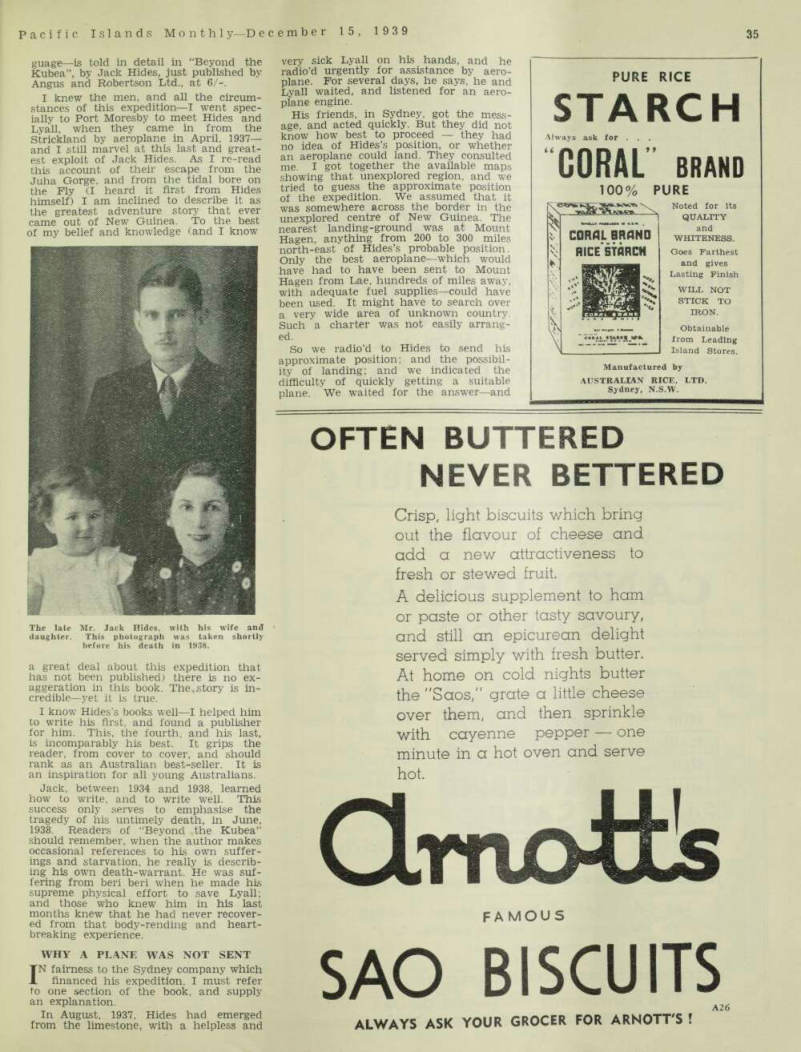
The late Mr. Jack Hides, with his wife and daughter. This photograph was taken shortly before his death in 1938.
it never came. There was not another word from the expedition, until Hides and Lyall turned up, in extremis, on the Lower Fly.
We guessed—and, we now know, we were right—that the teleradio had failed.
It was most unfortunate. If that last valve had remained in action only an other 24 hours, we would have had in formation on which we could have acted.
As it was, we were not clear about Lyall’s
condition; and in anv case wp bnd onlv the vaguest idea of their potion* We understood, for instance, that they were short of food; actually, at that time, they had abundant supplies. They lacked onlv fresh food.
Hides sent urgent messages to medical men in New Guinea, “nd to Guinea Air ways, which gave an idea nf hi* but that inflrmatlon was notavailable to his company in Sydney
Hides writes of their last days on the Ply, when all hope seemed gone: “I wondered with bitterness why that plane had not come, why a vessel had not been sent to meet us (on the Fly). I remem bered every word of those last radio mes sages, and I re-read them again and again. Surely someone must know we were in trouble”.
Hides learned, when he returned to Sydney, that his friends knew that he was in trouble, and were very anxious about him, but they could do nothing, because they did not know where to look for him. For that reason, I think that this last section of his book must have been written, from his notes, after he died.—R. W. ROBSON.