Stone Bowl In
pp. 27-29 · Read in the full issue
Madrid
History of Ancient Artifact of Polynesia
By A. C. Rowland
OF the examples of Polynesian art and craftsmanship which have come under European obversation. the most interesting, perhaps, is the stone bowl of the Marae Taputapuatea. presented by Pomare 1., of Tahiti, to the interpreter.
Maximo Rodriguez, in the year 1775. and by him transported to Lima, Peru; whence it was taken to Spain and even tually lodged in the Museo Arqueologico Nacional, at Madrid.
The third volume of that scholarly work. “The Quest and Occupation of Ta-
hiti by Emissaries of Spain in 1772-76”, by Doctor Bolton Glanvill Corney, and published by the Hakluyt Society, con tains in its introduction, from the pen of Doctor Corney, the known history of this remarkable piece of native work manship.
“The stone bowl, or charger, that Maximo Rodriguez acquired from Tu and delivered to the Viceroy Amat at Lima is a very remarkable object.
“It is beautifully sculptured from a block of hard, fine grained, black doler ite, derived, as the diarist (Rodriguez) tells us, from the island called Maurua.
“This stone is j;he kind employed by the people of the Society Islands for their penu (food mashers, or pestles); and in past times they fashioned their axe-heads and adze-blades out of the same material, from the same source, where, as I am assured, a dyke or sill of it exists and has been quarried by successive generations of natives from time immemorial.
“When‘we consider that, so far as is recorded or known, the sculptors of Mau rua were without metal tools of any kind and probably used only chisels of obsidian and rasps of other igneous rock, the labour and skill displayed in carving this material cannot fail to ex cite our wonder and admiration, as it did that of the Tahitians.
“Any object carved in Maurua was first carried to Pora Pora, whose prin cipal aril were sovereign lords of the lesser island, and naturally had the right of disposal over all such valuables.
“The particular aril who flourished there in Maximo’s time was the notorious Puni.
“It was doubtless by the courtesy of this personage that the stone bowl . . . was sent over as a handsome present, on account of its singular workmanship, to
the aril Tu, who was Puni’s principal co-ruler and social rival, or superior.
“The colour of the stone of which this bowl is carved is a dark slatey grey, al most black. Its dimensions are: Length, 3ft. 10in.: greatest breadth, Ift. KHin : height, feet included, llin.; greatest depth of the cavity, 4in.; greatest thickness of floor, Sin.
“It is oval in form, somewhat elon gated, broadly rounded at one end and tapering gracefully from the widest part towards the opposite extremity, which terminates in a shallow lip.
“The secret of the design is found in the fact that (leaving the feet or legs out of question) it is a copy of the cala bash. or bottle-gourd. The pericarp of these gourds, dried and bisected length wise. is in general domestic use among the natives as food bowls, etc.; and mod els of them carved in wood, mostly of larger size than the gourds themselves.
are also employed. They are known as umete, and this term (which is of wide distribution among Maori races) is equal ly applicable to the stone bowl of Marae Taputapuatea.
“The uses to which Maximo’s bowl was applied in ancient times have not been clearly revealed; nor is it known whether, in the making, it was designed for any single or definite purpose, domestic or sacred, or no. But it was undoubtedly considered by the Raiateans to be a very remarkable and choice object and, like the seat carved of the same material that Maximo saw at Vaiari, had been
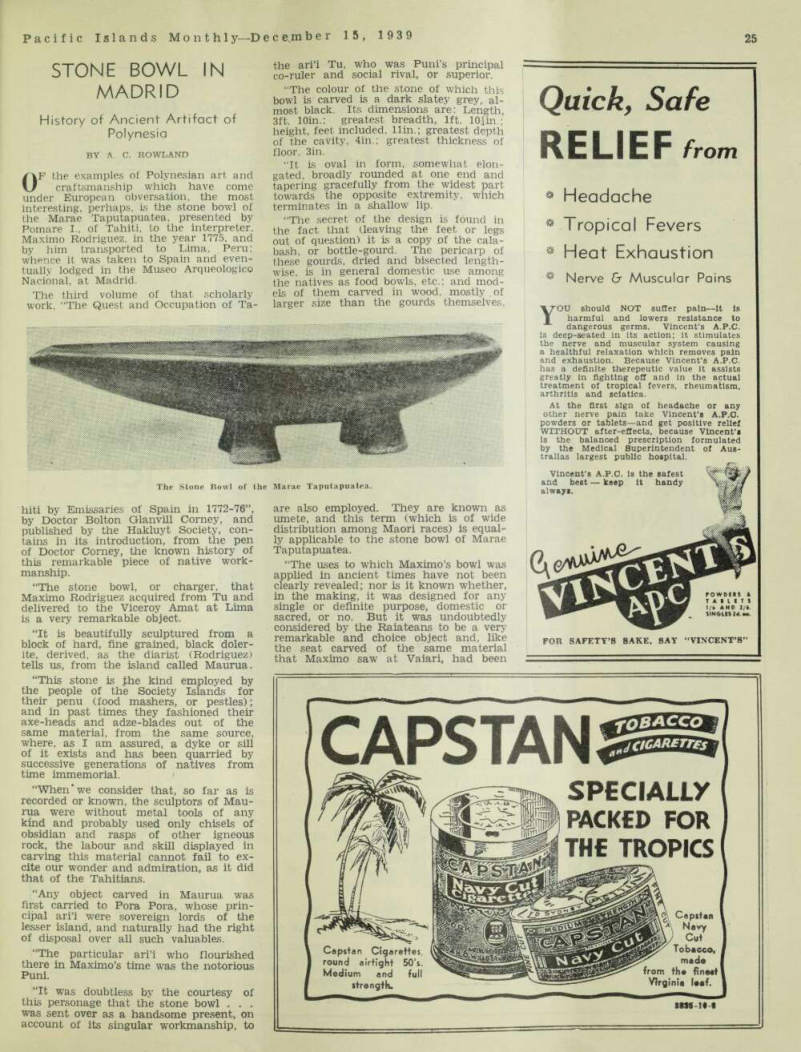
The Stone Bowl of the Marae Taputapualea.
sent across by the chiefs of the island to their royal cousins at Tahiti as a graceful compliment to their rank.
“The late F. Debell Bennett, F.R.C.S., a capable observer who saw a good deal of native life in Tahiti and Ra’iatea in the course of his whaling cruises, chiefly during 1834, noticed that hot stones were put in medicine bowls for heating the water when warm infusions were desir ed. This idea has a bearing upon the opinions of the principal living elders of these islands and Pora Pora, who, on hearing of Maximo’s bowl described, de clared that it was an ‘umete raau mo’a’ —a sacred medicine bowl, in which her bal potions used to be mixed and consecrated in the Marae; a procedure which was deemed to impart special curative efficacy to them.
“It is further possible that it may have served as an ava bowl for strictly cere monial use in the Marae on great occa sions.
“My friend, Mr. J. Lyle Young, whose long experience in the islands and study of their archaeology and folk-lore en title his opinion to particular weight, does not find this view acceptable: and quotes a legend he heard related many years ago, representing that —‘at a Marae in Huahine a large bowl was used to re ceive the viscera of victims who were laid on the altar stone of the Marae’.
“It is well known that the tahu’a in those islands were accustomed to look for augury by inspection of the freshly removed entrails of sacrificed victims, generally pigs. But whether this practice ever extended to the viscera of human victims does not seem to be on record.
“Many other points relating to this singular object are open to discussion, sculptured as it was by a primitive peo ple who, insofar as Europeans have ever been able to discover, possessed no metal tools of their own, and certainly had no knowledge of tempering any iron or bronze instruments that may conceivably have come in their way from some an cient wreck.
“But it must suffice, in this place, to add that the bowl of Marae Taputapuatea remains safely housed in Salon 111. of the ethnological section of the Museo Arqueological Nacional, at Madrid, where, in 1912. I had the good fortune to find and identify it as exhibit No. 2664, though all knowledge of its history and its coun try of origin had been lost for a hundred years or longer”.