Difficult Relationship Between Americans
pp. 18-21 · Read in the full issue
and Japanese in Hawaii "Incidents" During October Visit of Warships Disclose Unpleasant Temper
By John Williams. Of Honolulu
(Being No. 7 of Series of Articles Describing Japan’s Plans and Politico-Economic Network in Pacific)
(There have been such astonishing developments, not wholly unexpected, in the stubborn digging-in of alien and U.S. born Japanese in Hawaii, that this instalment of the series, dealing with Japanese “peaceful penetration” of Ihe c'haracter’) “ Va ' Uable inSiBb ‘ n character.)
Honolulu, Nov. 1.
PREVIOUS instalments of this series have told in detail how the Japanese machine of 150,000 Japanese works in the Hawaiian Islands for the glorification of the Imperial Japanese dream. The last instalment ended by describing how the Japanese had been officially warned by the US. customs service to desist from usmg Japanese warships for lifting donation cargoes of scrap metals, comfort
bags, etc., for Japanese soldiers in the field, rice, flour, clothing and other con tributions from the Japanese in Hawaii to the Japanese war machine in Asia.
For more than two years Japanese warships (see previous instalments) have been making regular calls at Hawaii and doing this. The U.S. customs service in August held an undercover round-up of what was going on and, as a result, the Japanese were warned about using war ships, which receive the courtesies of U.S. ports, as common carriers.
On October 18, the Japanese navy warships, “Iwate” and “Yakumo”, and the naval auxiliary “Shiretoko”, arrived m Honolulu with 350 cadets, for a six days’ stay. Before they arrived, Tajaichi Sakai, an executive secretary of the Jap anese consulate in Hawaii, was told in plain language what America considers as courtesy-of-the-port behaviour, and that such courtesy would be withdrawn if the warships persisted in lifting dona tion cargoes.
It was pointed out to Sakai that such cargoes should be exported on regular commercial ships and duly manifested, according to U.S. laws.
Sakai explained the American attitude to a gathering of potent “inner” Japan ese in Honolulu, but, instead of respect ing the U.S. laws and wishes, this is what happened: First of all, the Japanese consulate objected to the piers on the Honolulu waterfront which had been assigned to the three navy ships, due October 18.
Honolulu harbour officials, under pres sure from organised Japanese business interests, gave in and changed the piers.
As soon as the warships docked, four heavy trucks rolled on to the pier, load ed with groceries and other supplies “shaken” from local Japanese markets, as contributions for use by the war ships. This saves the Japanese navy spending money in this U.S. port, which throws open its gates.
Of course, as usual, there were organ ised inspections of the warships by con ducted classes from the Japanese language schools. (With very few excep tions. all U.S.-born Japanese children attend Japanese language schools daily when the American schools are out. The teachers are alien-born Japanese, and, if not, all have spent some years in Japan, embracing the correct Japanese spirit.) U.S. agents noted that when these child ren boarded the warships, each child was given a Japanese flag which each proudly carried ashore, up through the American streets, back to school. The flags were heaped for distribution upon each warship’s deck—and alongside each heap was a contribution bowl. As each child took a flag, each child dropped in a coin.
Mr. Sakai, the Japanese consulate go between, was once more summoned and, in his presence, the warship officers were informed that if the contributions for the flags continued, the U.S. Government
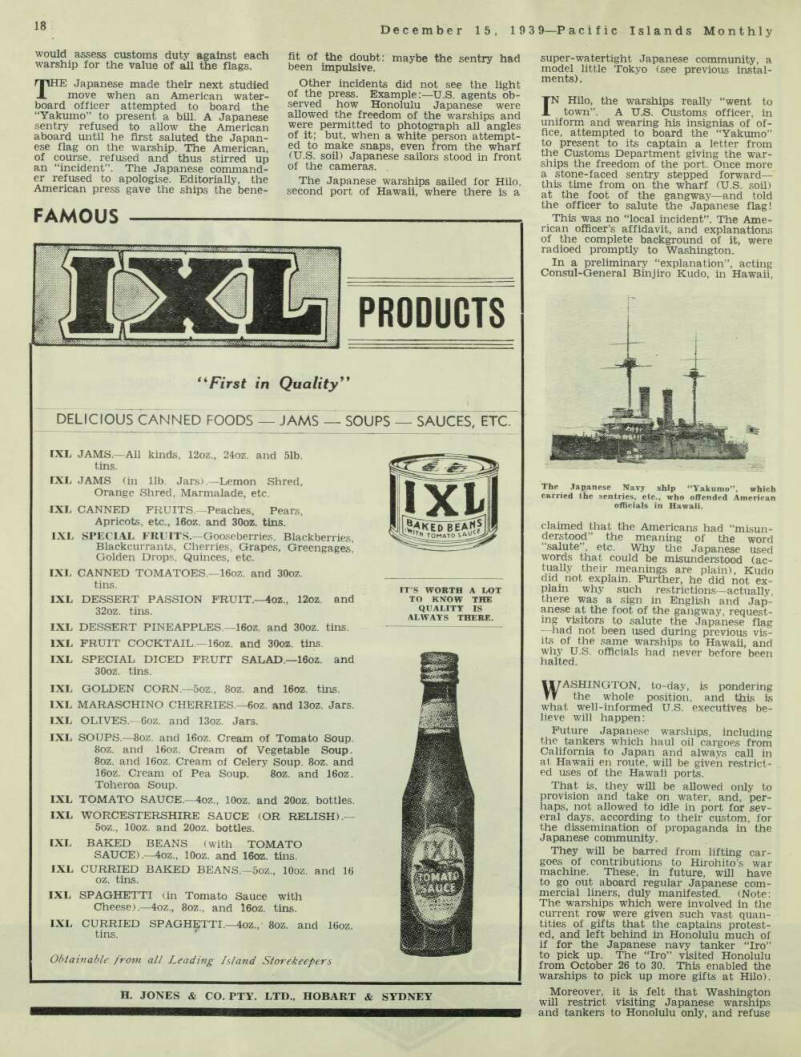
would assess customs duty against each warship for the value of all the flags. rriHE Japanese made their next studied X move when an American water board officer attempted to board the “Yakumo” to present a bill. A Japanese sentry refused to allow the American aboard until he first saluted the Japan ese flag on the warship. The American, of course, refused and thus stirred up an “incident”. The Japanese command er refused to apologise. Editorially, the American press gave the ships the bene
fit of the doubt: maybe the sentry had been impulsive.
Other incidents did not see the light of the press. Example:—U.S. agents ob served how Honolulu Japanese were allowed the freedom of the warships and were permitted to photograph all angles of it; but, when a white person attempt ed to make snaps, even from the wharf (U.S. soil) Japanese sailors stood in front of the cameras.
The Japanese warships sailed for Hilo, second port of Hawaii, where there is a
super-watertight Japanese community, a model little Tokyo (see previous instal ments).
IN Hilo, the warships really “went to town”. A U.S. Customs officer, in uniform and wearing his insignias of of fice, attempted to board the “Yakumo” to present to its captain a letter from the Customs Department giving the war ships the freedom of the port. Once more a stone-faced sentry stepped forward — this time from on the wharf (U.S. soil) at the foot of the gangway—and told the officer to salute the Japanese flag!
This was no “local incident”. The Ame rican officer’s affidavit, and explanations of the complete background of it, were radioed promptly to Washington.
In a preliminary “explanation”, acting Consul-General Binjiro Kudo, in Hawaii,
claimed that the Americans had “misun derstood” the meaning of the word “salute”, etc. Why the Japanese used words that could be misunderstood (ac tually their meanings are plain), Kudo did not explain. Further, he did not ex plain why such restrictions—actually, there was a sign in English and Jap anese at the foot of the gangway, request ing visitors to salute the Japanese flag —had not been used during previous vis its of the same warships to Hawaii, and why U.S. officials had never before been halted.
WASHINGTON, to-day, is pondering the whole position, and this Is what well-informed U.S. executives be lieve will happen: Future Japanese warships, including the tankers which haul oil cargoes from California to Japan and always call in at Hawaii en route, will be given restrict ed uses of the Hawaii ports.
That is, they will be allowed only to provision and take on water, and, per haps, not allowed to idle in port for sev eral days, according to their custom, for the dissemination of propaganda in the Japanese community.
They will be barred from lifting car goes of contributions to Hirohito's war machine. These, in future, will have to go out aboard regular Japanese com mercial liners, duly manifested. (Note: The warships which were involved in the current row were given such vast quan tities of gifts that the captains protest ed, and left behind in Honolulu much of if for the Japanese navy tanker “Iro” to pick up. The “Iro” visited Honolulu from October 26 to 30. This enabled the warships to pick up more gifts at Hilo).
Moreover, it is felt that Washington will restrict visiting Japanese warships and tankers to Honolulu only, and refuse
The Japanese Navy ship “Yakumo”, which carried the sentries, etc., who offended American officials in Hawaii.
them the use of other Hawaii ports. This will keep the antagonistic Nipponese un der the proper observation by army, navy, coast-guard and Customs intelligence ex perts. rE Japanese in Hawaii have been handled with kid gloves by those American commercial interests —the sugar and pineapple companies and their sub sidiary retail monopolies—which intro duced the Japanese coolie labour to the Islands more than 50 years ago. To-day. the 150,000 Japanese in Hawaii are a fine market for exploitation by these in terests.
However, the freedom which the poli tical pawns of these interests give the Japanese in Hawaii offends the U.S.
Federal officers who, for a change, want proper respect for the laws of the land.
They anticipate that Washington now will give the okay for a crackdown and,
generally tighten enforcement of the laws.
This will be another dent in Hirohito’s ambitions.
WHAT has happened and will happen in Hawaii with the Japanese prob lem must someday be faced by Austra lian and New Zealand Governments re sponsible for the welfare of outlying Paci fic Territories. Hawaii is a fine example of what actually happens when the Jap anese are given access to a gullible country.
Kodo —or the Imperial way of Japan is a passionate, religion with Hirohito’s subjects, even with alien born. With almost fanatical stubbornness they are pressing ahead with their devotion.
It starts from minor items in Hawaii such as Japanese housemaids and wait resses collecting the tin foil from discard ed cigarette packages—to the presenta-
tion of warplanes and trucks from the Japanese community as a whole. The loy alist Japanese in Hawaii, too, contribute so much each month in cash (starting at one shilling each) to the Japanese war plan. They are pledged to it for the duration. (NEXT MONTH: The remarkable story of a Japanese sailor who dared to desert from a Japanese warship in American waters. Why he deserted, and other dra matic details according to his sworn state ments to U.S. officials. His statement gives an insight into the brutality of the Japanese navy machine —behind the scenes.) The Maharajah of Tripura, Sir Vir Vikram Kishore Deo, K.C.5.1., passed through Suva recently, and met several representative Indians. His Highness, who was born in 1908, and succeeded to his title in 1923, was accompanied by his sister, the Yuvarani Saheb, of Baria. They both expressed great interest in the In dians settled in Fiji, and the educational facilities provided for them.
A Japanese sampan off the port of Honolulu, flying the U.S. flag and 8 Japanese flags. This is how Hawaii Japanese welcome their visiting warships.
The Japanese Navy tanker “Iro”, loaded “to the gills’’ with American oil, going astern from wharf in Honolulu. In the background Is a U.S. battle cruiser.