Missionary Autocrat Of Raiatea
pp. 44-46 · Read in the full issue
Centenary of the Death of John Williams
By Eric Ramsden
r[E centenary of the death of Rev.
John Williams, prophet of religion and ambassador of trade in the Pacific, falls this month. On November 20, 1839, Williams was killed at Erro manga, in the New Hebrides. His skull, and a few bones, were recovered by H.M.S. “Favourite”, and later buried, with military honours, in Samoa, “He was ultimately to wear a martyr’s crown”, an ironical American authority has written concerning the converted ironmonger, “but not before he had car ried the gospel of industry, trade, and Jehovah to thousands of islanders and
had thoroughly identified business and religion in Polynesia.”
Following the death of Rev. Samuel Marsden (with whom he was on exceed ingly friendly terms) Williams was un doubtedly the most dominating mis sionary figure in what w r as essentially a missionary age. But, as the years have passed, and while one cannot deny his ability, his extraordinary driving force, and his great gifts, Williams’ aura has dimmed somewhat. It is time that we had him in correct perspective, making every allowance, of course, for his en vironment and the time in which he lived. All men of such fanatical faith have their limitations.
WILLIAMS was the first great propa gandist for missions in the South Seas. His “Missionary Enterprises” will always be a Pacific classic. Though important, it does not possess the value, to-day, of Ellis’ “Polynesian Researches”.
Though these men shared a common faith, Williams saw the field ripe with corn, ready for the reaping; he wanted to convert islands overnight, and on many occasions he did so. We know now, of course, that he merely scratched the surface. The Polynesians were more in terested in his trade goods than in a new brand of religion. Williams saw little or any good in the religious cul ture of the Polynesians.
Ellis, on the other hand, was a man of wider intellectual interests. He recorded what he saw of the old life that so rapidly was passing. While he, too, re joiced in the destruction of the ancient gods, and other material representations of the dying culture, he was by no means so sweeping in his denunciation.
Williams’ book sold in thousands. It was read with avidity by a mission conscious British public, which was pre pared to pour its gold into mission coffers. Edition after edition was printed.
Williams personified romance in the South Seas—the great missionary leader carrying all before him. And, if it so happened that he introduced British goods to many a remote atoll, and there by obtained a return for that same British interest, it detracted not at that time from his evangelical fervour.
To-day, we realise that missionaries have their place in the scheme of things —that, inevitably, they have been the buffer between primitive peoples and vested commercial interests. We know, too, that generally speaking they are trained and skilful men imbued by the highest ideals.
YK7~IT.iTJAMS was a pioneer. The urge to ?? convert was insufficient for his great energies; his desire was to set the indolent Polynesians working.
The former ironmonger’s assistant, now T the uncrowned King of Raiatea, of Raro tonga, whose influence extended even to Samoa, ancj whose ambition was limit less, wanted to impose the yoke of com mercial Birmingham upon his subjects.
Again and again he exhorted them to provide more arrowroot, more bamboos of coconut oil. He had schemes for sugar mills and coffee plantations. Williams’ reports are full of such references. He was also a builder. Bigger, and still more commodious chapels had to be built. In his way he was as great, in that connec tion, as Laval at Mangareva, The only
difference was that the French priest used more durable materials.
Little wonder that there were rebel lions against Williams, plots against his life. On returning to Raiatea (where his authority had been unquestioned, where no native was even permitted the age old custom of tattooing) he wrote: ”1 was perfectly astounded at beholding the scenes of drunkenness which prevailed in mv formerly flourishing station. There were scarcely a hundred people who had not disgraced themselves, and persons who had made a consistent profession of religion for years had been drawn into the vortex!”
BUT, perhaps, the greatest disservice that Williams did to Polynesia— and he performed it with the best of intentions—was the sweeping des truction of the gods. With joy, he watched them burning. He encouraged the natives to cook food with these ancient relics. To the mainmast of his little schooner he hung them, as he sailed from island to island, exhibiting the triumph of his faith by such sym bolic manifestations.
True, he saved a number, and sent them as trophies of the chase to mission museums in England. But Williams de stroyed far more than he preserved. For those that have survived we are grate ful. Most of them have been examined and described within recent years by Pro fessor Peter H. Buck, of the Bishop Museum, Hawaii.
Such, indeed, was the teaching of Williams and his colleagues in Tahiti that Pomare II begged that his idols should be burned as fuel for food—no greater degradation could possibly be
imagined in Polynesian eyes—rather than that they should be sent to England to “expose his folly”! To the Cook Islanders, naturally enough, Williams preached upon the folly of idolatry, emphasising the importance of the words; “With part thereof he roasteth roast, and is satis fied: and the residue thereof he maketh a god, and worshipped it, and prayeth
unto it, and saith, Deliver me, for thou art my God.”
“Nothing could be better calculated to make an impression on the mind of an intelligent South Sea Islander than those inimitable verses of inspired truth”, he wrote. “Indeed, the effect is likely to be far greater than that produced on the mind of an English reader.”
MOST works of reference give Williams the credit for having discovered Rarotonga. Undoubtedly, he believed it himself. But an account of Good enough’s stay was published in “The Sydney Gazette” before Williams ever set foot there. It is difficult to believe that Williams had no knowledge of it (especi ally as it is known that he was a sub scriber to that journal). Even before Goodenough’s visit to the island, the “Bounty” mutineers had called there, and in all probability there were others.
But, perhaps, the worst side of Williams’ work was the intolerant rule he established at Raiatea. Much blood was spilt there before he re-established his autocracy. One writer has described the island in 1831 as “a powder keg waiting for a spark”. Tyerman and Ben net, who visited Raiatea in 1822, saw nothing incongruous in “two pits, fifteen feet deep, each the width of a common drawing well at the top widening down wards”, which had been dug as dungeons to hold “two refractory and profligate persons till they should be brought to re pentance.”
The sin with which these offenders, a man and a woman, had been charged, was tattooing. After two days, the woman was so terrified by incarceration in the
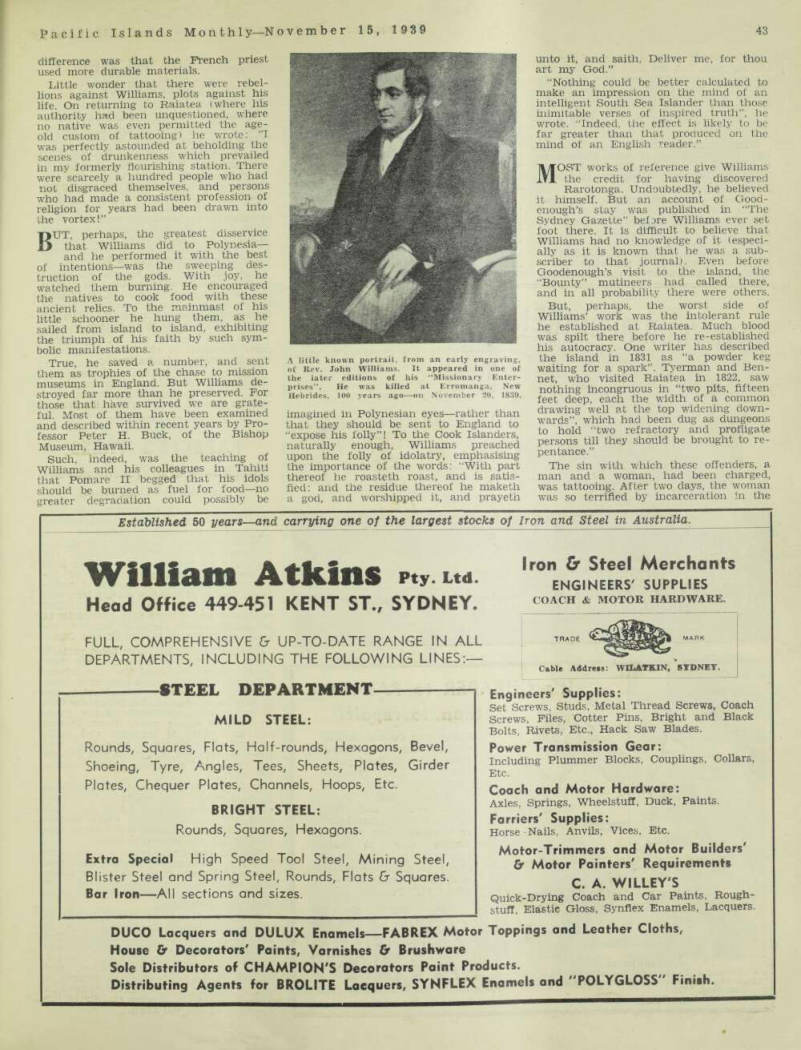
A little known portrait, from an early engraving, of Rev. John Williams. It appeared in one of the later editions of his “Missionary Enter prises”. He was killed at Erromanga, New Hebrides, 100 years ago—on November 20, 1839.
pit that, with the assistance of friends, she escaped. But the man who had per formed the operation was kept there on breadfruit and water until “he mani fested satisfactory signs of contrition.”
To other iniquitous tattooers was meted out the punishment of hard labour on public works.
When such methods failed Williams had another idea: it was decided to scarify the tattooing to “make foul blotches where elegant devices had been pricked ip”.
Without doubt, Williams was inspired by the best of motives, animated by the highest ideals. He wanted the new order established, the people clothed and in their right minds, the men in trousers, and the women in hideous Mother Hub bards and equally unattractive poke bonnets. In a measure he succeeded. The
iSSS* 0 ?. missionary, in the main, had the be hnid him. But at what a cost: wnat a price the Polynesians had to pay! elimination of the old native standards would have come if Williams had never seen the Pacific. In the more frequented islands, disintegration had already set in. Williams merely helped that process along in many a more re mote community, impelled change by his assertive personality, and then imposed the yoke of missionary autocracy. That reaction would follow was inevitable. . Neither must it be forgotten that the intolerance of Williams, and his Calvin istic colleagues, in opposing the introduc tion of other religions, is responsible for the fact that to-day Tahiti is French.
The deportation by Pomare IV of the two French priests in 1836 gave France justi fication for intervention there.