European War
pp. 18-22 · Read in the full issue
Japan’s Pacific Plans In Relation to the European War To Seek Friendly Relations With U.S.A. While Awaiting "Decay" of British Empire
By John Williams, Of Honolulu
(Being No. 6 of Series of Articles Describing Japan’s Plans and Politico-Economic Network in Pacific).
Honolulu, Oct. 19.
NOW that there is a war raging in Europe, besides the undeclared one in Asia, Australians had better “get down to tin-tacks” about the intentions of Japan in East Asia generally and in the Western Pacific in general.
The whole picture of Japanese aggres
sion and expansion concerns Australia because, without a firm foothold in China and points to the south-west, Japan can not very well make steady advance into those islands, such as the Philippines and the Indies, that lie as a bulwark between Japan proper and Australia.
In the past instalments of this series I have attempted, from the voluminous evidence at hand, to convey some idea of the vast Japanese penetration network that is slowly and surely moving into almost every community around the Pacific. One does not have to be anti- Japanese to see the facts.
The Japanese are convinced they have a good cause, and for good Japanese rea-
THUS Professor Roberts, overseas news 1 commentator, in “Sydney Morning Herald” on November 4:— The conflicting and hazy reports which have come from Tokyo show that an intense political struggle is being waged, not over participation in the European war. but over the policy to be adopted in China, and thus, inferentially, towards Western Powers in the Orient} The one section favours defiance of the West; the other, especially concerned with the fundamental export trade, maintains that Japan’s very existence under wartime conditions presupposes good relationships with the Allies and the United States.
The Japanese are coming out into the open with their proposal to initiate a “Central Chinese Government” under the puppet renegade, Wang Ching-wei. This would not only provide a means of “liquidating the China episode”; it would also give Japan a buffer by means of which she could “save her face” and yet compromise with the Western Powers on such matters as the currency dispute in China. But speculation is premature.
Japan is merely testing the reactions of foreign Powers to the idea of a puppet State; how that State would be used depends entirely on the outcome of the nebulous struggles in the Japanese poli tical arena.
Pending such an outcome, the Far East remains in a state of uneasy flux. Hos tilities in China are practically at a deadlock; and the Japanese are extremely concerned with the attitude of Russia.
sons. They sneer, for example, at the British Empire type of Empire because it lacks the Kodo (or Imperial way) upon which Japan’s Empire ambitions are based.
AFTER waging war upon China for more than two years, Japan has entered upon the next stage of her ag gressions. So far as she is concerned, Japan has conquered the Chinese. Japan possesses every Chinese port, and controls the great rivers which are the trade arteries of the vast undeveloped coun try. Japan, at the same time, is receiv ing help from British and American capitalists. American interests are sell ing out important mining concessions, and British interests are selling their entire outputs of coal, etc., to Japan.
After all, these capitalists are in China for only one reason—to exploit the nat ural resources and make profits. Now
that these interests are surrounded by Japanese guns, they are doing the only thing left to do, and trading with Japan.
Otherwise, Japan would take over.
This is a slow process, and a secret process, because the vested interests keep their deals from the public; but, never theless, the deals are taking place. The Japanese <1 could quote from dozens of Japanese resources) now are confident that this second phase of their conquest of China is well assured.
They do not expect to accomplish it in a hurry. It may take 10, 20 or even 100 years. The Japanese prophets hesi tate to set a definite time limit—but all are confident of ultimate victory.
Japan And Germany
THE war in Europe has given Japan added confidence because she is cer tain that, when it comes to a pinch, her
Berlin and Rome axis friends will stick to her.
Indeed, the Shanghai “Mainichi”, a Japanese paper, said after the European war had been raging for a month: — Japan must aid Germany in defeat ing Britain, if Germany cannot do it alone. When the Japanese Government ann ®H l ? ced its neutrality in the European conflict, this meant that Tokyo consid -Ifd;erventionn tion in Europe as secondary.
But the term ‘non-intervention’ was used to signify that if it became necessary to intervene in Europe to settle the Sino- Japanese conflict, then Japan will plunge into the European war to pursue her aim in East Asia”.
That is putting it in plain black-and white. The paper added that Japan looks upon the British Empire as her Public Enemy No. 1. because Britain, more than any other nation, has attempted to block Japan’s expansion into China
THE general Japanese opinion, fur ther, is agreed that the Empire is S™ff ast declin |- Here is an opinion recently expressed by Kiyoshi Kawakami a leading Japanese journalist, who, nor mally, is stationed in Washington to re port upon the American scene for a network of Nippon newspapers. Writing m a series of syndicated articles which appeared in the Tokyo “Mainichi” and me Osaka “Mainichi Shimbun”, this ob server said:— . . No matter how we look at it, Eng ™ + ? as . b f gu ? t 0 decline - Rather than of rnaking an enemy of the united States, and without playing the role of destroyer of the British Empire let us leave that to other countries (Ger many etc.). This is clear to anyone look ing at the present European situation I must repeat, therefore, to our hot-blood speed^ atriot ” C m6n: ‘ More haste ’ less
New Naval Bases
rpo accomplish her purpose in Asia, and X to prepare herself for her ultimate war against Britain in the Western Paci fic, Japan is carefully and methodically expanding on two fronts: military and economic.
On the military front, the army has its hands full in China, but the navy is having its turn on the Imperial stage now. The navy is developing important bases, new stepping stones, new spring boards for Japan’s next thrust south ward.
Look at these new bases on your map On the island of Formosa, which lies across the track between Hong Kong and Japan, the navy already has estab lished an important base of men, mater ials and supplies.
To the west from Formosa, in Mei chow Bay, in South Fukien province of the China mainland. Japan has es tablished another base, to support the Formosa base. Meichow Bay has been declared “secret”, and foreign shipping has been ordered to keep out of it.
To the south of Hong Kong lies Hainan Island, which Japan seized a year ago, and on Hainan the navy is well advanced with another base which commands the southern approaches to Hong Kong, Britain’s last outpost in China.
On these three important bases sur rounding Hong Kong, Japan’s war ma chine is poised to spring, whenever the tension in Europe catches Britain off guard. That is how Japan fights.
If Japan gets away with this design, then, indeed, will Australia have to look to her outlying defence scheme, based upon Darwin, Torres Strait and New Guinea.
Attitude Of U.S.A.
WASHINGTON has the Orient honey combed with under-cover secret-ser vice workers and, for some time, these experts have been reporting what Japan is up to. As a result, as soon as Ger many invaded defenceless Poland and set Europe aflame, Washington made bold moves, but logical moves for her Pacific security.
Additional naval forces—an aircraft ship, a squadron of the latest long-range patrol bombers, and six of the latest long-range submarines—were assigned to the Western Pacific. Ostensibly, they will work in what Washington calls a “neu trality patrol”. But, at the same time, Washington sent U.S. Ambassador Grew back to Tokyo, and his first public state ment in Tokyo, made this week, startled
the Japanese because it used most “un diplomatic” words.
Mr. Grew made it plain that Japan’s behaviour in China is offending U.S. public opinion, which, in these realistic days, profoundly affects Washington’s diplomatic actions. Those actions, the Japanese know full well, are backed by American preparedness in the Pacific, even on new Islands bases within an easy bomber’s flight to Tokyo.
Bombshell For Hawaiians
WASHINGTON has gone further. If you read back through the instal ments of this series, you will see how Japan keeps in touch with the 150,000
Japanese in Hawaii by frequent calls at Hawaii ports of Japanese navy tankers, etc. These tankers, as I have revealed, carry away from Hawaii ports valuable contributions of money and materials to the Nippon expansion machine.
These Japanese navy ships are given the freedom of the Hawaii ports, as the navy ships of any nation are. However, Washington, two months ago, made a secret probe of what goes on behind the scenes during these tanker visits to Hawaii and, as a result, Washington has taken appropriate action.
On October 18, two Japanese naval training ships, the “Iwate” and “Yaku mo”, arrived in Honolulu for a six-days’ visit. Before their arrival the Japanese Consul-General in Hawaii was advised in writing by Washington that, as the ships would be given the courtesy of Hawaii ports, the ships upon departing must not lift any of the war gifts (scrap metals, comfort bags, etc.), which the Hawaii Japanese for years have been loading into the navy tankers.
This announcement by Washington, courteously kept from the U.S. Press, was a bombshell for the watertight Hawaiian- Japanese community. It was discussed in detail at a special meeting of the Honolulu Japanese Chamber of Commerce the day before the warships arrived. This private meeting discussed all sorts of
subterfuge for getting around the Wash ington order.
But Washington is taking no risks and trusting nobody. The warships are in
port as this is being written, and on the docks where they are tied up, U.S. cus toms guard and plain-clothes observers are keeping a close check upon the war-
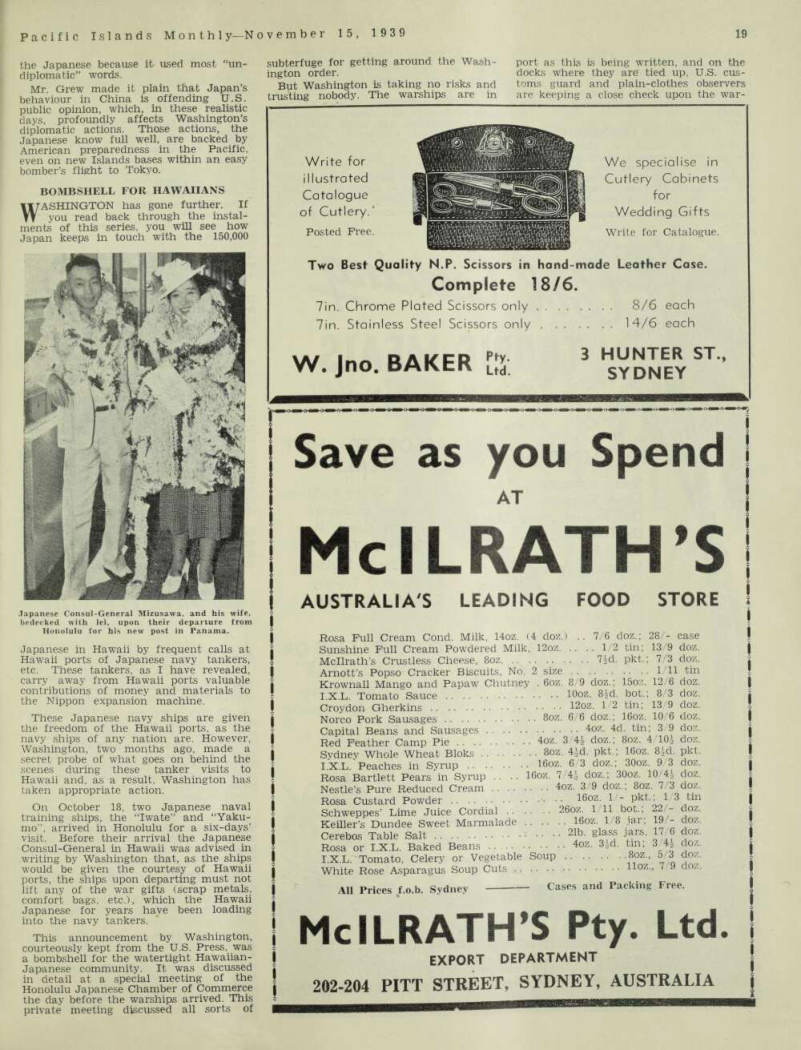
Japanese Consul-General Mizusawa, and his wife, bedecked with lei, upon their departure from Honolulu for his new post in Panama.
Sh -rnfio i + . . , .
This latest action of Washington s is typical of America s intention to act with a firm hand, if that is the only international technique which Tokyo under-
“Beautiful Friendship”
J Aoaivt . .
APAN. of course, is almost overanxious to make a “beautiful friendship” with America, because it is upon American goodwill that the other front— the economic—of Japans expansion depends. The U.S. is a top customer of
Japan, and it is by selling abroad that Japan gets funds for her overseas pur chases of vital materials for her war ma chine. japan, too, hopes that America will not carry to finality her announced inten tlon -P* ab rogating her treaty with Jap an> but, instead, will write a new and a better treaty. The Japanese are that optimistic. But U.S. public opinion will have something to say about it.
With her armed machine, as we have seen above, poised to spring on the next move southward, Japan has donned silk
gloves on the economic front and, behind a flow of her goods in all directions across the Pacific, she is making steady advances, too.
Goods —and guns!
And Now—Panama
WE have seen in prior instalments of this series how Japan has built up a super-economic machine in Hawaii. It is regarded by experienced observers as a major stepping-stone in her invasion of the Americas.
Japan’s latest advance into the Ame ricas has been the appointment of a consular representative (for the first time) in the State of Panama, vital Central American outpost. This will give Japanese warships and nationals just another excuse to become more familiar with the Panama Canal area.
Much to the joy of the Japanese in Hawaii, Consul-General Mizusawa, who has served faithfully in Hawaii, was appointed first diplomatic representative to Panama. He left Hawaii in Septem ber.
Before he left, he was feted by the Japanese Chamber of Commerce. Said he, in reply to enthusiastic congratula tions : “I have served at various places, but in no place have I seen where Japanese merchants have collectively made such progress as in Hawaii. Since, as you all know, the disposition of the Americans is to place emphasis on economic foun dations and appear to negotiate on equal footing based on economic power, I be lieve that the enrichment of economic power is rather important. Your effici ent manner of progress is being seriously viewed and respected, even in Japan. . .”. (In the next instalment, details of how this new Japanese economic machine works will be given. They will be based upon direct quotations from Japanese documents and newspapers).