From Notes Made In New Guinea
pp. 11-12 · Read in the full issue
By R. W. Robson, Editor of "Pacific Islands Monthly"
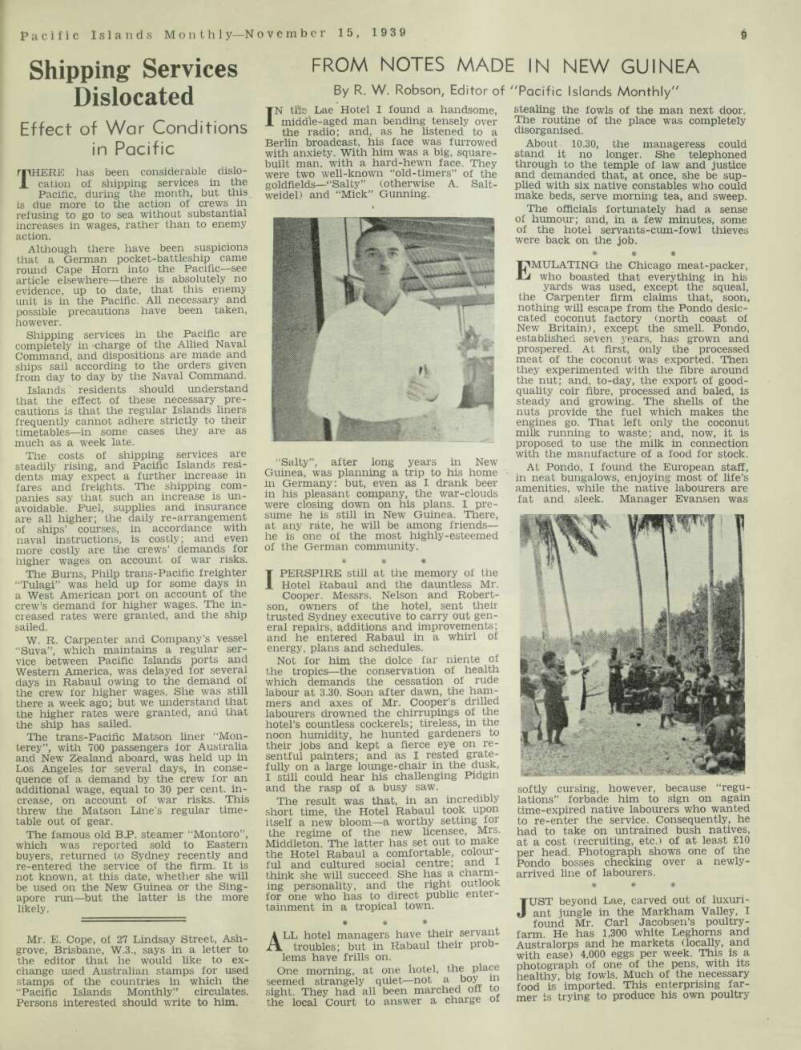
IN the Lae Hotel I found a handsome, middle-aged man bending tensely over the radio; and, as he listened to a Berlin broadcast, his face was furrowed with anxiety. With him was a big, square built man, with a hard-hewn face. They were two well-known “old-timers” of the goldfields—“Salty” (otherwise A, Salt weidel) and “Mick” Gunning.
I PERSPIRE still at the memory of the Hotel Rabaul and the dauntless Mr.
Cooper. Messrs. Nelson and Robert son, owners of the hotel, sent their trusted Sydney executive to carry out gen eral repairs, additions and improvements; and he entered Rabaul in a whirl of energy, plans and schedules.
Not for him the dolce far niente of the tropics—the conservation of health which demands the cessation of rude labour at 3.30. Soon after dawn, the ham mers and axes of Mr. Cooper’s drilled labourers drowned the chirrupings 9f the hotel’s countless cockerels; tireless, in the noon humidity, he hunted gardeners to their jobs and kept a fierce eye on re sentful painters; and as I rested grate fully on a large lounge-chair in the dusk, I still could hear his challenging Pidgin and the rasp of a busy saw.
The result was that, in an incredibly short time, the Hotel Rabaul took upon itself a new bloom —a worthy setting for the regime of the new licensee, Mrs.
Middleton. The latter has set out to make the Hotel Rabaul a comfortable, colour ful and cultured social centre; and I think she will succeed. She has a charm ing personality, and the right outlook for one who has to direct public enter tainment in a tropical town. * * * ALL hotel managers have their servant troubles; but in Rabaul their prob lems have frills on.
One morning, at one hotel, the place seemed strangely quiet—not a boy m sight. They had all been marched off to the local Court to answer a charge oi
stealing the fowls of the man next door.
The routine of the place was completely disorganised.
About 10.30, the manageress could stand it no longer. She telephoned through to the temple of law and justice and demanded that, at once, she be sup plied with six native constables who could make beds, serve morning tea, and sweep.
The officials fortunately had a sense of humour; and, in a few minutes, some of the hotel servants-cum-fowl thieves were back on the job. * * ♦ EMULATING the Chicago meat-packer, who boasted that everything in his yards was used, except the squeal, the Carpenter firm claims that, soon, nothing will escape from the Pondo desic cated coconut factory (north coast of New Britain), except the smell. Pondo, established seven years, has grown and prospered. At first, only the processed meat of the coconut was exported. Then they experimented with the fibre around the nut; and, to-day, the export of good quality coir fibre, processed and baled, is steady and growing. The shells of the nuts provide the fuel which makes the engines go. That left only the coconut milk running to waste; and, now, it is proposed to use the milk in connection with the manufacture of a food for stock.
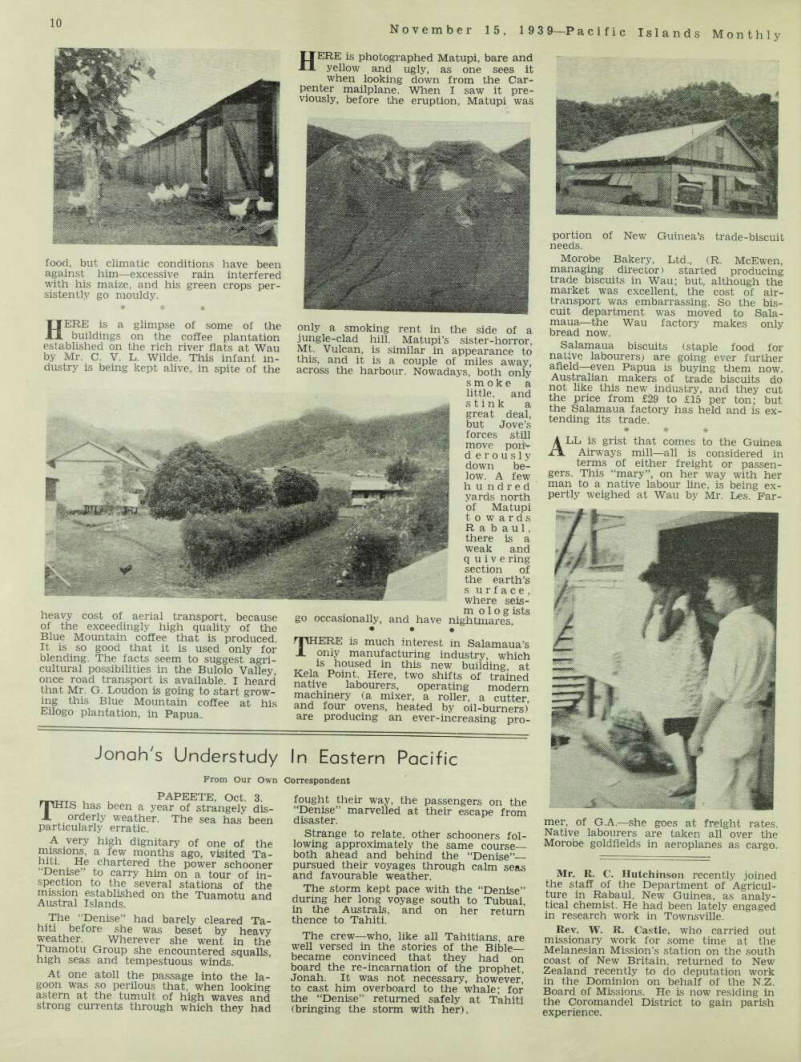
At Pondo, I found the European staff, in neat bungalows, enjoying most of life’s amenities, while the native labourers are fat and sleek. Manager Evansen was
softly cursing, however, because “regu lations” forbade him to sign on again time-expired native labourers who wanted to re-enter the service. Consequently, he had to take on untrained bush natives, at a cost (recruiting, etc.) of at least £lO per head. Photograph shows one of the Pondo bosses checking over a newly arrived line of labourers. * * * JUST beyond Lae, carved out of luxuri ant jungle in the Markham Valley, I found Mr. Carl Jacobsen’s poultry farm. He has 1,300 white Leghorns and Australorps and he markets (locally, and with ease) 4,000 eggs per week. This is a photograph of one of the pens, with its healthy, big fowls. Much of the necessary food is imported. This enterprising far mer is trying to produce his own poultry
"Salty”, after long years in New Guinea, was planning a trip to his home in Germany: but, even as I drank beer in his pleasant company, the war-clouds were closing down on his plans. I pre sume he is still in New Guinea. There, at any rate, he will be among friends — he is one of the most highly-esteemed of the German community.
food, but climatic conditions have been against him—excessive rain interfered with his maize, and his green crops per sistently go mouldy. * * * HERE is a glimpse of some of the buildings on the coffee plantation established on the rich river flats at Wau by Mr. C. V. L. Wilde. This infant in dustry is being kept alive, in spite of the
heavy cost of aerial transport, because of the exceedingly high quality of the Blue Mountain coffee that is produced.
It is so good that it is used only for blending. The facts seem to suggest agri cultural possibilities in the Bulolo Valley, once road transport is available. I heard that Mr. G. Loudon is going to start grow ing this Blue Mountain coffee at his Eilogo plantation, in Papua.
HERE is photographed Matupi, bare and yellow and ugly, as one sees it when looking down from the Car penter mailplane. When I saw it pre viously, before the eruption, Matupi was
9 n ly a smoking rent in the side of a jungle-clad hill. Matupi’s sister-horror, Mt. Vulcan, is similar in appearance to this, and it is a couple of miles away, across the harbour. Nowadays, both only
smoke a little, and stink a great deal, but Jove’s forces still move pon dero u s 1 y down be low. A few hundred yards north of Matupi towards Rabaul, there is a weak and q u i v e ring section of the earth’s s u r f a c e , where seis
m o 1 o g ists go occasionally, and have nightmares. • • • rERE is much interest in Salamaua’s only manufacturing industry, which is housed in this new building, at Kela Point. Here, two shifts of trained native labourers, operating modern machinery (a mixer, a roller, a cutter, and four ovens, heated by oil-burners) are producing an ever-increasing pro-