Takata Hits Back
pp. 60-62 · Read in the full issue
The Story of a New Caledonian Rebellion in the Seventies
By A. G. Miller
A DWARF starts life under a severe handicap if he happens to be a hideous freak with an enormous head mounted on a stunted body. Bom to pagan parents, such a type stands a good chance of having his skull dashed against a convenient boulder.
However, Takata survived, for the New Caledonians insisted on keeping alive their misshapen children.
Takata was still a boy when the French occupied this island, as large as Wales, which lies 800 miles nor’ east of Bris bane, There was no organised resistance from 50,000 kinky-headed Melanesians, split into numerous tribes, and speaking local dialects. The whites treated these warriors as though the Canaques were spineless East Indian coolies.
Save for occasional murders, French rule seemed firmly established. Tribal con flicts continued to take place in the road less mountains, but as chiefs often settled disputes by single combat, the death roll was not alarming.
The newcomers sought good land for 1 heir sugar and coffee plantations, while their herds grew steadily. Convicts built a road up the West Coast to Bourail, 105 miles from Noumea, the capital. Gradu ally the Kanakas were forced back into the ranges which form the island’s back bone. Ticket-of-leave prisoners stole native women to share their huts.
During the 1877 drought, Governor Pritzbuer allowed cattlemen to move their stock into native reserves. The hungry animals ate crops and trampled down fences surrounding burial grounds. The Kanakas began to murmur.
EARLY in ’7B. Admiral Pritzbuer met the West Coast chiefs at Teremba.
Their spokesman was Atai. a burly
six-footer who had served in the police.
Complaining that the Ourail tribes had been driven from their fertile lands the native picked up a handful of stones and said: “You have left us nothing but rocks.”
His Excellency was not impressed.
Fokalo Valley was well suited for farm ing, and the bluff sailor did not care if the natives found it difficult to grow yams taro, and bananas in the hills. He ignored Atai’s chief adviser, Takata, now a famous witch doctor.
The sorcerer hated all blancs; medicine men are seldom popular with white over lords. Realising that Pritzbuer would not change his mind, Takata began to organ ise a Popular Front. Soon gendarmes re ported that the sorcier of La Foa was visiting villages far and wide, while Atai sulked in the mountains.
“Why should we worry? Les Canaques cannot unite; they hate each other too much”, said officials complacently.
Pritzbuer was succeeded by Captain Olry, who found the colony in a financial crisis.
Takata found that many chiefs wanted to sit tight until they could see which way the tide was running. Some realised that the oui-ouis, as the French were nicknamed, were a powerful tribe cap able of bringing warriors across the sea in their huge fire-belching canoes. To con vince them that the blancs were fast asleep, Takata arranged a test killing.
ON the night of June 19, 1878, Dogny warriors murdered a convict named Chene, who lived with a native woman and her children.
The killing at Ouamenie did not alarm the authorities; Olry was told that the crime was simply an isolated affair, so no reinforcements were rushed to the dis trict. Gendarmes rode out to arrest the slayers, and the colony remained calm.
Takata was delighted.
“What did I tell you? Our enemies are asleep”, snarled the little witch doctor.
“They are few and we are many. Now is the time to strike.”
Signal fires roused the coastal tribes.
La Foa, a tiny hamlet 75 miles from Noumea was attacked, and seventeen people slain.
The whole West Coast broke into re volt. With Snider, spear, and tomahawk, a host of naked rebels swept down on Bouloupari and massacred 35 police and civilians. There was almost a panic in the capital, when the grim news was tele graphed from Moindu.
OLRY issued arms to every able bodied Frenchman and interned all native servants on He Nou, the convict depot across the bay.
A naval transport and a couple of small gunboats were fortunately available—one commanded by Henri Riviere, famous novelist and man-about-Paris. A steamer hurried to Sydney to cable Paris for help.
Had the natives been led by a soldier, they would have marched on Noumea and forced Olry to remain on the defensive.
Instead, they wasted time burning and looting isolated homesteads.
The Kanakas, reckoned the island’s best fighters, were eager to take the warpath.
Their East Coast lands had not been
stolen, but who could stay at home when half New Caledonia was ablaze? If there was another French disaster. Grand Chief Gelima would be forced to let Nondo, the war leader, lead his men into action.
LUCKILY, there was a white man who knew both chiefs and could speak their language.
Lieutenant Adea Servan rode alone; the sight of an armed escort would have brought a volley from the thick naouilli scrub lining the bridle path to Kanala Bay. He arrived in the nick of time.
A handful of white settlers had taken shelter in a blockhouse. The young bucks were shouting for blood and old Gelima was finding it difficult to restrain them.
The lone horseman was greeted with ferocious shouts. Here was a single blanc, with his chassepot slung over his shoulder.
Had Servan hesitated to push his way through the yelling crowd, he would have been hacked to death.
Gelima was relieved to see his friend; but tall Nondo scowled and fingered his war-axe.
“I ask you to fight against your here ditary enemies. Kanala warriors are not frightened of Atai and Baptiste”, shouted the envoy, handing his carbine to the war chief. “Take this, my friend —it is a wea pon fit for a great warrior.”
Flattered, Nondo pledged his men to the French cause. The anxious Governor received a telegram from Kanala: “Nondo and five hundred braves crossing moun tains by torchlight”, reported Servan.
Noumea’s citizens sighed with relief— then shuddered as news came through
from Bouloupari that Colonel Gaily- Passeboc had been killed by snipers.
SERVAN’S dusky recruits did splendia work. Sweating marine infantrymen in heavy boots, loaded with rifles, ammunition, and packs, could not slip through the thick scrub with the ease of
these naked killers. Nondo’s support meant that the East Coast was perfectly safe, and induced canny chiefs to join Colonel Wendling’s column. The Chaine centrale, with deep gorges and sharp peaks running up to five thousand feet, was ideal country for guerilla warfare.
Mobile detachments swept along the West Coast, burning villages, destroying crops, and chopping down coconut palms.
Kanakas were shot on sight.
As August ended, it was obvious that there would be no general rising. Atai was on the run—and Wendling and Riviere were getting plenty of exercise, too.
Takata’s gory hatchet was in every skirmish; the sorcier bore a charmed life, but he must have realised that his re bellion was a failure. Too many chiefs had submitted to the French without fir ing a shot.
On September 1, a force of Kanala warriors attacked Atai’s camp at Foni moulou. Trapped and outnumbered, the rebels fought to the last man. It was a primitive combat in the best New Cale donian tradition, spear against spear, hatchet against hatchet.
Servan rode into the clearing as Segou held up Atai’s bleeding head. The chief’s son was dead. So was Baptiste. The Frenchman shuddered as a grinning war rior hacked off Takata’s outsize skull.
The revolt began to fizzle out. Three hundred whites and friendly natives were dead, including an American fisherman named Bill Oxford and his daughter, Jean.
Atai’s head was shipped to the Louvre Museum to thrill Parisians on Sunday afternoons, while Takata’s grotesque skull
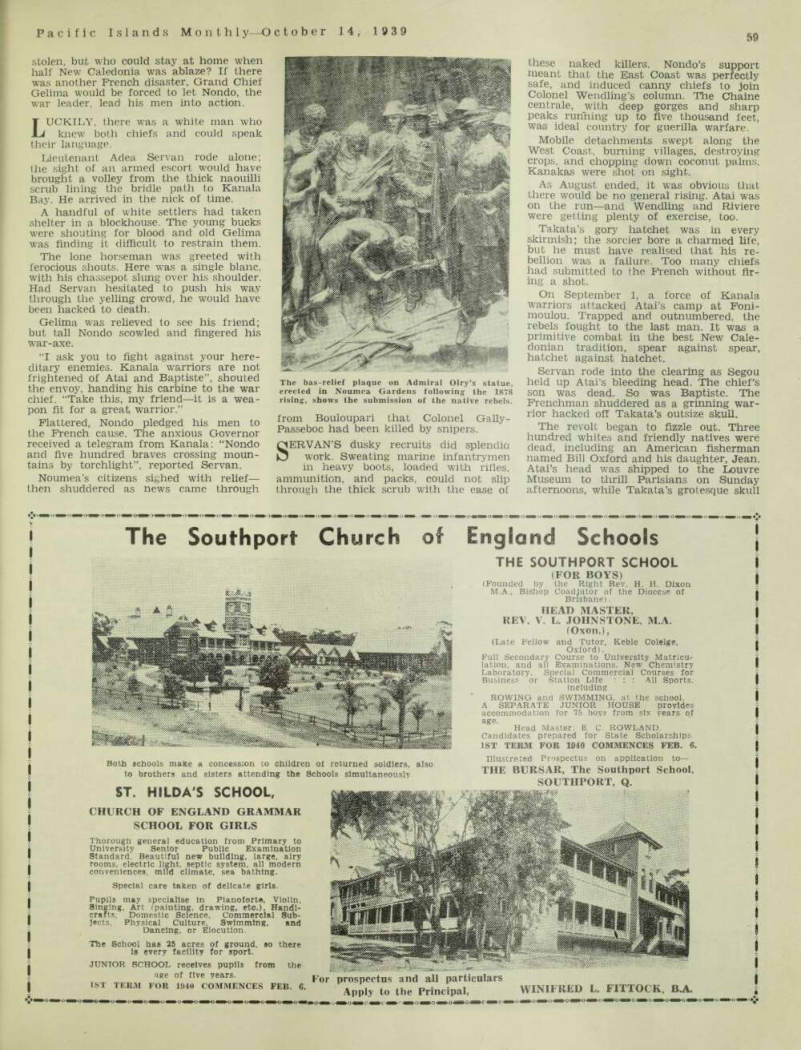
The bas-relief plaque on Admiral dry’s statue, erected in Noumea Gardens following the 1878 rising, shows the submission of the native rebels.
adorned a stake in Noumea. One night this grim trophy vanished. It may have been souvenired by a soldier, but any witchdoctor would have given his right hand for such a priceless relic.
OLRY handed out medals to Nondo and his allies, who also secured the pick of their dead foemen’s wives.
Henri Riviere wrote a book on this strange campaign, then went to Tonkin.
When the Black Flags—river pirates—be seiged Hanoi, he led a sortie from the citadel. He was wounded, taken prisoner, and impaled alive on a stake, together with thirty of his men. France avenged this deed, and Indo-China became a French colony.
Grateful New Caledonians erected a statue to Olry. Kanala warriors served in the Great War; others helped to quell a minor rising in 1917.
Time plays queer jokes. Men whose fathers fought under the Black Flags now toil in nickel mines not far from La Foa and Kanala.
The Kanakas sit in the shade and watch their women working in the fields. Their lands are native reserves, secure from speculators and planters; the tribesmen are warriors and not indentured labourers.
Takata’s rising was a failure, but in the long run les Canaques have benefited, be cause a thousand rebels followed Atai and his ferocious dwarf to death.