How War Came To Central Pacific
pp. 50-52 · Read in the full issue

Sir Harry Luke Speaks to Distant Islands by Radio
WHEN Britain goes to war, one of her greatest problems is to give prompt information and instructions to all her far-flung dominions, colonies and de pendencies. Radio has simplified that problem.
Some of the older residents in the Central Pacific, early in September, drew a contrast between the conditions of 1914, and those of 1939.
In 1914, isolated British communities did not know, for many weeks, that war had broken out. In 1939, people on even the remote atolls in the Solomons, the Gilbert and Ellice group, and the North ern Cooks, not only knew on September
3 that war had come, but many of them actually, on short-wave radio, heard the Prime Minister, in London, make the dread announcement, at 11 am.
One of the most interesting, as well as most impressive, incidents, was an address delivered by Sir Harry Luke (Governor of Fiji and High Commis-
sioner for the Western Pacific), through the Suva radio station, on September 4.
Sir Harry spoke, first, to the people in Fiji, and described the necessary war precautions that were being taken. He remarked on the large number of men of all three races—European, Indian and Fijian—who had offered their services, and he praised the way in which com pulsory military training had been ac cepted.
His address was then repeated, first in Hindi and then in Fijian. r[EN, conscious that his broadcast speech on this momentous occasion, was being listened to by persons with radio receivers in some of the more dis tant groups of islands —over which, as High Commissioner for the Western Pacific, he exercises jurisdiction—Sir Harry Luke spoke as follows: “To the peoples of the Gilbert and Ellice Islands Colony, the British Solomon Islands Protectorate, the New Hebrides, and the Kingdom of Tonga, many of whom it has been my privilege to meet personally during recent months, I am glad to be able to give an assurance that their safety and interests are being closely watched. I am in constant touch with the three Resident Commissioners and with the Agent and Consul, Tonga.
“In all these Territories the necessary legislation to implement defence measures is being enacted as rapidly as circum stances permit, and steps have already been taken to ensure reserve supplies of essential commodities and to safeguard vital lines of communication.
“It must be a matter of satisfaction to
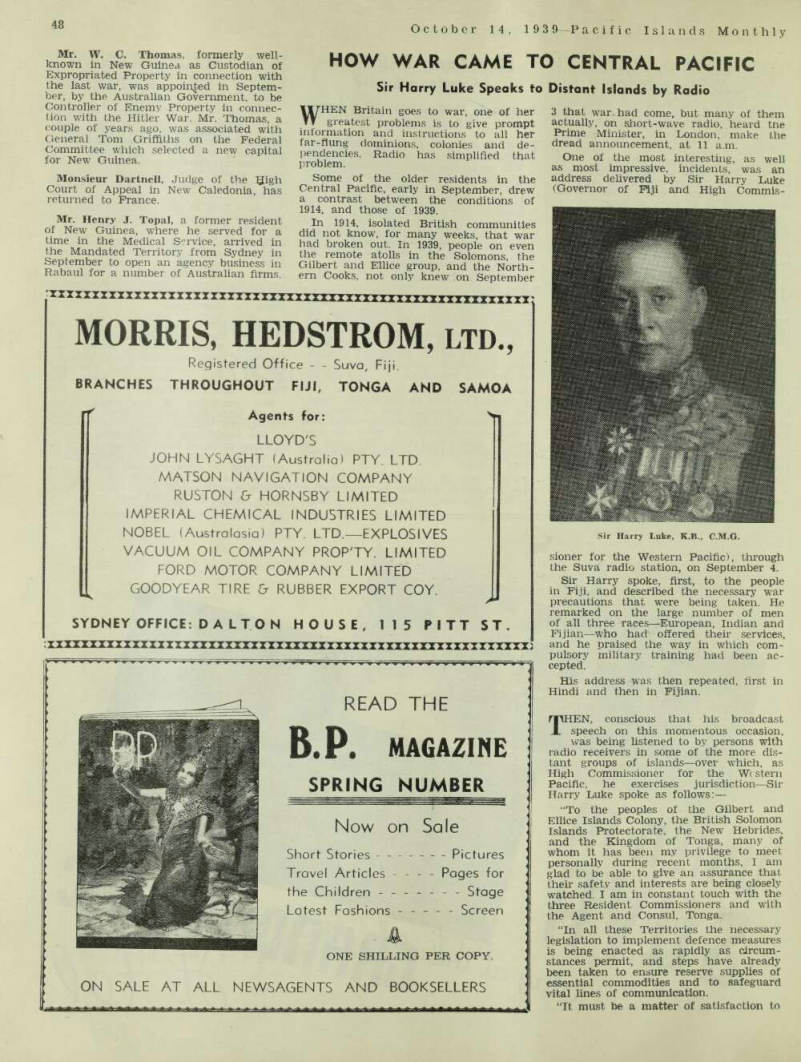
Sir Harry Luke. K. B., C.M.O.
us all to know that we have within the Pacific our trusted Allies the French, and the full measure of co-operation which they have so readily afforded us in the New Hebrides is most gratifying.
“To Her Majesty Queen Salote of Tonga and her subjects, who have assured His Majesty’s Government of their full support and have offered to place the resources of the Kingdom at the dis posal of Great Britain, I have already been charged to convey an expression of the sincere gratitude and appreciation of the Secretary of State for the Colonies.
To that appreciation and gratitude I should like to add an expression of my own.”
Compulsory Military Training
ACTING under the Defence Force Or dinance, 1923, the Governor of Fiji, in August, introduced a system of compulsory military training. It applies to all male Europeans between the ages of 18 and 25. in the districts of Suva.
Lautoka, Ba and Nausori. Enrolment, or ganisation and training have proceeded briskly and satisfactorily.
The age limit for compulsory training was raised from 22 to 25 by special legis
lative action, immediately after the out break of war.
At the Legislative Council meeting on September 5, the Governor was asked to receive expressions of loyalty from Ratu J. L. V. Sukuna (on behalf of the Fijians) and Messrs. S. Hasan, Chattur Singh, Vishnu Deo, Tularam and K. B. Singh (on behalf of the Indian community).
All declared that their young men will ingly would take ud arms for Britain, if that were permitted.
Dr. A. W. Hogg, who for five months relieved Dr. P. J. Monaghan at Apia Hospital, Samoa, returned to New Zea land in September, accompanied by his wife and daughter. They had planned to leave Samoa in August, but a few days before their vessel sailed for N.Z.. Dr.
Hogg slipped on a banana skin outside B.P.’s store in Apia and fractured his thigh. He spent several weeks in hos pital.
Mr. W. Evans, of Colyer. Watson and Co., Ltd., Rabaul, New Guinea, paid a short visit to Sydney by air at the end of September.