’Frisco-Sydney Airmail
pp. 9-10 · Read in the full issue
Plan For Immediate
Pan American Airways Offer To Run New Boeing Flying-Boats :: British Service Held Up By War
IT IS probable that the new trans-Pacific airmail, connecting North America with New Zealand and Australia, will be inaugurated by Pan American Airways in November or December, using the route Honolulu-Canton Island -Fiji-Noumea-Auckland. It is probable that the terminal point in California will be San Francisco, and the terminal point in Australia will be Sydney.
This development is directly the result of war conditions.
UNTIL the outbreak of war, it seemed certain that Pan American Airways and Imperial Airways—American and British respectively—would almost simul taneously inaugurate trans-Pacific ser vices and would either share the traffic between them, or would carry on com petitive lines.
Pan American Airways were first in the field, by many years. About 1935, the Company made an agreement with the New Zealand Government, under which they were given landing rights in Auck land; and they proceeded to organise a route from Honolulu via Kingman Reef and Pago Pago, with an important base in Auckland. Pioneer flights were made at the end of 1937, but ended in disas ter when the “Samoa Clipper” was de stroyed in an explosion at Pago Pago.
The route was deemed unsatisfactory, and P.A.A. then explored the possibili ties of an alternative route—namely, from Honolulu to Canton Island, then to Nou mea (New Caledonia), and then to Auck land. Finally, this route was accepted and organisation work has been proceed ing during the past year. Important flying boat base facilities have been provided at Noumea, and at Canton Island, and a hotel is being built at the latter place.
IN the meantime, Imperial Airways have been proceeding steadily with their plans. Having successfully established the England-Australia service, they pro ceeded to build three large flying-boats
for the new link between Sydney and Auckland: and, in August last, the new flying-boat “Aotearoa”, 22 tons, arrived in Sydney.
The “Aotearoa” made a pioneer flight from Sydney to Auckland on August 28, and the Pan American Airway’s new Boeing, “Californian Clipper”, made a pioneer flight from San Francisco to Canton Island, Noumea, and Auckland.
The two fine new flying-boats therefore met in Auckland on August 30 —a notable occasion.
Up to that point, there was uncer tainty about the plans of the two avi ation companies. It was apparent that Pan American Airways were not happy about the terminal at Auckland, because this meant that they were shut out from the valuable Australian traffic. It was equally apparent that Imperial Airways were having difficulty in regard to the American end of their trans-Pacific ser vice—it is still not clear that British machines will have the right to call re gularly at Honolulu, although it is believ ed that that was a condition of permis sion being given to the American ma chines to land in Auckland.
HOWEVER, on September 3, came the war; and that, apparently, put an end. for some considerable time, to the British plans for a trans-Pacific service.
The “Aotearoa” made a survey flight from Auckland to Suva and returned to Auckland, and thence back to Sydney. The
two sister ships of the “Aotearoa”, it was announced, are to be used for war ser vice, somewhere.
Meanwhile, there is a definite need for a trans-Pacific airmail between Australia and New Zealand and the North Ameri can continent. It was announced from Washington, on October 5, that repres entatives of the United States Post Of fice and Pan American Airways had urg ed the Civil Aeronautical Authority to permit a passenger and airmail service from California to Australia via Hono lulu. Canton Island, Noumea, and Auck land.
This caused a flutter of lively interest in aviation circles in Australia—first, be cause it shows that at last Pan Ameri can Airways are working in harmony with the American Post Office; second, because it indicates that America, probably with British goodwill, is planning to go ahead with the new trans-Pacific airmail; and, thirdly, because plans apparently have been made towards the extension of the American service to Australia.
Although it was not stated in the offi cial announcement, it is clearly under stood that, if the American service is commenced, it will provide for a call at Fiji—that is, between Canton Island and Noumea.
It was stated in the “New Zealand Herald” on September 15 that the Pan American Airway’s administration build ing at the Auckland airbase is to be doubled in size and that plans definitely have been made for a regular call at Fiji —but the P.A.A. have not yet decided where the landing place at Fiji is to be. Suva has weather disadvantages. It is suggested that Suva must be used dur ing one season, and Lautoka when the trade-wind is in the opposite direction.
The “Sydney Morning Herald”, on Oc tober 9, said that Pan American Airways is expected to inaugurate a South Pacific air service on a regular schedule in No vember. The newspaper added that the United States Government had not yet secured landing rights in Australia.
The “Melbourne Herald”, on October 6, said that Australia would not be likely to reject a Pan American Airways appli cation for landing rights that had the
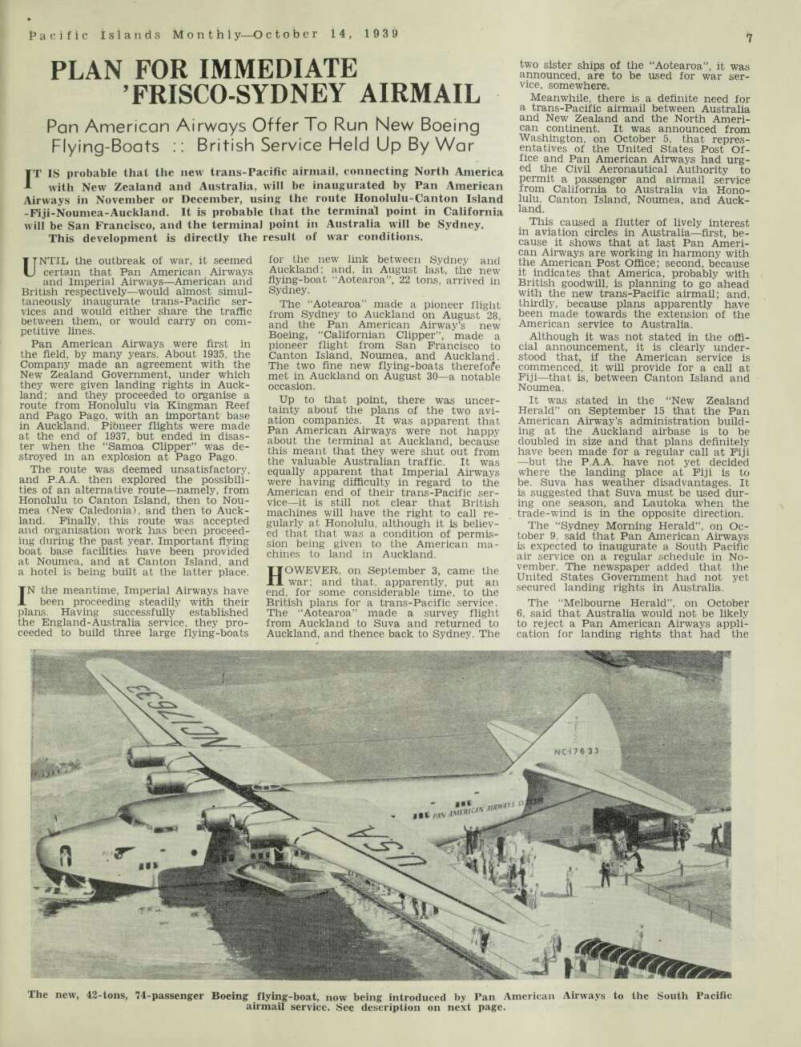
The new, 42-tons, 74-passenger Boeing flying-boat, now being introduced by Pan American Airways to the South Pacific airmail service. See description on next page.
wholehearted support of the United States Government. This newspaper added that the American service could not start un til the hotel on Canton Island has been built and properly equipped—Canton will be a regular overnight stopping place.
The Route
Distances between points are;— San Francisco-Los Angeles 411 miles Los Angeles-Honolulu .. .. 2,570 Honolulu-Canton Island .. 1,915 „ Canton Island-Suva 1,250 „ Suva-Noumea 730 „ Noumea-Auckland 1,124 „ Auckland-Sydney 1,200 „
The Machines
Pan American Airways South Pacific service will be carried on by three flying boats —“California Clipper”, “Honolulu Clipper”, and “American Clipper”. They are members of a fleet of six huge fly ing-boats constructed for Pan American Airways by the Boeing Aircraft Com pany for scheduled operation on the Pacific and the Atlantic Oceans. The “Yankee Clipper”, “Atlantic Clipper” and “Dixie Clipper” are being operated on the two routes over the Atlantic.
These are the largest aircraft, either military or commercial, in the world.
They are all-metal, double-deck, four engined (1,500 h.p. each) monoplane fly ing-boats, equipped with auxiliary “sea wdngs” (technically called hydro-stabi lizers, for lateral stability on the sur face or in heavy seas>. Their gross weight (fully loaded) is 82,500 lb.; their overall
length is 109 feet; their wingspan is 152 feet; and their fuel capacity is 4,200 gallons. .Their highest speed is 190 m.p.h. and their cruising speed (at long range cruising) 150 m.p.h. Their range is 4,275 miles, and their ceiling 21,000 feet.
The maximum capacity of each flying boat is: Passengers (sitting only) 74; Pas sengers accommodated over night 40; cargo 5,000 lb.
All four engines are accessible for servicing, adjustment or repair in flight.
Engine stations are maintained in the big nacelles, behind each motor, and con nected by telephone to the flight deck.
There are two decks. On the flight deck are the offices, etc., of the operating staff. On the main deck are:—Five main passenger cabins, each with accom modation for 10 day-time, 6 night-time passengers; dining lounge, with dining accommodation to serve 15 passengers at a time; one 4-passenger compartment aft.; at the stern, a private “bridal suite”, completely furnished apartment; separate men’s and women’s dressing rooms and lavatories; galley, with ice box and steam table, for preparation of food for 85 people.
There is a complete internal telephone system among flight deck posts, engine stations in wing, and steward’s galley.
Mr, I. L. Howell, of the S.D.A. Mission returned to Papua recently after fur lough in Australia.