"Gus" Nelsson
pp. 73-74 · Read in the full issue
Passes On
Fine Old Pioneer of Popua
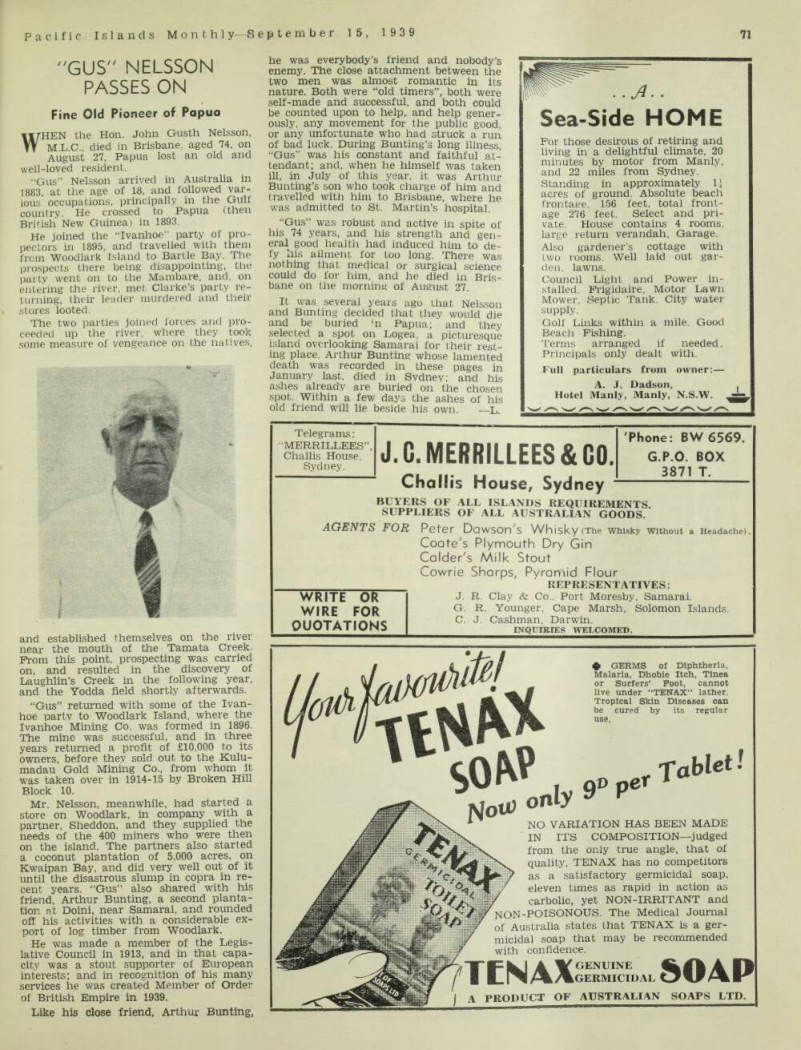
WHEN the Hon. John Gusth Nelsson, MLC., died in Brisbane, aged 74, on August 27, Papua lost an old and well-loved resident.
“Gus” Nelsson arrived in Australia in 1883, at the age of 18, and followed var ious occupations, principally in the Gulf country. He crossed to Papua (then British New Guinea) in 1893.
He joined the “Ivanhoe” party of pro peclors in 1895, and travelled with them from Woodlark Island to Bartle Bay. The prospects there being disappointing, the party went on to the Mambare, and, on entering the river, met Clarke’s party re turning, their leader murdered and their stores looted.
The two parties joined forces and pro ceeded up the river, where they took some measure of vengeance on the natives,
and established themselves on the river near the mouth of the Tamata Creek.
Prom this point, prospecting was carried on, and resulted in the discovery of Laughlin’s Creek in the following year, and the Yodda field shortly afterwards.
“Gus” returned with some of the Ivan hoe party to Woodlark Island, where the Ivanhoe Mining Co. was formed in 1896.
The mine was successful, and in three years returned a profit of £lO,OOO to its owners, before they sold out to the Kulu madau Gold Mining Co., from whom it was taken over in 1914-15 by Broken Hill Block 10.
Mr. Nelsson, meanwhile, had started a store on Woodlark, in company with a partner, Sheddon, and they supplied the needs of the 400 miners who were then on the island. The partners also started a coconut plantation of 5,000 acres, on Kwaipan Bay, and did very well out of it until the disastrous slump in copra in re cent years. “Gus” also shared with his friend, Arthur Bunting, a second planta tion at Doini, near Samarai, and rounded off his activities with a considerable ex port of log timber from Woodlark.
He was made a member of the Legis lative Council in 1913, and in that capa city was a stout supporter of European interests; and in recognition of his many services he was created Member of Order of British Empire in 1939.
Like his close friend, Arthur Bunting,
he was everybody’s friend and nobody’s enemy. The close attachment between the two men was almost romantic in its nature. Both were “old timers”, both were self-made and successful, and both could be counted upon to help,, and help gener ously, any movement for the public good, or any unfortunate who had struck a run of bad luck. During Bunting’s long illness, “Gus” was his constant and faithful at tendant; and, when he himself was taken ill, in July of this year, it was Arthur Bunting’s son who took charge of him and travelled with him to Brisbane, where he was admitted to St. Martin’s hospital.
“Gus” was robust and active in spite of his 74 years, and his strength and gen eral good health had induced him to de fy his ailment for too long. There was nothing that medical or surgical science could do for him. and he died in Bris bane on the morning of August 27.
It was several years ago that Nelsson and Bunting decided that they would die and be buried m Papua; ‘ and they selected a spot on Logea, a picturesque island overlooking Samarai for their rest ing place. Arthur Bunting whose lamented death was recorded in these pages in January last, died in Svdnev: and his ashes already are buried on the chosen spot. Within a few days the ashes of his
old friend will lie beside his own.
L.
Mr. and Mrs. George Gough, who were married in Port Moresby. Papua, on August 8, have now settled down in their new home at the Laloki River. The bride formerly was Miss Gwendoline Tremayne.