Kirschbaum
pp. 62-63 · Read in the full issue
The Late Father
Tribute by Wau Protestants
AMONG many fine tributes to the memory of Father Kirschbaum, of Wau, a German and a Roman Catholic, killed in an aeroplane accident, none was more notable than that given by the British Protestant congregation of Padre Sherwin’s little church.
Mr. Sherwin announced that his ser vice on Sunday evening, August 14, would be in memory of Father Kirschbaum, and the church was packed with every sort and condition of Wau citizen. Many had not seen the inside of a church for years, and they handled the hymn-books as if they feared the things would bite; but they were sincerely glad to do homage to a man whom all had loved.
Mr. Sherwin preached briefly, but feel ingly. “Father Kirschbaum was a very
great priest, and a fine Christian gentle man”, he said. “He was the friend of everyone in this community. He was loved by all—with him, there was no denomina tional barrier. His noble soul has passed on; but the memory of him remains to assist and enrich the lives of those who remain.”
An Appreciation
The following tribute to Father Kirsch baum was written by a well-known resi dent of Wau, under the pen-name of “Outis”:— The shock caused bv the tragic death of Father Kirschbaum and his companions,
was only equalled by the deep sorrow and sense of loss felt by all this community, and many who knew him on the Sepik.
Father Kirschbaum’s intellectual at tainments were harnessed to a great sim plicity of mind and kindness of heart.
Science, as well as the Church and com munity, has lost one of great value, and outstanding qualities.
For over 20 years, Father Kirschbaum lived on the Sepik, and probably was one of the greatest authorities on the culture and linguistics of this area. His eager wish to go with an American party to the upper reaches of the Sepik. received a heavy blow when permission from the Administration was rescinded last year, after preparations had been made.
Essentially of a studious nature, besides his accomplishments in the native sphere Father Kirschbaum added a list of five modern languages to his repertoire, apart from Latin and a knowledge of Hebrew.
With the minds of so many peoples open to him, tolerance and broadmindedness
characterised his attitude towards men and matters. His flock, in particular, both native and white, mourn the loss of a noble-hearted priest and father in God.
His kindliness of manner, human sym pathy, and keen sense of humour, have left an enduring impression of a very gallant and charming Christian gentle man, as well as a great priest.
In some degree, the remarks of Tacitus concerning his father-in-law Agricola, may apply to Father Kirschbaum; “ . . , busts and statues, like their originals are frail and perishable. The soul is formed of finer elements, and its inward form is not to be expressed by the hand of an
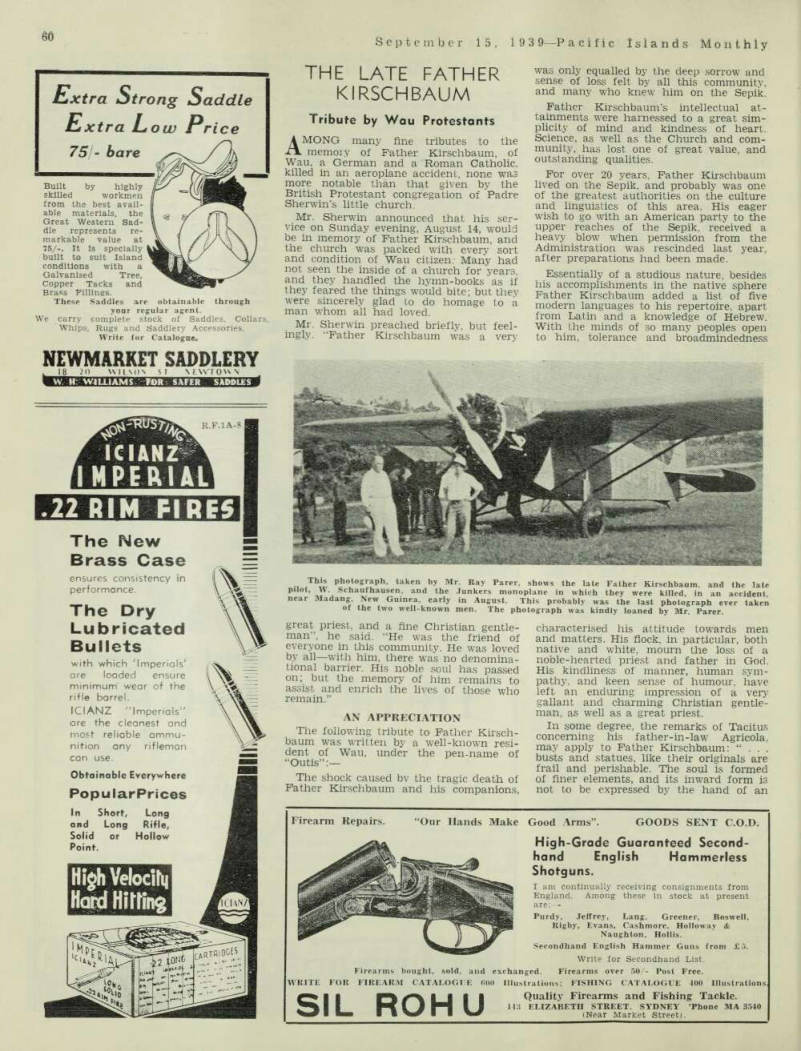
Th is Paraph, taken by Mr. Ray Parer, shows the late Father Kirschbaum. and the late pilot, W. Schaufhausen, and the Junkers monoplane in which they were killed, in an accident, near Madang, New Guinea, early in August. This probably was the last photograph ever taken of the two well-known men. The photograph was kindly loaned by Mr Parer.
artist with unconscious matter ... All of Agricola that gained our love, and raised opr admiration, still subsists, and will ever subsist, preserved in the minds of men, the register of ages, and the re cords of fame,”
Auf wiedersehen!
Mission Used Four Planes
The Eastern New Guinea Mission which is controlled by the German Society of the Divine Word, with its headquarters at Alexishafen, near Madang, and which was established in 1896, has made much use of aeroplanes to maintain contact with its 17 centre stations and 181 out stations.
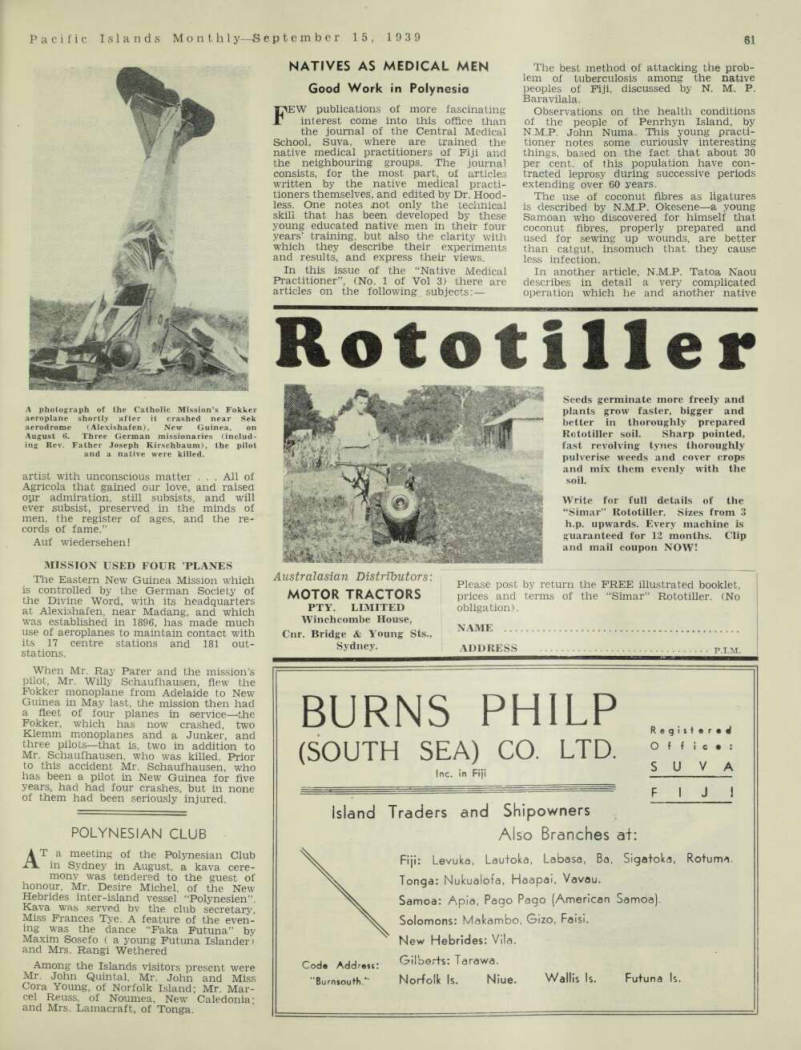
When Mr. Ray Parer and the mission’s pilot, Mr. Willy Schaufhausen, flew the Fokker monoplane from Adelaide to New Guinea in May last, the mission then had a fleet of four planes in service—the Fokker, which has now crashed, two Klemm monoplanes and a Junker, and three pilots—that is, two in addition to Mr. Schaufhausen. who was killed. Prior to this accident Mr. Schaufhausen, who has been a pilot in New Guinea for five years, had had four crashes, but in none of them had been seriously injured.
A photograph of the Catholic Mission’s Fokker aeroplane shortly after it crashed near Sek aerodrome (Alexishafen), New Guinea, on August 6. Three German missionaries (includ ing Rev. Father Joseph Kirschbaum), the pilot and a native were killed.