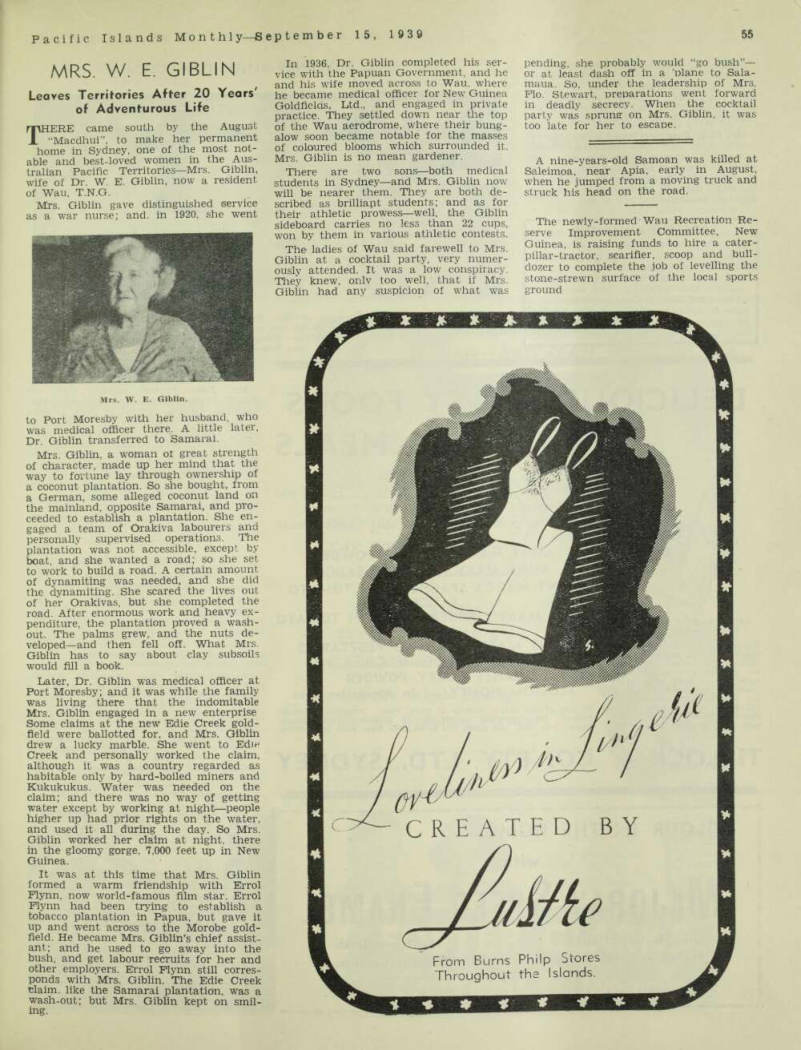
Mrs. W. E. Giblin
pp. 57-58 · Read in the full issue
Leaves Territories After 20 Years' of Adventurous Life
rERE came south by the August •Macdhui”. to make her permanent home in Sydney, one of the most not able and best-loved women in the Aus tralian Pacific Territories —Mrs. Giblin, wife of Dr. W. E. Giblin, now a resident of Wau, T.N.G.
Mrs. Giblin gave distinguished service as a war nurse; and. in 1920, she went
to Port Moresby with her husband, who was medical officer there. A little later, Dr. Giblin transferred to Samarai.
Mrs. Giblin, a woman ot great strength of character, made up her mind that the way to fortune lay through ownership of a coconut plantation. So she bought, from a German, some alleged coconut land on the mainland, opposite Samarai, and pro ceeded to establish a plantation. She en gaged a team of Orakiva labourers and
personally supervised operations. The
plantation was not accessible, except by boat, and she wanted a road; so she set to work to build a road. A certain amount of dynamiting was needed, and she did the dynamiting. She scared the lives out of her Orakivas, but she completed the road. After enormous work and heavy ex penditure, the plantation proved a wash out. The palms grew, and the nuts de veloped—and then fell off. What Mrs.
Giblin has to say about clay subsoils would fill a book.
Later, Dr. Giblin was medical officer at Port Moresby; and it was while the family was living there that the indomitable Mrs. Giblin engaged in a new enterprise Some claims at the new Edie Creek gold field were ballotted for, and Mrs. Giblin drew a lucky marble. She went to Edie Creek and personally worked the claim, although it was a country regarded as habitable only by hard-boiled miners and Kukukukus. Water was needed on the claim; and there was no way of getting water except by working at night—people higher up had prior rights on the water, and used it all during the day. So Mrs.
Giblin worked her claim at night, there in the gloomy gorge, 7,000 feet up in New Guinea.
It was at this time that Mrs. Giblin formed a warm friendship with Errol Flynn, now world-famous film star. Errol Flynn had been trying to establish a tobacco plantation in Papua, but gave it up and went across to the Morobe gold field. He became Mrs. Giblin’s chief assist ant; and he used to go away into the bush, and get labour recruits for her and other employers. Errol Flynn still corres ponds with Mrs. Giblin. The Edie Creek claim, like the Samarai plantation, was a wash-out; but Mrs. Giblin kept on smil ing.
In 1936, Dr. Giblin completed his ser vice with the Papuan Government, and he and his wife moved across to Wau, where he became medical officer for New Guinea Goldfields, Ltd., and engaged in private practice. They settled down near the top of the Wau aerodrome, where their bung alow soon became notable for the masses of coloured blooms which surrounded it.
Mrs. Giblin is no mean gardener.
There are two sons—both medical students in Sydney—and Mrs. Giblin now will be nearer them. They are both de scribed as brilliapt students; and as for their athletic prowess—well, the Giblin sideboard carries no less than 22 cups, won by them in various athletic contests.
The ladies of Wau said farewell to Mrs.
Giblin at a cocktail party, very numer ously attended. It was a low conspiracy.
They knew, only too well, that if Mrs.
Giblin had any suspicion of what was
pending, she probably would “go bush”— or at least dash off in a ’plane to Sala maua. So, under the leadership of Mrs.
Flo. Stewart, preparations went forward in deadly secrecy. When the cocktail party was sprung on Mrs. Giblin, it was too late for her to escape.
A nine-years-old Samoan was killed at Saleimoa, near Apia, early in August, when he jumped from a moving truck and struck his head on the road.
The newly-formed Wau Recreation Re serve Improvement Committee, New Guinea, is raising funds to hire a cater pillar-tractor, scarifier, scoop and bull dozer to complete the job of levelling the stone-strewn surface of the local sports ground
Mrs. W. E. Giblin.
Major G. Swinbourne, Senior Administrative Officer in the Gilbert and Ellice Islands Colony service, arrived in Australia by the “Comorin” late in August, after spending furlough in Europe. He was accompanied by Mrs. Swinbourne.
Mr. F. J. Purdy returned to Sydney re cently from the New Hebrides by the "Morinda” after visiting his son, who manages the store of F. J. Purdy and Co., at Aoba. Mr. Purdy lived in the Islands for more than 30 years, but is now resi dent in Australia.
Mr, John Preece, secretary of the N.S.W. branch of the Institute of Inter national Affairs, arrived in New Guinea at the end of August by the “Bulolo”, to collect information and statistical mat erial dealing with aviation and mining.
The Institute is compiling a history of New Guinea aviation and as no official figures relating to the N.G. air services are available for the period prior to 1932.
Mr. Preece will make a personal contact with Territory residents who have been connected with the air transport develop ments since the early flying days.