150 Years Ago
pp. 46-48 · Read in the full issue
Old Diary Describes Samoa Of
Remarkable Story of Emanual Silva, Senior and Junior
By Charles Reed, Of Apia
ALTHOUGH he had been rewarded by two nations for valour—he had saved many lives during the 1889 hurricane m Apia—and he was 99 years old when he died recently, and was a pioneer set tler in Samoa, Emanual Silva was almost unknown in this community. He resided close to Apia, but he had been for long a recluse.
This remarkable old man could remem ber not only the hurricane of 1889. but also of 1854, when eight European ships were lost in Samoan waters, and famine came to Samoa.
The writer had known Emanual during 20 years, yet was unaware that the old man had in his possession a diary of events and happenings covering nearly 70 years prior to the landing in the Pacific Islands of the first early mis sionaries.
This diary had belonged to his father, a Portuguese, and a runaway sailor, who came to Samoa and landed at the island of Manono from a Portuguese slave-ship which had been damaged on a coral-reef, after leaving Easter Island with a cargo of slaves. These slaves were Polynesians, who then inhabited Easter Island.
Emanual, the son, was actually in his hundredth year, but he had retained his mental faculties, and had excellent eye sight, reading printed matter with no difficulty. He worked at his plantation, producing his entire needs, up to the time of his death.
He described the many internecine wars between rival families of rank and the coming and going of the ancient ocean going, double-pontooned canoes, from the outlying islands of Tonga, Wallis and Viti. These, more often than not, came to Samoa, not to trade, but for conquest.
But. after the initial friendly reception, the visiting canoe-party would be sur rounded, the crew clubbed or disposed of, and their highly-prized canoe confiscated.
The canoe would then be named after the Samoan chief who had taken the craft.
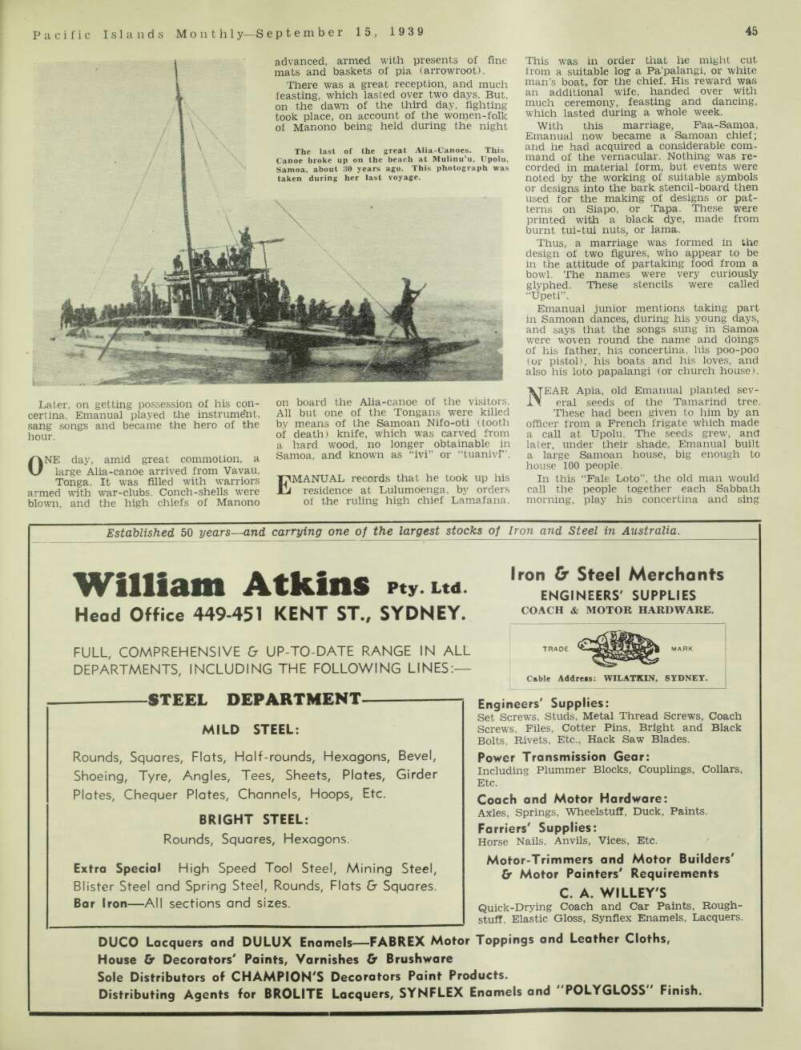
The last of these great canoes broke up on the beach at Mulinu’u, near Apia, about the year 1910. This Alia-canoe carried 150 men.
SILVA, senior, reached Samoa in this way. About the year 1765, a slave ship struck a reef a few days after leaving Easter Island (then called Rapanui) and with broken mast and gear, drifted to the island of Upolu, Samoa. The crew, suffering from scurvy and thirst, were craving fruit, water and fresh vegetables. A boat was put off ai the tiny island of Manono (off Upolu) to seek fresh water. Among the crew was a young Portuguese seaman named Emanual Silva.
The Portuguese sailors were hospitably received by the people of Manono Is land and young Emanual was enamoured by the friendliness of the people and the beauty of the island. Emanual resolved to jump his ship at all costs, despite the fact that recapture would mean the loss of his head.
According to the diary, Emanual put into a small cask his kit of carpenter’s tools, a concertina, a pistol and some old clothes, his dirk (or knife) and an old metal-bound Bible. With these effects he safely landed. He hid the cask in the jungle undergrowth, and himself re mained in hiding three days, when his ship finally sailed away.
Young Emanual then laid himself out on the beach at Manono, pretending to be unable to walk. Later, he was dis covered by natives and was carried into a native hut. Here he was kindly treated and given food and a lava-lava (loin cloth) of the native tapa cloth.
Later, on getting possession of his concertina’ Emanual played the instrument. sang songs and became the hero of the hour ONE day. amid great commotion, a large Alia-canoe arrived from Vavau.
Tonga It was filled with warriors armed with war-clubs Conch-shells were biown and the high chiefs of Manono
advanced, armed with presents of fine mats and baskets of pia (arrowroot).
There was a great reception, and much feasting, which lasted over two days. But. on the dawn of the third day. fighting took place, on account of the women-folk of Manono being held during the night
on board the Alia-canoe of the visitors.
All but one of the Tongans were killed by means of the Samoan Nifo-oti (tooth of death) knife, which was carved from a hard wood, no longer obtainable in Samoa, and known as “Ivl” or "tuanivf.
„ A , Tttat „.
records that he took up his Hi residence at Lulumoenga, by orders of the ruling high chief Lamafana.
This was in order that he might cut from a suitable log a Pa’palangi, or white man's boat, for the chief. His reward was an additional wife, handed over with much ceremony, feasting and dancing, which lasted during a whole week.
With this marriage, Faa-Samoa, Emanual now became a Samoan chief; and he had acquired a considerable com mand of the vernacular. Nothing was re corded in material form, but events were noted by the working of suitable symbols or designs into the bark stencil-board then used for the making of designs or pat terns on Siapo. or Tapa. These were printed with a black dye, made from burnt tui-tui nuts, or lama.
Thus, a marriage was formed in the design of two figures, who appear to be in the attitude of partaking food from a bowl. The names were very curiously glyphed. These stencils were called “Upeti”.
Emanual junior mentions taking part in Samoan dances, during his young days, and says that the songs sung in Samoa were woven round the name and doings of his father, his concertina, his poo-poo (or pistol), his boats and his loves, and also his loto papalangi (or church house).
NEAR Apia, old Emanual planted sev eral seeds of the Tamarind tree.
These had been given to him by an officer from a French frigate which made a call at Upolu. The seeds grew, and later, under their shade, Emanual built a large Samoan house, big enough to house 100 people.
In this “Fale Loto”, the old man would call the people together each Sabbath morning, play his concertina and sing
The last of the great Alia-Canoes. This Canoe broke up on the beach at Mulinu’u, Upolu, Samoa, about 30 years ago. This photograph was taken during her last voyage.
several hymns. Then he would expouad his belief in the Atua (God) and would read from his Bible for an hour, inter preting its meaning into Samoan. Young Emanuai would sit near his father and would hide his face in his hands in prayer, while several hundred Samoans would listen attentively outside the church house. The church house was al ways filled to capacity, and there was no money then known or used (and no col led ion made). The Samoans soon learned the hymns by heart and would sing them at their dances.
The great Tamarind trees can be seen to-day, close to Apia; but, with the ar rival of (he first missionaries from Tahiti, the church house of Emanuai was ordered to be destroyed by burning, and
the sailor-priest was admonished as “un orthodox”, and acting without legal right.
About this time, whalers frequently called at Samoa for water and coconuts, pigs and native arrowroot (then known as pia). This latter formed one of the main articles of diet, being cooked with fish and coconut cream. The exchange or barter was usually in the form of a poopoo (or musket) and a flask of powder or an axe.
Malietoa Vaiinupo, king of all Samoa, received orders to arrest the Portuguese, Emanuai Silva. He was charged with be ing an imposter—and la'er went into ob scurity.
MANY of the whaling ships called at Norfolk Island, then a whaling ground, and during a stay of several
days at Samoa would generally leave a runaway sailor or two behind in Samoa.
One of these men, a negro cook called “Mea-uli” (The Black) or Black Tom. made history in Samoa. He was a great pugilist, and fought on several occasions with Captain ■‘Bully” Hayes. Once, he nearly killed Hayes.
This negro afterwards owned a small drinking saloon in Apia, and Captain Hayes, always a gentleman, respected the weight of his bottles. His hotel was known as the “Parlour” and was a shanty of but one room and a kitchen. Among his customers, of that day, are noted “Snowy”.
“Bluenose”. “Lofty Pritchard”, “Adams”.
“Bully Hayes”, “Old Mac”, and several foreigners. Most of these men were handy with tools, or were good boat-builders and, for this reason, were generally well-re ceived by the Samoans, who were proud to have an expert boat-builder married into the family.