Japanese Are Not Americans
pp. 26-30 · Read in the full issue
Some Lessons from the Second Generation in Hawaii (BEING NO. 5 OF SERIES OF ARTICLES DESCRIBING JAPAN’S PLANS AND
Spy Network In Pacific)
By John Williams, Of Honolulu
IN this instalment I propose to let the Japanese speak for themselves: that is, give quotations from statements of their leaders and from considered Japanese newspaper editorials, etc.
We are considering the Japanese in Hawaii because they present the best pic ture outside of Japan itself of how a Japanese community will “dig in” and. with approaching arrogance.
remain aloof from the peoples of the lands in which they settle.
They consider themselves racially superior. To-day there are more than 150,000 Japanese in Hawaii, and the first of them settled 60 years ago. Hawaii is an ideal place for anybody to mix with another race: apart from the wide assort ment of races here, there is a racial toler ance between races that is an object lesson.
If the Japs intend to mix, Hawaii is the place. Considering their number, very few have inter-married, and the ones who have are social outcasts of the Japanese community.
Those Americans responsible for bring ing the Japanese horde to Hawaii (the sugar and pineapple interests) thump the propaganda drums, that the 150,000 Japanese of to-day are being American ised, culturally and economically.
Just let us see. Look at statements pub lished in the Japanese press in Hawaii.
There are numbers of dailies and week lies. First of all, consider this: The Hawaii Shimpo oh March 25, 1939, bemoaned as follows: “The Japanese language papers on the U.S. mainland handle news of the cur rent incident (the war in China) in a very unconstrained manner. Their free dom of action is enviable to Hawaii. Of course, this is because the reading public is restricted to Japanese. Therefore they can have freedom of action.
“However, in Hawaii the Japanese language papers are read by Americans, too. When we know that every word and sentence is being read by Americans (watchful Government interpreters), we must be careful of the manner in which we write. When we write on the Japanese- American relations, we must use common sense. We must naturally refrain from hurting the feelings of the Americans . . .
Though we have something we wish to write, we try as much as possible to with hold writing it . . . There is no other alternative for us but to make the most of our lot in this manner and bear this uncomfortable situation in Hawaii.”
tv-iovo iQ an irrmnrtant lananese comin unity 6 on HmraU BTOUDIt has its Japanese organi-
atSs !see' stocktaking of Japanese
oramisations in Hawai lnd heir meanto “iM” Mav W 39. when this
series 'started) including newspapers,
On June 27, 1939, the Maui Shimbun moaned, too; “ ... It is not wise for the Americans of Japanese ancestry in Hawaii to wanwrong to^c°ata e that m tlre C Japanese have or
will become Americanised. We believe that This is but a superficial remark ... We want to cry out loudly that the second generation Japanese of Hawaii, it is to be regretted, have a very meagre knowledge of their mother country, Japan. fAPAN isn 't letting any grass grow J under its feet in hanging on to the second generation Japs in Hawaii.
There are 110,000 of Indeedl, the of h^ dd^ er pr r^ a
ownW" Scalin'* Hawaii,
there are several hours daily reserved ex clusively for Japanese broadcasts; these are given in the Japanese language, of course. If the 110,000 second generation Japs are being properly Americanised, you’d think that the bulk of the Jap radio programmes would be given in Eng lish. because the second generation crowd outnumber the first generation by three to one almost.
Favourite music of these Jap radio hours is the famed Patriotic March, the second verse of which says: “He who reigns above in power And in virtue dight, Sovereign of unbroken line, Is our changeless light.
We will follow one and all, Loyal subjects, we— Follow Him aright: fulfill Our great Destiny!”
Of course, they are singing about Em peror Hirohito, the “Son of Heaven” him self. These Jap radio hours do not fea ture patriotic songs swearing such un dying allegiance to the principles of Washington’s democracy.
IN the May issue of “P.1.M.” I told how the Japanese Government officially keeps in undercover touch with evepr Jap in Hawaii, via the Consul-General in Honolulu and some 200 sub-consular agents scattered throughout the islands in ordinary civilian jobs. To make sure that these 200 agents have every Jap in hand, there is an annual round-up. The one this year was held in May. Naturally it was held on every island in the Hawaii group. The Hawaii Mainichi is the lead ing Jap paper on the island of Hawaii.
On May 26, 1939, it said; ‘‘The Japanese consulate in Honolulu has made a request with the Hilo (the town in which the paper is printed)
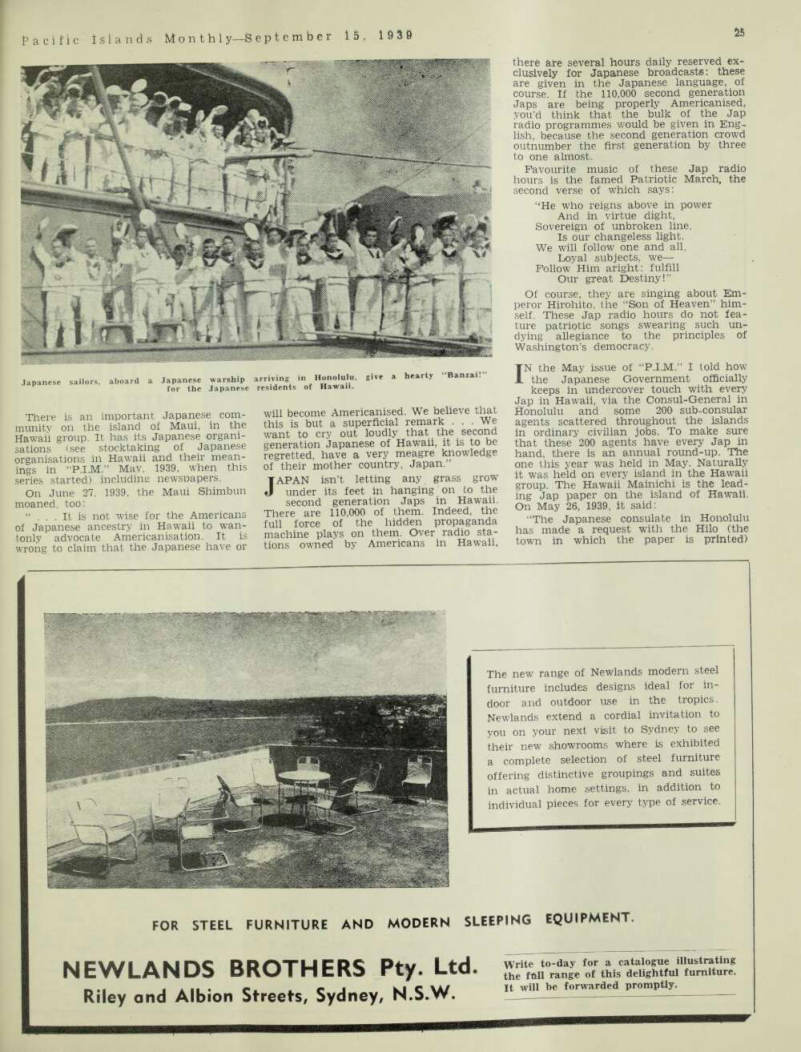
Japanese sailors, aboard a Japanese warship arriving in Honolulu, give a hearty Banzai, for the Japanese residents of Hawaii.
Japanese society to conduct an investi gation of the Japanese organisations for the study of the conditions of the Japanese residents in Hilo. According to this request, the investigation is to be conducted on a wide scale and is to in clude organisations'composed of American citizens of Japanese ancestry . .
The Maui Shimbun on the same day carried a similar appeal, but it listed in detail the array of Jap organisations, even down to Boy Scouts.
That these annual stocktakings of the Japanese strength in Hawaii are directly supervised by the consulate was proved when the Kauai Shimpo, a Jap paper published on the island of Kauai, on May 30, 1939, reported: “Vice-Consul Toshijiro Kudo, of the Japanese consulate, unexpectedly arrived here by plane on the morning of May 27 ... As the purpose of his visit is primar ily to consult with the consular agents of the various districts to bring about a smoother and faster execution of business, he is declining all receptions of a general nature . .
Of course, the Japs are worried about the impressions they make upon the Americans. They always refer to Ameri cans as foreigners, although, of course, America happens to own-Hawaii. Consul- General Midzusawa visited the island of Kauai in October, 1938, and the Nippu Jiji (the Jap “Sydney Morning Herald” of Hawaii) on October 24, 1938, reported that Midzusawa beseeched the Kauai Japs thus: “I urge each one of you to prudently take advantage of all opportunities in the future to enlighten foreigners and cor rect them in order to make diplomatic re lations as smooth as possible . .
JAPAN’S best implement in keeping a tight grip upon her nationals in Hawaii is the navy. Said the Honolulu Nippu Jiji on June 8, 1939: “Outside of China no other place is visited more frequently by the Japanese navy than Hawaii. Due to such relations, our navy is especially intimate with Hawaii . . ”
The Japanese in Hawaii are so devoted to the navy that on the island of Hawaii this year the Jap community decided to give a warplane to the Jap navy. The Jap undercover network swung into action and soon the price of a warplane had been secured. The man who gave the big gest cheque was Isaku Fujimoto, who happens to be the president of the Hilo Japanese Society. The money for the war plane was sent to Tokyo in American dol lars, in care of Captain Mitsuo Kinoshita of the Jap navy tanker Shiriya, on April 13. In time, the warplane was built—a naval attack ’plane—and it was christened “The Spirit of the Japanese in Hawaii”.
On July 8, at the Kasumigaura naval air base, it was ceremoniously turned over to the navy.
Most excited spokesman of all at the ceremony was Isaku Fujimoto himself, who travelled all the way from Hawaii for the event. That night, over Tokyo radio station JOAK, excited Fujimoto made a special broadcast to Jap listeners-in in Hawaii. Here is an extract: • . • Even the Japanese residents of Hawaii, separated by thousands of miles of water, are bent upon doing what little we can in (‘behind the front’ work) and think that we do not fall behind others in the manifestation of our sincerity to ward our mother country. Furthermore, we came to think of this warplane do nation to perform our duty as Japanese residents abroad . . ”
THE Jap navy thinks the Japs in Hawaii are fine. Here is what Cap tain Noboru Ishizaki, of the Jap navy tanker “Iro“, told the Jap press in Hawaii on October 25, 1938: “ . . . There is no other port which has so many Japanese as Hawaii. Our morale is raised and stimulated when we mingle with you, and our determination is strengthened to be diligent in our work.
Also, we wish to express our deep appre ciation for your ‘behind the front’ sincer ity, shown by donations of comfort bags, war relief and national defence money.”
On June 29, 1939, at a banquet in Hono lulu. Captain Kinoshita, of the navy tanker “Shiriya”, was more outspoken.
He said: “ , . . We, as men of the navy, possess the duty of comforting you who are play ing an active part in the first line of our oversea development . . .”
ANOTHER way in which Japan keeps the second generation (that is, all the Japs born in Hawaii) duly im pressed with their racial and cultural superiority is the continuous encourage ment of tours of Japan and North China, which are run at excursion rates by the Jap steamship lines. In commenting upon the excursions which are underway at the moment, the Hawaii Hochi, an other Honolulu Jap paper, on June 8, 1939, said: “ . . . Taking into consideration the training of personalities of the second generation Japanese youths going on these trips, the sponsors are planning to introduce as many prominent Japanese leaders and second generation Japanese in Japan as possible to contribute toward their training through inspiration by these greats . .
Speaking of Americanisation of U.S.
born Japs, these excursions are sponsored by committees of Jap businessmen, some of them U.S. born. It is noteworthy that these “Americanised” Japs don’t conduct
excursion tours of the U.S. mainland to better understand the American scheme.
An outstanding Honolulu Jap, behind the Japanisation of the U.S. born Japs, is Masayoshi Uyehara, proprietor of Kewalo Inn, top Jap restaurant in Honolulu.
Lately, he returned from a tour of Japan and North China, and on June 9 he told the Jap press in Honolulu: “ . . . The whole nation (Japan) is marching toward the ideal of national co-operation for the realisation of the aim of the great Asiatic crusade ... I have returned to Hawaii greatly im pressed with Japan’s endless power and deeply inspired by the people’s sincere attitude of unanimous co-operation.” fT\HE Japanese in Hawaii are co-operat- A ing okay. Second generation Japs born in the U.S. now are being specially trained in Jap industrial schools for work in North China. The Jap langu age schools in Hawaii actually are teach ing Chinese, to equip these youths even better. It is not a hurried job. The Japs know the “crusade” in the Orient (as they now call the China Incident > is going to be a long up-hill fight.
Said the Nippu Jiji of Honolulu on February 16, 1939:
. . . The future of the employment situation in Hawaii is becoming more and more gloomy . . . mainland America is hopeless and South America is anything but satisfactory. No matter what may be said, it is the Orient, after all ...” (Next month’s instalment will reveal details, quoting precisely from Japanese sources themselves, of Japan’s new plan for the Japanisation of as much of the world as Japan can masticate.)