Pacific Ships
Widespread Effect of War
r;E numerous shipping services which maintain contact with the Pacific territories have been sharply affected by the outbreak of war.
All British shipping services came under Admiralty control at midnight on August 26, and a week later, on September 3, when war broke out, all movements of British and French shipping became secret—that is to say, it is an offence to publish anything which might indicate to the enemy the position of an Allies ship.
In the past, the shipping timetables re presented an important section of the "Pacific Islands Monthly”—it has been our practice to publish timetables three and four months ahead. This was done without making any charge to the ship ping companies—it was recognised as in formation of considerable value to Pacific Islands residents.
Under war conditions, it is, of course, impossible to publish the timetables; but, as soon as the war is over, they will be restored. In the meantime we are allowed to publish only the fact—as will be seen from a perusal of our pages—that certain territories are regularly serviced by cer tain shipping lines.
Generous Action By Neutrals
We were advised by the Censor that we could publish the timetables of Dutch (K.P.M.) and American (Matson) ship ping lines. We asked the managers of the respective lines whether they had any objection to this publication. In each case, the managers of those neutral com panies asked us not to publish the time tables—not that they feared any attacks on their shipping by hostile submarines, but because they did not wish the British and French shipping companies to feel that they, as neutrals, were taking advan tage of British and French difficulties at this time.
Accordingly, we have not published the Dutch or American timetables and unless we receive a request to the contrary, they also will be withheld from publication un til the end of the war.
Submarines In Pacific
THERE is plenty of evidence to show that German submarines had been at sea for several days prior to the de claration of war; and, as Germany had between 40 and 50 submarines, ranging
from 500 to 750 tons, it is believed that at least a couple of score of these com merce-destroyers were at large in the oceans of the world. It was known, early in September, that several were operating in the North and South Atlantic, and it is . suspected that some got round into the Indian Ocean and the North Pacific.
It is known that at least two British ships have been sunk by German sub marines in the neighbourhood of the Philippine Islands.
So far, no shipping casualties have been reported in the South Pacific, but there apparently is some possibility of an attack. The utmost possible precautions are being taken by all British and French naval authorities in the Pacific.
Four German merchant vessels were in South Pacific ports and waters when war broke out; and, apparently, they all received sufficient warning to allow them to make a dash for safer places. Their fate is not known.
The “Friderun”
There was much interest in New Guinea concerning the fate of the “Friderun” — the N.D.L. steamer which for years has maintained a service between Hong Kong and New Guinea. The “Friderun” was due at Madang (on the north coast of New Guinea) on August 25, but she did not appear at that time; and at present, owing to the absence of shipping infor mation, no one in Sydney knows where she is. It is presumed that, when war broke out, she was somewhere between south-east Asia and Australia, and it is possible that she sought internment in a Dutch East Indies or Japanese port.
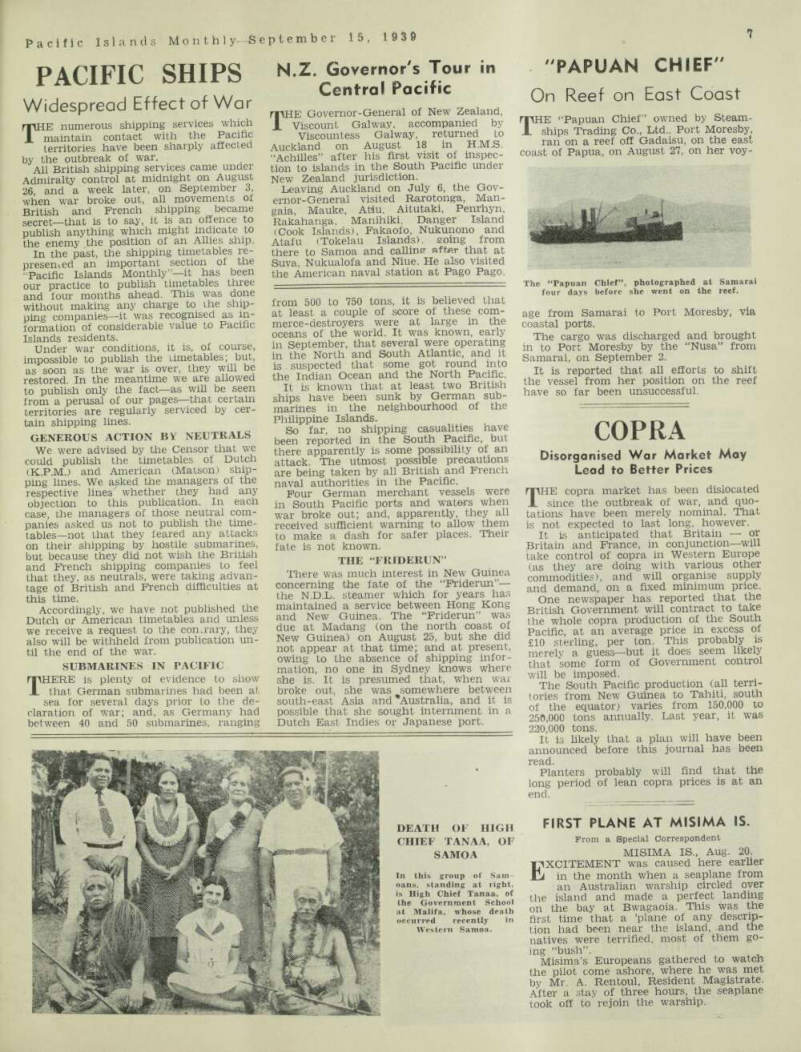
Death Of High
Chief Tanaa, Of
Samoa
In this group of Sam oans. standing at right, is High Chief Tanaa, of the Government School at Malifa, whose death occurred recently in Western Samoa.