No Amalgamation
Committee in Favour of Some Co-ordination of Services
THE nature of the report, submitted to the Australian Government by the Committee which considered the pos sible amalgamation of the Mandated Ter ritory of New Guinea and the Australian territory of Papua, was disclosed on Sep tember 12. The summaries which the daily newspapers published—as is usual in connection with Islands affairs —were garbled.
The Committee, as was expected, re jected the idea of amalgamation because so many difficulties now exist owing to differences in laws, in administrative methods and conditions and in widely different financial conditions, and because it is impossible, anyway, to reconcile the Mandate conditions with Papuan condi tions.
The report says that of all the sites submitted for New Guinea administration headquarters, as an alternative to Rabaul, Lae has the strongest claims. It has no harbour, but has a good anchorage; and it has all other necessary facilities, and none of the disadvantages possessed bv Madang (country low, flat and swampy), Salamaua (too low, and necessary to re claim swamp), Wau and Upper Ramu (building and living costs high owing to absence of communications), Bita Paka and Tavui (to be considered only as residential centres, if capital remains at Rabaul).
The Committee was unanimous on the following points; That general amalgamation is neither desirable nor practicable; that a feder ated system (namely, a Governor with authority over both territories, and the two temtories retaining practically sep arate administrations) had no advantage*
that a unified service would have no out standing advantage, and whatever minor advantages it might have would be can celled because of the difficulties such a system would create.
A majority of the Committee (Messrs.
Eggleston and Townsend) were of the opinion that some amalgamation of tech nical services would be worthy of consid eration; Mr. Murray was against this view.
The Committee considered that greater co-ordination of the two Administrations, with advantage to both and to Australia, was possible and could be secured by regu lar conferences between the Admini trators on a voluntary basis.
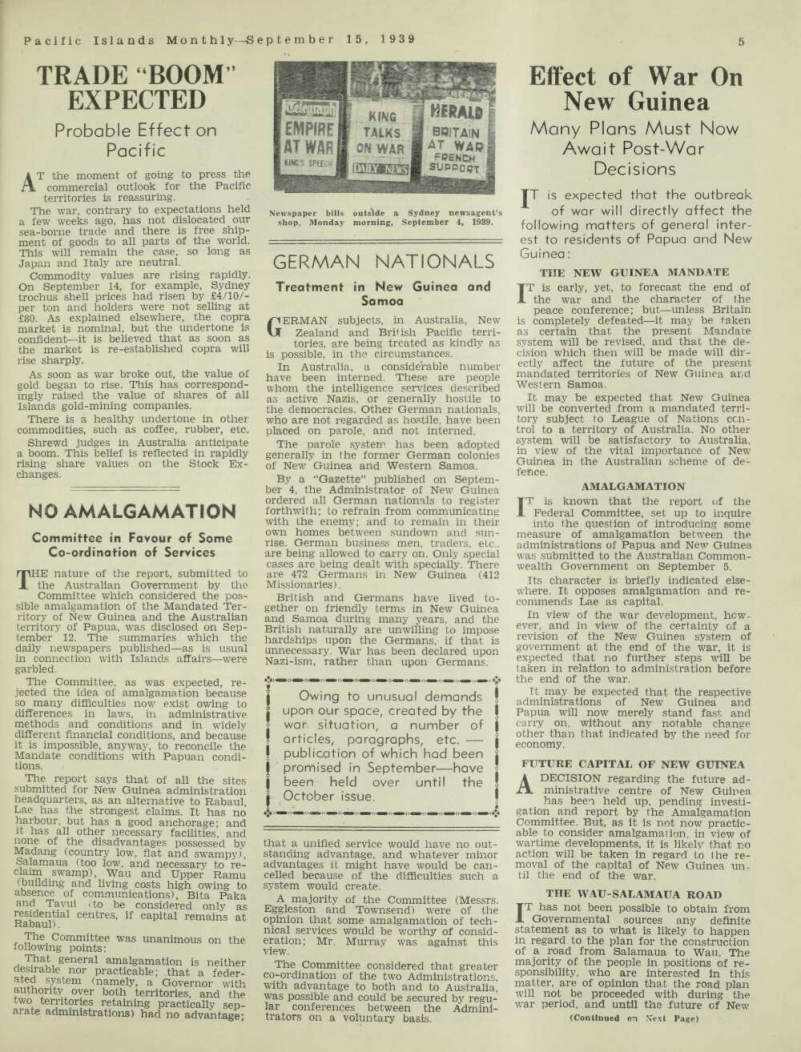
Newspaper bills outside a Sydney newsagent’s shop, Monday morning, September 4, 1939.