Luck Or Vision?
p. 86 · Read in the full issue
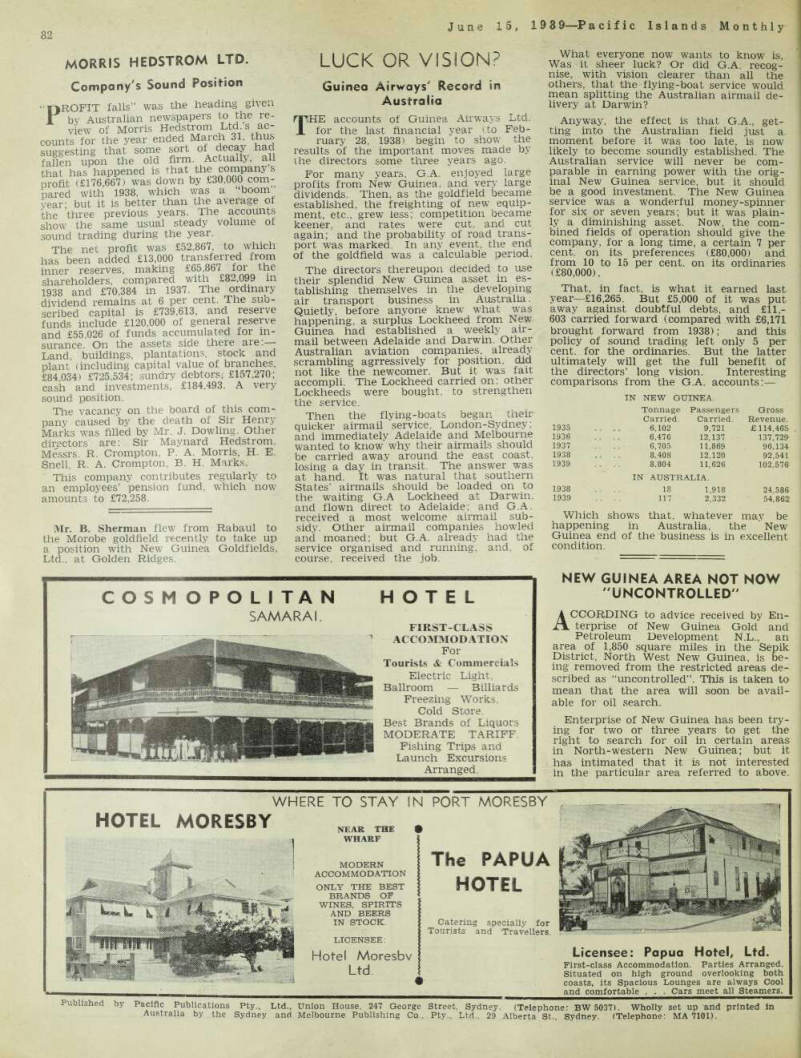
Guinea Airways' Record in Australia
TSHE accounts of Guinea Airways Ltd. for the last financial year (to Feb ruary 28, 1938) begin to show the results of the important moves made by the directors some three years ago.
For many years, G.A. enjoyed large profits from New Guinea, and very large dividends. Then, as the goldfield became established, the freighting of new equip ment, etc., grew less; competition became keener, and rates were cut. and cut again; and the probability of road trans port was marked. In any event, the end of the goldfield was a calculable period.
The directors thereupon decided to use their splendid New Guinea asset in es tablishing themselves in the developing air transport business in Australia.
Quietly, before anyone knew what was happening, a surplus Lockheed from New Guinea had established a weekly air mail between Adelaide and Darwin. Other Australian aviation companies, already scrambling agrressively for position, did not like the newcomer. But it was fait accompli. The Lockheed carried on: other Lockheeds were bought, to strengthen the service.
Then the flying-boats began their quicker airmail service. London-Sydney: and immediately Adelaide and Melbourne wanted to know why their airmails should be carried away around the east coast, losing a day in transit. The answer was at hand. It was natural that southern States’ airmails should be loaded on to the waiting G.A Lockheed at Darwin, and flown direct to Adelaide; and G.A. received a most welcome airmail sub sidy. Other airmail companies howded and moaned: but G.A. already had the service organised and running, and. of course, received the job.
What everyone now wants to know is, Was it sheer luck? Or did G.A. recog nise, with vision clearer than all the others, that the flying-boat service would mean splitting the Australian airmail de livery at Darwin?
Anyway, the effect is that G.A., get ting into the Australian field just a moment before it was too late, is now likely to become soundly established. The Australian service will never be com parable in earning power with the orig inal New Guinea service, but it should be a good investment. The New Guinea service was a wonderful money-spinner for six or seven years; but it was plain ly a diminishing asset. Now, the com bined fields of operation should give the company, for a long time, a certain 7 per cent, on its preferences (£80,000) and from 10 to 15 per cent, on its ordinaries (£80,000).
That, in fact, is what it earned last year—£l6,26s. But £5,000 of it was put away against doubtful debts, and £ll.- 603 carried forward (compared with £6,171 brought forward from 1938); and this policy of sound trading left only 5 per cent, for the ordinaries. But the latter ultimately will get the full benefit of the directors’ long vision. Interesting comparisons from the G.A. accounts;—
In New Guinea.
Which shows that, whatever may be happening in Australia. the New Guinea end of the business is in excellent condition.
Tonnage Passengers Gross Carried.
Carried.
Revenue. 1935 6,102 9,721 £114,465 1936 6.476 12,137 137,729 1937 6,705 11,869 96,134 1938 8,403 12,120 92,541 1939 8,804 11,626 102,576
In Australia.
1938 18 1,918 24,586 1939 117 2,332 54,862