Crocodile Is
p. 51 · Read in the full issue
Taken
After Swallowing a Native Labourer
From a Special Correspondent.
Namatanai, May 3.
A FEW weeks ago, Mr. Harry Waters, veteran of Gallipoli and France, the well-known manager of B.P.’s Bo pire plantation, at Namatanai, New Ireland, New Guinea, on making line one morning, noticed that one of his Aitape boys, a sturdy youngster named Kamot, was absent.
Inquiries revealed that, the previous
night, he had gone to sleep, with four or five of his coun trymen, in a house built quite close tp the bank of the Bo pire River, which has a bad reputation for crocodiles.
Since Mr. Waters’ arrival, sev eral dogs had been taken from the bank, but no human be ings had been attacked.
It appears that as was his custom, Kamot got up and went down to the river’s brink at about 4 a.m. to bathe and comb his hair, before making line. Shortly after he left, one of his mates heard a scream, but either fear or indifference prevented him from going out to investigate. Beyond doubt, the unfortunate Kamot had been taken by a crocodile.
A search of the bank dis closed signs of a desperate
struggle. Young mangrove trees were torn out by the roots, others were broken
and bent. The poor boy had made a strong battle for life, before he was dragged, screaming, into the water, and to the saurian’s lair.
Mr. Waters determined to catch or kill the murderer. Soon after the tragedy, having located the den of the crocodile under the bank, just over a deep pool, Mr. Waters, accompanied by Roadmaster Wright, and a number of boys, went to the place, armed with 10 lbs. of dyna mite and a small-bore pistol.
One charge was flung into the hole, but without effect, except a few bubbles breaking on the surface. The second, and heavier charge, however, produced ex cellent results. A column of stones and mud was hurled into the air, the earth trembled, and when the commotion had
ceased, the watchers on the bank saw a monster crocodile whirling around on the surface, threshing the water with its tail, its huge jaws clashing, its arm ed feet waving frantically in the air, evidently badly hit, or in its death throes.
Mr. Wright at once emptied two cart ridges into the brute —and it was subse quently discovered that they took effect in its belly near the tail. Before the dumb-stricken natives could do anything, the crocodile disappeared below the sur face.
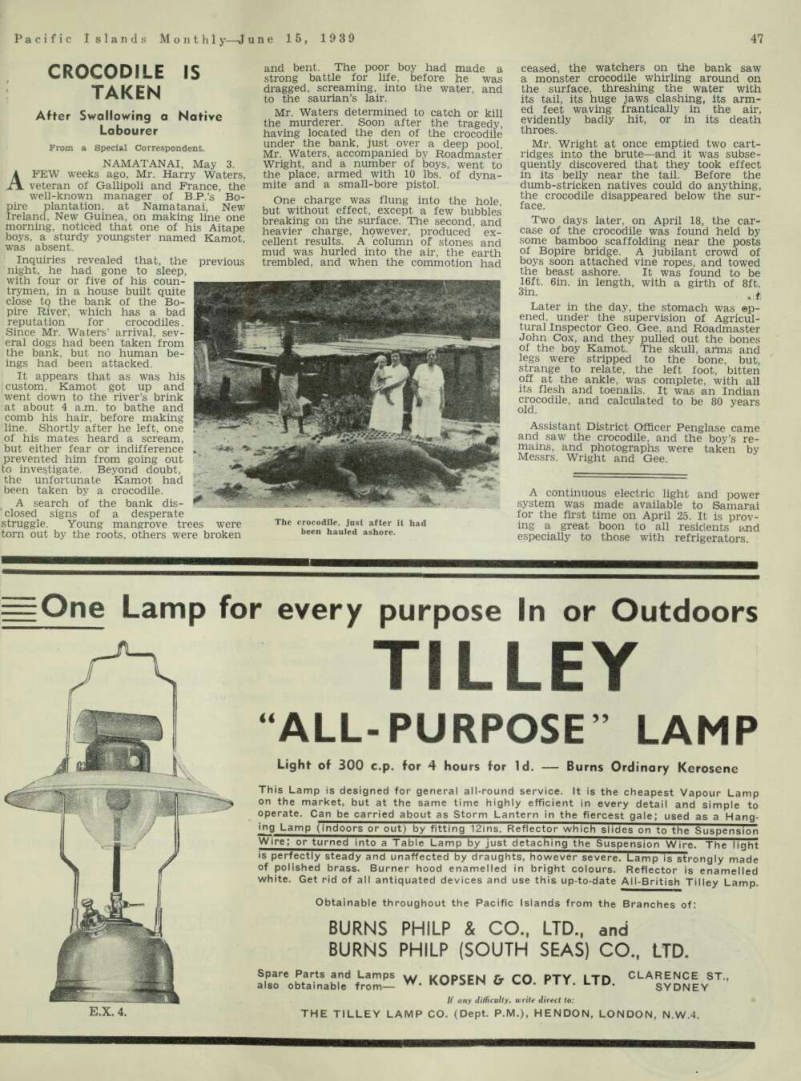
Two days later, on April 18, the car case of the crocodile was found held by some bamboo scaffolding near the posts of Bopire bridge. A jubilant crowd of boys soon attached vine ropes, and towed the beast ashore. It was found to be 16ft. 6in. in length, with a girth of Bft.
Sin. f * 1 1, Later in the day, the stomach was op ened, under the supervision of Agricul tural Inspector Geo. Gee, and Roadmaster John Cox, and they pulled out the bones of the boy Kamot. The skull, arms and legs were stripped to the bone, but, strange to relate, the left foot, bitten off at the ankle, was complete, with all its flesh and toenails. It was an Indian crocodile, and calculated to be 80 years old.
Assistant District Officer Penglase came and saw the crocodile, and the boy’s re mains, and photographs were taken by Messrs. Wright and Gee.
A continuous electric light and power system was made available to Samarai for the first time on April 25. It is prov ing a great boon to all residents and especially to those with refrigerators.
The crocodile, just after it had been hauled ashore.