Across The Indian Ocean
pp. 31-33 · Read in the full issue
"Cuba" Leaves on Unique Survey Flight
ON June 3. the great flying-boat “Guba” familiar to residents of Western New Guinea and Papua during the past year, while providing transport for the Archbold expedition, in Dutch New Guinea —left Sydney on an historic trip.
It is being used to survey a new airmail route betw r een Australia and England, via
the Middle Indian Ocean and Central and West Africa.
For years, Captain P. G. Taylor, of Sydney, associate of “Smithy” and Ulm in flights that made history, has cherished the hope that one day he would accom plish the flight from Australia to Africa across the Indian Ocean—the only major
ocean crossing still to be attempted.
Captain Taylor has many times pointed out the vulnerability of the present air mail route to Australia, due to the possi bility of trouble in the Mediterranean and through the East, and he has advo cated that this new route should be ex plored as an alternative. In December, 1937, he flew to England in search of sup port and suitable equipment, but nothing was available. Now, however, the Com monwealth Government has agreed to finance the flight, and the British Gov ernment will contribute up to £3,500.
The Government has chartered from Mr. Archbold (Research Associate of the
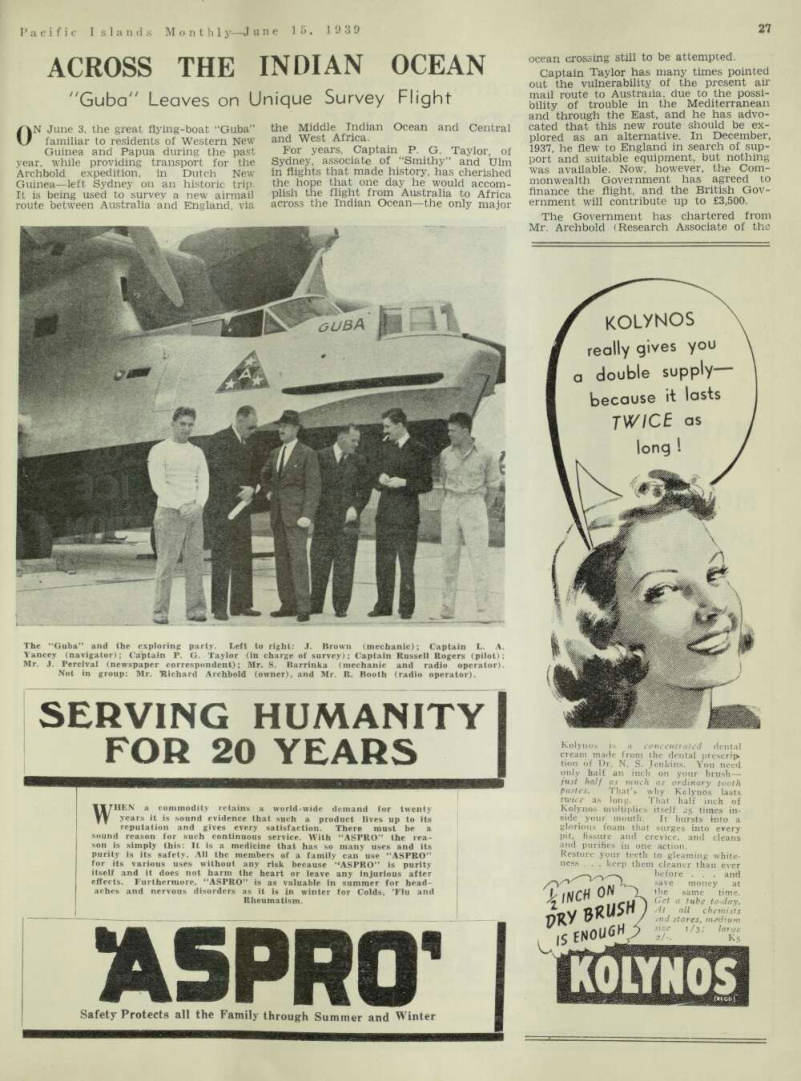
The “Cuba” and the exploring party. Left to right: J. Brown (mechanic); Captain L. A.
Yancey (navigator); Captain P. G. Taylor (in charge of survey); Captain Russell Rogers (pilot); Mr. J. Percival (newspaper correspondent); Mr. S. Barrinka (mechanic and radio operator).
Not in group; Mr. Richard Archbold (owner), and Mr. R. Booth (radio operator).
American Museum of Natural History) his flying-boat “Cuba”, which arrived in Sydney from New Guinea on May 14.
Captain Taylor is in charge of the sur vey, to ascertain the value of the islands en route for flying-boat bases, land plane aerodromes, and for aviation generally, and this work will include the sounding of coral lagoons to determine their suit ability for flying-boats. With Captain Taylor are Mr. Archbold and his crew of five, and Mr. J. Percival, second repre sentative of the Commonwealth Govern ment and newspaper correspondent.
The route of the flight is from Port Hedland, West Australia, to Cocos Island (approximately 1.230 nautical miles); from Cocos Island to Diego Garcia Island, in the Chagos Archipelago (1,472 nautical miles); from Diego Garcia to Port Vic toria. on Mahe Island, in the Seychelles (1,022 nautical miles); and from the Sey chelles to Mombasa, in Kenya Colony (950 nautical miles).
After leaving Pt. Hedland (W.A.) on June 4 on the first stage of the flight, the “Guba’s” navigator (Capt. Yancey) was unable to find Cocos Island, owing to bad weather conditions. The course was changed N.E. and the “Guba” flew to Batavia. Dutch East Indies. ft took off for Cocos two days later.
After reaching Africa Captain Taylor «nd Mr Percival will return to Australia by boat, but Mr. Archbold will continue the flight across Africa and the Atlantic Ocean to the United States, thus com pleting a flight round the world.
Vacuum Oil Company Pty., Ltd., sent 2.500 gallons of petrol and supplies of oil by ship from Perth to Cocos Island; from India to Diego Garcia; and from South Africa to the Seychelles; and sup plies have been provided by the Com pany at all other points required between Africa and U.S.A.
The party propose to remain about a week at each island stopping-place, dur ing which period, while Captain Taylor is carrying out the survey, Mr. Archbold will undertake scientific studies, as these islands have never been visited by an ex pert biologist.