Secrets Of Japan's Mandated Islands
pp. 15-18 · Read in the full issue
The Bitter "Undercover" Struggle in the Northern Pacific
By John Williams
Honolulu, May 15.
DURING the row in the U.S. Congress about whether America should convert Guam into a substantial navy base, the State Department was asked point blank what information it had upon the Japanese mandated islands which surround Guam.
On March 13, the department assured
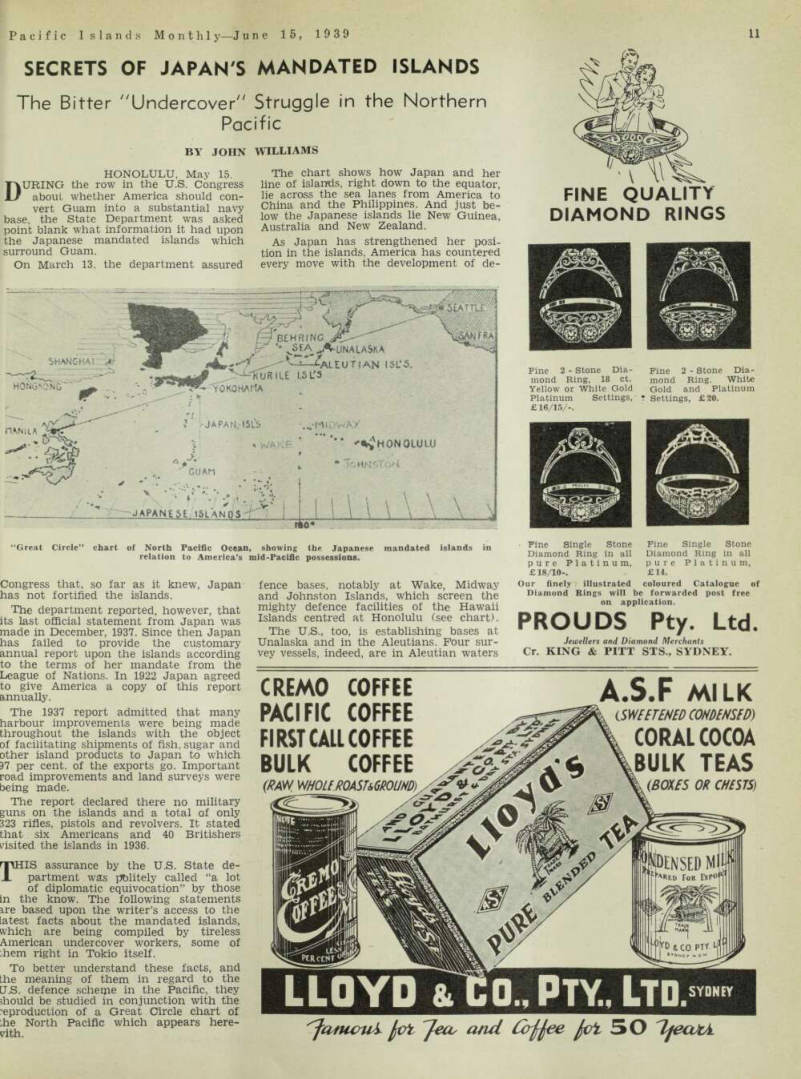
The chart shows how Japan and her line of islands, right down to the equator, lie across the sea lanes from America to China and the Philippines. And just be l°w the Japanese islands he New Guinea, Australia and New Zealand, As Japan has strengthened her posi tion in the islands, America has countered every move with the development of de-
Congress that, so far as it knew, Japan has not fortified the islands.
The department reported, however, that its last official statement from Japan was made in December, 1937. Since then Japan has failed to provide the customary annual report upon the islands according to the terms of her mandate from the League of Nations. In 1922 Japan agreed to give America a copy of this report annually.
The 1937 report admitted that many harbour improvements were being made throughout the islands with the object of facilitating shipments of fish, sugar and other island products to Japan to which ?7 per cent, of the exports go. Important road improvements and land surveys were being made.
The report declared there no military guns on the islands and a total of only 323 rifles, pistols and revolvers. It stated that six Americans and 40 Britishers visited the islands in 1936.
FIS assurance by the U.S. State de partment was pblitely called “a lot of diplomatic equivocation” by those in the know. The following statements ire based upon the writer’s access to the latest facts about the mandated islands, which are being compiled by tireless American undercover workers, some of :hem right in Tokio itself.
To better understand these facts, and the meaning of them in regard to the LT.S. defence scheme in the Pacific, they ;hould be studied in conjunction with the 'eproduction of a Great Circle chart of :he North Pacific which appears here vith.
fence bases, notably at Wake, Midway and Johnston Islands, which screen the defence facilities of the Hawaii Islands centred at Honolulu (see chart), The U.S., too, is establishing bases at Unalaska and in the Aleutians. Four sur vey vessels, indeed, are in Aleutian waters
“Great Circle” chart of North Pacific Ocean, showing the Japanese mandated islands in relation to America’s mid-Pacific possessions.
now chartering a shorter great circle route from Pacific coast ports to the Asiatic mainland. This will shorten the route now commonly used by at least 100 miles and keep the ships more in Alaskan waters, where westerly storms are less severe.
At present, the great circle route is laid to the south of the Aleutians, a region frequently menaced by fogs. The line from Seattle to Manila on the chart herewith shows the proposed new route.
AMERICA boldly has gone below the equator in her countering of Japan.
Notable example is her decision to eventually convert Canton Island (north west of Samoa) and Rose Island (east of Samoa) into navy, air. submarine and destroyer bases.
America, with methodic purpose, is pouring billions of dollars into making and maintaining this great Pacific de
fence front, from Alaska to Samoa, as im pregnable as possible and this determina tion is perhaps the strongest point in America’s (apparently) undefined Pacific policy. At least, this defence bulwark is much more effective than the whims and rhetoric of the parochial politicians who live in the headlines back in Washington. rE navy, indeed, knows much more about the mandated islands than it cares to tell. The information is amazingly complete.
Right after America and Japan in 1922 agreed to exchange annual statements about the islands, first American to pop into them was William Herbert Hobbs, a specialist in corals and islands festoons, and he ostensibly was sponsored by the University of Michigan, but both the U.S. and Japanese navies, to use his own words, helped him to see the islands in “exceptional ways”. In 1923, my good
friend Junius Woods, a “Chicago Tribune” reporter, toured the islands, and much of the time he was accompanied by Albert W. Herre, an American fisheries expert.
Outstanding was the visit of Professor Paul Hibbert Clyde, of the University oi Kentucky, in 1935. As a result he wrote the masterly “Japan’s Pacific Mandate’ (Macmillan, 3 dollars), which is the most exhaustive and authoritative job done so far. That is, from the alien point of view.
There is little Japanese literature in English upon the islands. Most complete Japanese effort in Englisn is “Japan s Mandate in the South Seas”, by iadao Yanaihara, professor of economics, of the Imperial University, Tokio. He was given extraordinary official facilities and research aid, but his book to-day is only in manuscript form. The Institute of Pacific Relations in New York has a copy, and in due course it will be published.
The bulk of the American observers worked in cahoots with the U.S. navy. Men were specially chosen for their skill at observing—and remembering. The infor mation and photographs, which they later published, are superficial alongside the data which they turned over to secret hies in Washington.
The navy, of course, sends in under cover workers on its own account—and they don’t write books—if they escape!
IN 1932 there was an exciting incident — which ended in death. Two navy offi cers were assigned to get into the is lands and find out everything they could —from the navy angle.
For several months they lived “on the beach” in Hawaii. They suntanned deeply, studied Pacific languages, lived with Fili pinos and Japanese, and generally ac quired native angles of living and acting.
They became skilled in dialects.
Eventually they shipped into the is lands as hapa-haole (half-caste) seamen.
One of them never came back.
The survivor wrote a startling report about concrete artillery foundations, oil tanks, aircraft and submarine facilities— facts which were not mentioned in the annual reports made by Japan to the League of Nations and to America. Phis instance vividly let America know that Japan means business about her navy inspired drive southwards.
Immediately upon consideration of this dramatic report, America acted. Then be gan the “crop” of so-called annexations of long-forgotten and outlying isles, and the methodic development of them into “listening posts” and air and navy bases.
Outstanding among these is Wake, Mid way and Johnston Islands. Millions of dollars already have been poured into “improving” them. And the navy has clamped super-secret restrictions upon them. rE navy uses another angle: news paper reporters who are assigned to the Orient for U.S. mainland papers.
Some of these men become linguists. That it to say, a man assigned to Tokio (long before he goes) becomes skilled in Japan ese. In Tokio he acts dumb and conse quently overhears much valuable infor mation (and comment) during his move ments along official “beats”. These highly trained men actually become official ob servers and, by devious ways, they main tain contact with the U.S. army and navy networks.
These networks reciprocate. Thus, a re porter builds up his professional prestige and soon the world wonders at his un canny ability at forecasting outstanding international “developments”.
TO bring the facts of this story right up to date, lately I had access to a file of reports sent to the U.S, Govern ment by one of these newspaper observers.
Regarding the mandated isles, he wrote: •* . . The Overseas Ministry are choking off my application to vacation in the is lands because ‘restrictions on travel by foreigners are still in effect’. The re strictions include the island of Yap; which is strange, because it violates the special treaty between Japan and the U.S., which guaranteed the citizens of both countries the right of travel, entry and similar free dom of movement into Yap. Now Ameri cans are shut out.
“America allows Japanese freedom of travel in all U.S. territories, especially along the U.S. commercial air route from California to Hong Kong, which uses some of the secret navy island bases en route.
July last a former Japanese naval attache for air at Washington made this flight, although a U.S. navy intelligence worker was placed in the clipper’s crew especi ally to watch this Japanese. It was re ported that he attempted to see all he could at the bases.
“Japan, however, insists she is per
fectly within her rights in restricting travel, as she holds the islands under a Class C mandate, which provides that the mandated territory shall be governed under the laws of the country holding such mandate . . .
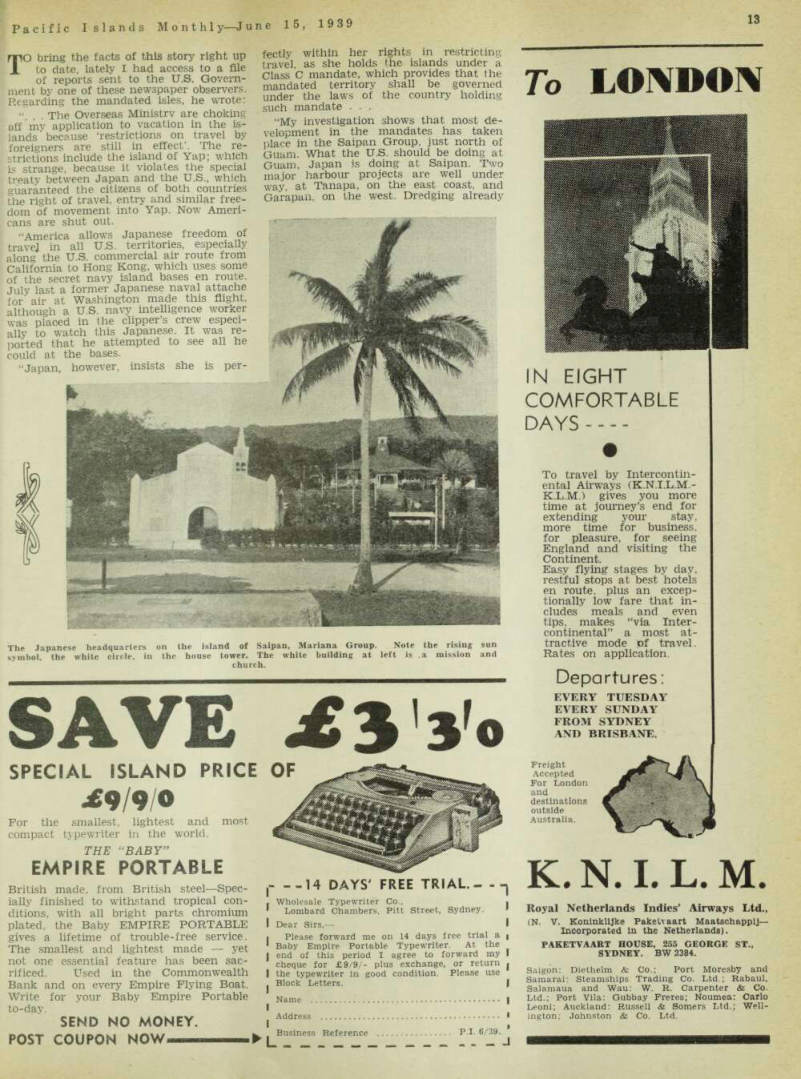
“My investigation shows that most de velopment in the mandates has taken place in the Saipan Group, just north of Guam. What the U.S. should be doing at Guam, Japan is doing at Saipan. Two major harbour projects are well under way, at Tanapa, on the east coast, and Garapan, on the west. Dredging already
The Japanese headquarters on the island of Saipan, Mariana Group. Note the rising sun symbol, the white circle, in the house tower. The white building at left is a mission and church.
has made fine anchorages for destroyers, submarines and airboats.
“Major developments also are taking place in the Palau Group, which lies with in ridiculously easy steaming and flying distance of the Philippines and New Guinea. Within Japan it is frankly ad mitted that Palau will be the springboard for the contemplated expansions into the Philippines, the Indies and New Guinea.
Japan wants their fathomless resources.
“Japan’s leading steamship company, which monopolises bookings for the is lands, told me that all steamers are booked for years ahead, a polite way of telling me to go to hell. . . .”
USING U. S. patterns for the ’planes, engines and instruments, a Japanese air company now is networking the entire mandated group so that, in effect, Japanese ’planes already are within site of New Guinea, in the same way as the American airway cuts through the Japan ese mandate at Guam.
In October, 1936, I twice flew in an American ’plane from Guam, and we pro ceeded to find out how close we could get to Rota, only 30 miles away, the nearest Japanese island to Guam; but pretty soon a Japanese radio station on Rota tapped a warning to keep away!
Below our wings were spread some of
the tiny isles that are scattered across more than a million square miles of the Pacific, an oceanic milky way that seems destined to inflame war passions.
Below us lay quiet lagoons, sheltered bays—fine roosting places for wings of death and hide-outs for stealthy under water prowlers. A vastness of ageless skies, ageless seas. In them fate is weaving a fantastic pattern. 1 THOUGHT of a precedent the Japanese quote. More than 500 years ago, the famed Satsuma clan set off from Japan in Malay junks and invaded the island of Luzon, in the Philippines.
November last, 500 years later, the Japanese came again. This time in fish ing sampans and trawlers. They landed. 200 of them, on Palawan Island and created serious disorders and bloodshed.
Filipino constabulary finally routed them.
The Japanese will come again. Their southward expansion is a national creed.
It is gaining momentum—and arrogance.
Their greed is being appeased by the Powers. They have snapped up the strategic Hainan and Spratley Islands.
America has appeased by stalling with Guam.
As the Japanese advance, they demand equal rights, the Open Door. When they have entered, they drive out rivals, then slam the door. The equality they demand in the Philippines, they refuse in the man dated isles. Why? (The next instalment of this series concerning Japanese expansion tactics in the Pacific will deal with Japan’s latest weapon: the development of wasp-like trawlers that, in effect, are long-range scouts and minelayers. To-day they are hovering near New Guinea, near the Indies, in Hawaii, Alaska, California, Mexico and Panama waters.
They trailed the U.S. battle fleet into the Atlantic during the recent war games. They are manned by navy-trained ratings. In emergencies they will menace all the shipping lanes.
Flotillas of them are familiarising them selves with equatorial waters from bases in the mandated groups.
These “trawlers” carry mines and torpedo tubes, cannon and anti-aircraft batteries.
Full details, including cross-section drawings that reveal the secret emplace ment, will be given in next month’s in stalment.)