Tropicalities
p. 13 · Read in the full issue
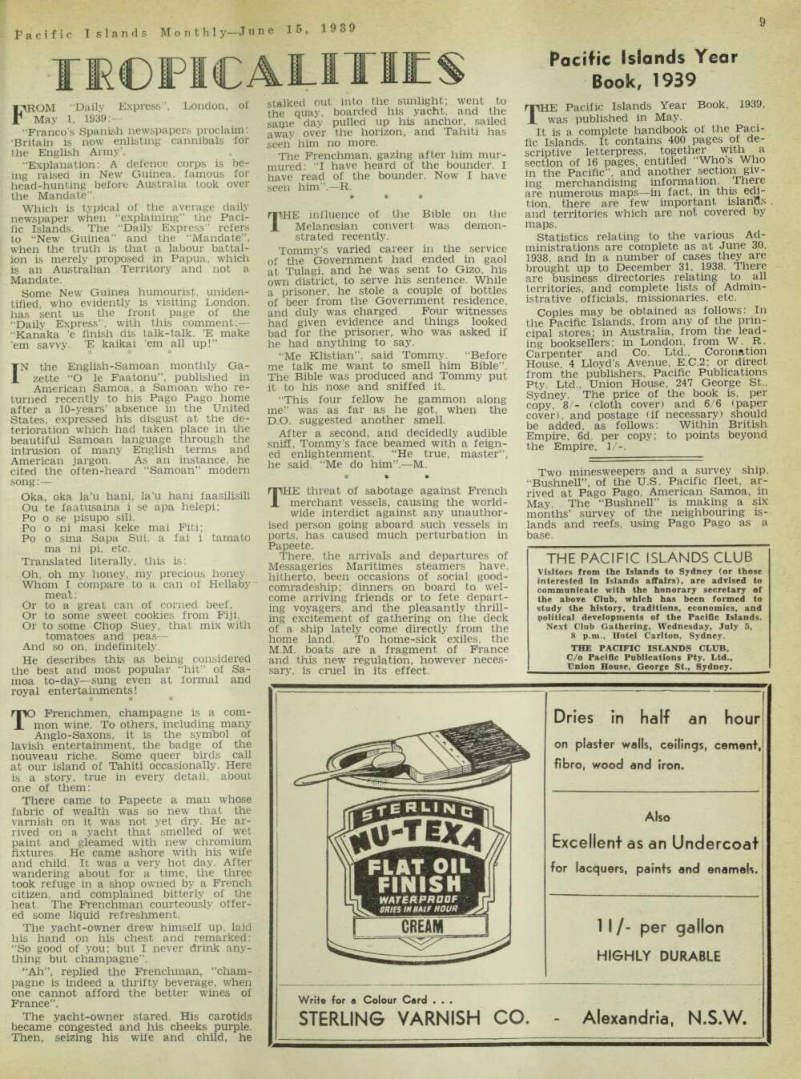
JIROM “Daily Express’, London, of 1 May 1, 1939; “Franco's Spanish newspapers proclaim: •Britain is now enlisting cannibals for the English Army’.
“Explanation; A defence corps is be ing raised in New Guinea, famous for head-hunting before Australia took over the Mandate”.
Which is typical of the average daily newspaper when “explaining” the Paci fic Islands. The “Daily Express” refers to “New Guinea” and the “Mandate”, when the truth is that a labour battal ion is merely proposed in Papua, which is an Australian Territory and not a Mandate.
Some New Guinea humourist, uniden tified, who evidently is visiting London, has sent us the front page of the “Daily Express”, with this comment:— “Kanaka ’e finish dis talk-talk. ’E make ’em savvy. E kaikai ’em all up!”
IN the English-Samoan monthly Ga zette “O le Faatonu”, published in American Samoa, a Samoan who re turned recently to his Pago Pago home after a 10-years’ absence in the United States, expressed his disgust at the de terioration which had taken place in the beautiful Samoan language through the intrusion of many English terms and American jargon. As an instance, he cited the often-heard “Samoan” modern song:— Oka, oka la’u hani, la’u hani faasilisili Ou te faatusaina i se apa helepi; Po o se pisupo sili, Po o ni masi keke mai Fiti; Po o sina Sapa Sui, a fai i tamato ma ni pi, etc.
Translated literally, this is; Oh, oh my honey, my precious honey Whom I compare to a can of Hellaby meal: Or to a great can of corned beef, Or to some sweet cookies from Fiji, Or to some Chop Suey, that mix with tomatoes and peas— And so on, indefinitely.
He describes this as being considered the best and most popular “hit” of Sa moa to-day—sung even at formal and
royal entertainments!
* * * ri Frenchmen, champagne is a com mon wine. To others, including many Anglo-Saxons, it is the symbol of lavish entertainment, the badge of the nouveau riche. Some queer birds call at our island of Tahiti occasionally. Here is a story, true in every detail, about one of them: There came to Papeete a man whose fabric of wealth was so new that the varnish on it was not yet dry. He ar rived on a yacht that smelled of wet paint and gleamed with new chromium fixtures. He came ashore with his wife and child. It was a very hot day. After wandering about for a time, the three took refuge in a shop owned by a French citizen, and complained bitterly of the heat. The Frenchman courteously offer ed some liquid refreshment.
The yacht-owner drew himself up, laid his hand on his chest and remarked: “So good of you; but I never drink any thing but champagne”.
“Ah”, replied the Frenchman, “cham pagne is indeed a thrifty beverage, when one cannot afford the better wines of France”.
The yacht-owner stared. His carotids became congested and his cheeks purple.
Then, seizing his wife and child, he
stalked out into the sunlight; went to the quay, boarded his yacht, and the saipe day pulled up his anchor, sailed away over the horizon, and Tahiti has seen him no more.
The Frenchman, gazing after him mur mured: “I have heard of the bounder. I have read of the bounder. Now I have seen him”. —R. * ♦ * THE influence of the Bible on the Melanesian convert was demon strated recently.
Tommy’s varied career in the service of the Government had ended in gaol at Tulagi. and he was sent to Gizo, his own district, to serve his sentence. While a prisoner, he stole a couple of bottles of beer from the Government residence, and duly was charged. Four witnesses had given evidence and things looked bad for the prisoner, who was asked if he had anything to say.
“Me Klistian”. said Tommy. “Before me talk me want to smell him Bible”.
The Bible was produced and Tommy put it to his nose and sniffed it.
“This four fellow he gammon along me” was as far as he got, when the D.O. suggested another smell.
After a second, and decidedly audible sniff, Tommy’s face beamed with a feign ed enlightenment. “He true, master”,
he said. “Me do him”.
M.
THE threat of sabotage against French merchant vessels, causing the world wide interdict against any unauthor ised person going aboard such vessels in ports, has caused much perturbation in Papeete.
There, the arrivals and departures of Messageries Maritimes steamers have, hitherto, been occasions of social good comradeship: dinners on board to wel come arriving friends or to fete depart ing voyagers, and the pleasantly thrill ing excitement of gathering on the deck of a ship lately come directly from the home land. To home-sick exiles, the M.M. boats are a fragment of France and this new regulation, however neces sary, is cruel in its effect.