Approaching
pp. 5-6 · Read in the full issue
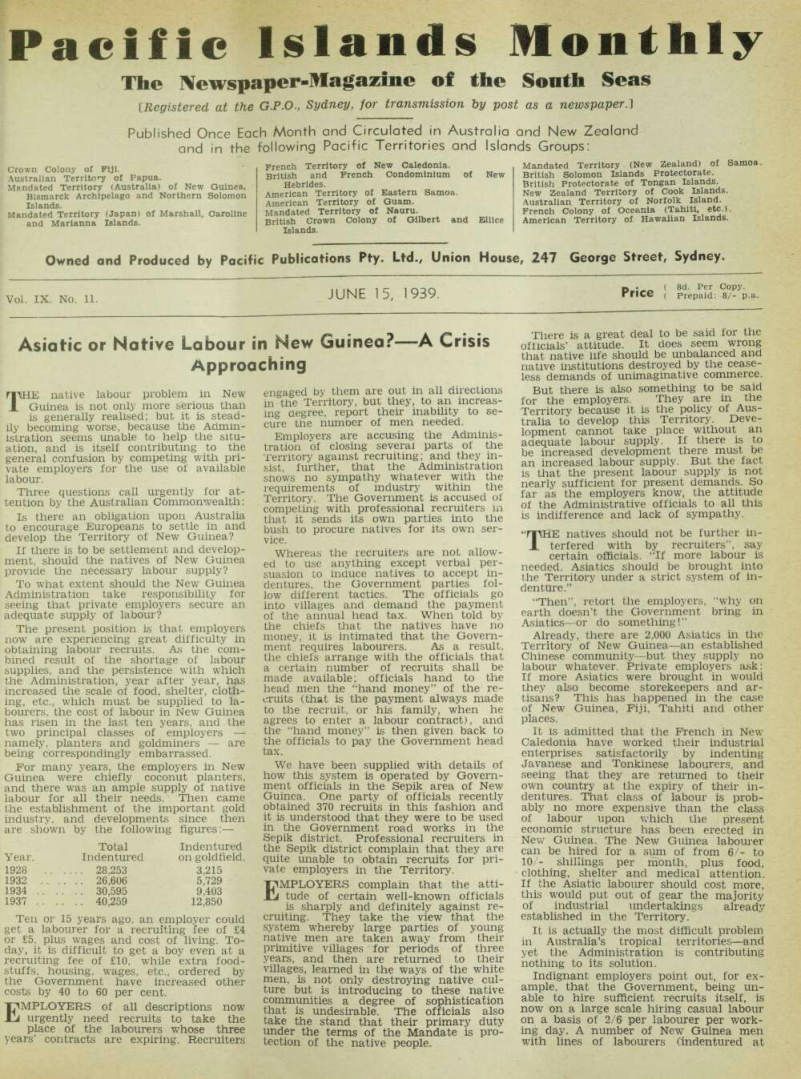
Asiatic or Native Labour in New Guinea? —A Crisis Approaching
THE native labour problem in New Guinea is not only more serious than is generally realised; but it is stead ily becoming worse, because the Admin istration seems unable to help the situ ation, and is itself contributing to the general confusion by competing with pri vate employers for the use of available labour.
Three questions call urgently for at tention by the Australian Commonwealth: Is there an obligation upon Australia to encourage Europeans to settle in and develop the Territory of New Guinea?
If there is to be settlement and develop ment, should the natives of New Guinea provide the necessary labour supply?
To what extent should the New Guinea Administration take responsibility for seeing that private employers secure an adequate supply of labour?
The present position is that employers now are experiencing great difficulty in obtaining labour recruits. As the com bined result of the shortage of labour supplies, and the persistence with which the Administration, year after year, has increased the scale of food, shelter, cloth ing, etc., which must be supplied to la bourers, the cost of labour in New Guinea has risen in the last ten years, and the two principal classes of employers namely, planters and goldminers are being correspondingly embarrassed.
For many years, the employers in New Guinea were chiefly coconut planters, and there was an ample supply of native labour for all their needs. Then came the establishment of the important gold industry, and developments since then are shown by the following figures:—
Ten or 15 years ago, an employer could get a labourer for a recruiting fee of £4 or £5, plus wages and cost of living. To day, it is difficult to get a boy even at a recruiting fee of £lO, while extra food stuffs. housing, wages, etc., ordered by the Government have increased other costs by 40 to 60 per cent.
EMPLOYERS of all descriptions now urgently need recruits to take the place of the labourers whose three years’ contracts are expiring. Recruiters
engaged by them are out in all directions in the Territory, but they, to an increas ing degree, report their inability to se cure the number of men needed.
Employers are accusing the Adminis tration of closing several parts of the Territory against recruiting; and they in sist, further, that the Administration shows no sympathy whatever with the requirements of industry within the Territory. The Government is accused of competing with professional recruiters in that it sends its own parties into the bush to procure natives for its own ser vice.
Whereas the recruiters are not allow ed to use anything except verbal per suasion to induce natives to accept in dentures, the Government parties fol low different tactics. The officials go into villages and demand the payment of the annual head tax. When told by the chiefs that the natives have no money, it is intimated that the Govern ment requires labourers. As a result, the chiefs arrange with the officials that a certain number of recruits shall be made available; officials hand to the head men the “hand money” of the re cruits (that is the payment always made to the recruit, or his family, when he agrees to enter a labour contract), and the “hand money” is then given back to the officials to pay the Government head tax.
We have been supplied with details of how this system is operated by Govern ment officials in the Sepik area of New Guinea. One party of officials recently obtained 370 recruits in this fashion and it is understood that they were to be used in the Government road works in the Sepik district. Professional recruiters in the Sepik district complain that they are quite unable to obtain recruits for pri vate employers in the Territory.
EMPLOYERS complain that the atti tude of certain well-known officials is sharply and definitely against re cruiting. They take the view that the system whereby large parties of young native men are taken away from their primitive villages for periods of three years, and then are returned to their villages, learned in the ways of the white men, is not only destroying native cul ture but is introducing to these native communities a degree of sophistication that is undesirable. The officials also take the stand that their primary duty under the terms of the Mandate is pro tection of the native people.
There is a great deal to be said for the officials’ attitude. It does seem wrong that native life should be unbalanced and native institutions destroyed by the cease less demands of unimaginative commerce.
But there is also something to be said for the employers. They are in the Territory because it is the policy of Aus tralia to develop this Territory. Deve lopment cannot take place without an adequate labour supply. If there is to be increased development there must be an increased labour supply. But the fact is that the present labour supply is not nearly sufficient for present demands. So far as the employers know, the attitude of the Administrative officials to all this is indifference and lack of sympathy.
“rpHE natives should not be further in- I terfered with by recruiters”, say certain officials. ‘Tf more labour is needed, Asiatics should be brought into the Territory under a strict system of in denture.”
“Then”, retort the employers, ‘‘why on earth doesn’t the Government bring in Asiatics —or do something!”
Already, there are 2,000 Asiatics in the Territory of New Guinea —an established Chinese community—but they supply no labour whatever. Private employers ask: If more Asiatics were brought in would they also become storekeepers and ar tisans? This has happened in the case of New Guinea, Fiji, Tahiti and other places.
It is admitted that the French in New Caledonia have worked their industrial enterprises satisfactorily by indenting Javanese and Tonkinese labourers, and seeing that they are returned to their own country at the expiry of their in dentures. That class of labour is prob ably no more expensive than the class of labour upon which the present economic structure has been erected in New Guinea. The New Guinea labourer can be hired for a sum of from 6/- to 10 - shillings per month, plus food, clothing, shelter and medical attention.
If the Asiatic labourer should cost more, this would put out of gear the majority
of industrial undertakings already
established in the Territory.
It is actually the most difficult problem in Australia’s tropical territories —and yet the Administration is contributing nothing to its solution.
Indignant employers point out, for ex ample. that the Government, being un able to hire sufficient recruits itself, is now on a large scale hiring casual labour on a basis of 2/6 per labourer per work ing day. A number of New Guinea men with lines of labourers (indentured at
Total Indentured Year. Indentured on goldfield. 1928 28.253 3,215 1932 26,606 5,729 1934 30,595 9.403 1937 40,259 12,850
10/- per month and found) are hiring out their lines to the Government now on the profitable basis of 2/6 per labourer per working day. This is all right for the men with the lines of labourers—but it is upsetting the industrial situation in New Guinea.
NOW there comes a threat of an even more serious dislocation of New Guinea labour conditions.
It is well-known that if a New Guinea labourer refuses to carry on with his indentures he may receive penal punish ment—usually imprisonment for a short period. News has been received that the Anti-Slavery and Aborigines Protection Society of London has brought the whole subject of labour contracts up for dis cussion at Geneva (it was on the agenda for discussion in June) and it was ex pected that an agreement would be reached by which penal sanctions will be abolished.
Such a decision might apply to New Guinea, which is under the mandates system, but, of course, would not apply to Papua, which is an Australian terri tory. If the penal system is abolished in New Guinea, the labour contract will be come simply a civil contract, as between the employer and the native, and it would be difficult to enforce it. The punishment for desertion would be only a fine and as the natives have no money and the em ployers cannot touch their property, it is difficult to see how employers will be able to control large numbers of labourers satisfactorily. The inevitable effect will be a rise in wages.
HERE is still another aspect of this vexed question. There seems to be a movement afoot, in many tropical coun tries in the British Empire, to raise the level of wages paid to native labourers.
The “Crown Colonist” says: “The West India Committee Circular has published some figures for unskilled agricultural labourers’ wages in other Colonies which compare with those in the West Indies, but it must be admitted that all are very low. In Mauritius, these are given as 1/to l/10is per day for a working week of 40 to 48 hours; or 15/- per month plus food, lodging and medical attendance.
In Fiji, it works out at 1/91 to 2/3 per day on the sugar estates. In Ceylon, the statutory minimum daily wage is to 9d.; in Singapore, factory labourers’ pay is 9’id. per day; in the Gold Coast, on cocoa plantations, hiring rates are lOd. per day; in Java, it is understood to be Bd. per day; and in India, labourers en gaged in sugar cultivation earn 3d. to 4d. a day. But it is probably misleading to take wages alone in different countries, since other Jactors, including living condi tions, have to be taken into account be fore a fair comparison can be made.”
The same journal says that a new Masters and Servants’ Ordinance in Trinidad eliminates the penalty of im prisonment for breaches of contract be tween employers and employed.
It would be difficult to say what 10/per month and “all found” including re cruiting and repatriation, is equal to in New Guinea, on a basis of a 48 hours’ working week—probably, 1/6 per working day, or £2 per month. Labourers from Java or Cochin-China, or Tamils from India, would cost no more than that— and they are more industrious and skil ful than New Guinea natives. rE serious character of the present position and general outlook, so far as it affects present employers in New Guinea, cannot be too strongly em
phasised. Employers in New Guinea find it heartbreaking that the Commonwealth Government is apparently unable to understand their difficulties, and formu late plans for their relief.
If New Guinea were an unimportant territory, where retrogression did not matter, it might not be worth while mak ing a fuss. But the occupation of New Guinea is vital to Australian safety and Australia cannot expect to continue in occupation if she does not make proper use of so large and rich a country.
Many representations along these lines have been made to Ministers in Canberra, But Ministers, being ignorant of the whole thing, simply refer these repre sentations back to the Administrator in New Guinea. And, of course, the Admini strator in New Guinea, being not sure of himself, will make no important move without the direct permission of Can berra.
The war which took place between Mr.
S. J. Smith, when Resident Commissioner in Rarotonga, and Mr. A. Carlyon, his chief police officer, ended in Wellington, N.Z., on June 7, when the Court of Ap peal gave a decision against the Public Service Commissioner. It would need a Calathumpian lawyer to follow the thing through all the trials and appeals; but apparently Mr. Carlyon (who entered the Commissioner’s office with a search war rant and seized certain papers) has been held justified.
Rev. E. O. Theile, of Dornoch Terrace, Highgate Hill, Brisbane, director of the Lutheran Mission in New Guinea, has been advised that the Board of Regents of the Wartburg Theological Seminary, of the American Lutheran Church, has conferred upon him the degree of Doctor of Divinity, honoris causa.
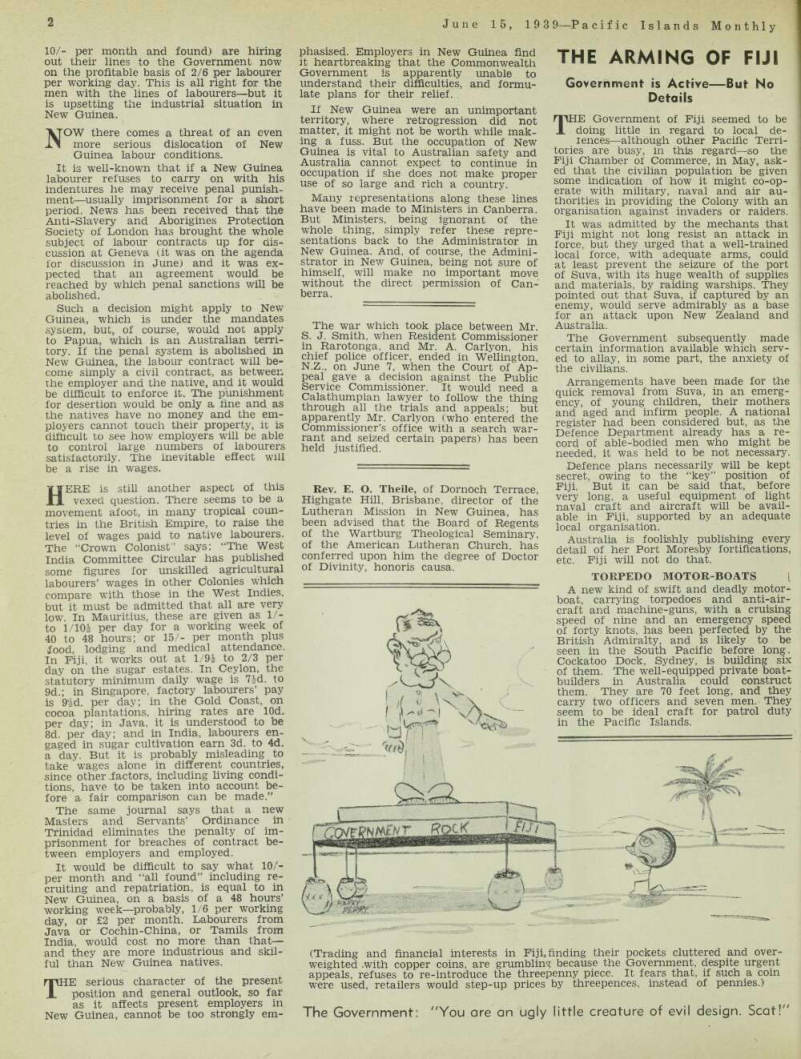
(Trading and financial interests in Fiji, finding their pockets cluttered and over weighted -with copper coins, are grumbling because the Government, despite urgent appeals, refuses to re-introduce the threepenny piece. It fears that, if such a coin were used, retailers would step-up prices by threepences, instead of pennies.) The Government: "You ore on ugly little creature of evil design. Scat!"