Sir Basil Thomson
pp. 45-47 · Read in the full issue
The Passing of Tonga's Literary ex-Prime Minister
By Eric Ramsden
ALL lovers of Pacific literature will learn with regret of the death of Sir Basil Home Thomson in London in March. Though his name is generally associated with his fascinating “The Diversions of a Prime Minister”, an amusing account of the time he spent in Tonga following the Shirley Baker de bacle, he was the author of equally in teresting, if not so well-known books on other parts of the South Seas.
Thomson left many good friends in Tonga. His first book, now regarded as a classic, was dedicated to George Tukuaho George Fatafehi, William Tungi and Asibeli Kubu. The majority of those he knew in the Island Kingdom have long since consumed their last bowl of kava.
Tonga is to-day a very different place to the Tonga that Thomson knew, and in laying the foundation for that measure of financial stability which the kingdom has enjoyed for so many years, he played a by no means inconsiderable part.
King George Tubou 11.
FOR the Tongans (over whom, for a time, he was virtually dictator), he had a genuine love. A man of wide culture, like others of similar mind, Basil Thomson was quick to grasp the essen tials of their culture and treat them as gentlemen. “When I refuse to treat ser iously the fatal experiment of engrafting
Western customs upon their own ancient and admirable polity,” he wrote, “I am only reproducing the sense of grotesqueness with which their present hybrid institutions inspire the best of them.
Where I have laughed, they have laughed with me: what I have deplored, they have no less regretted.
Every Polynesian has a sense of
humour. The- fact that Thomson was similarly equipped, was an important factor in his success among the Tongans.
Thomson was, I suppose, the finest medium of publicity that Tonga has ever known. Prior to the advent of his book (which contained a humorous review of the lighter happenings during his stay as Lord High Factotum, together with a
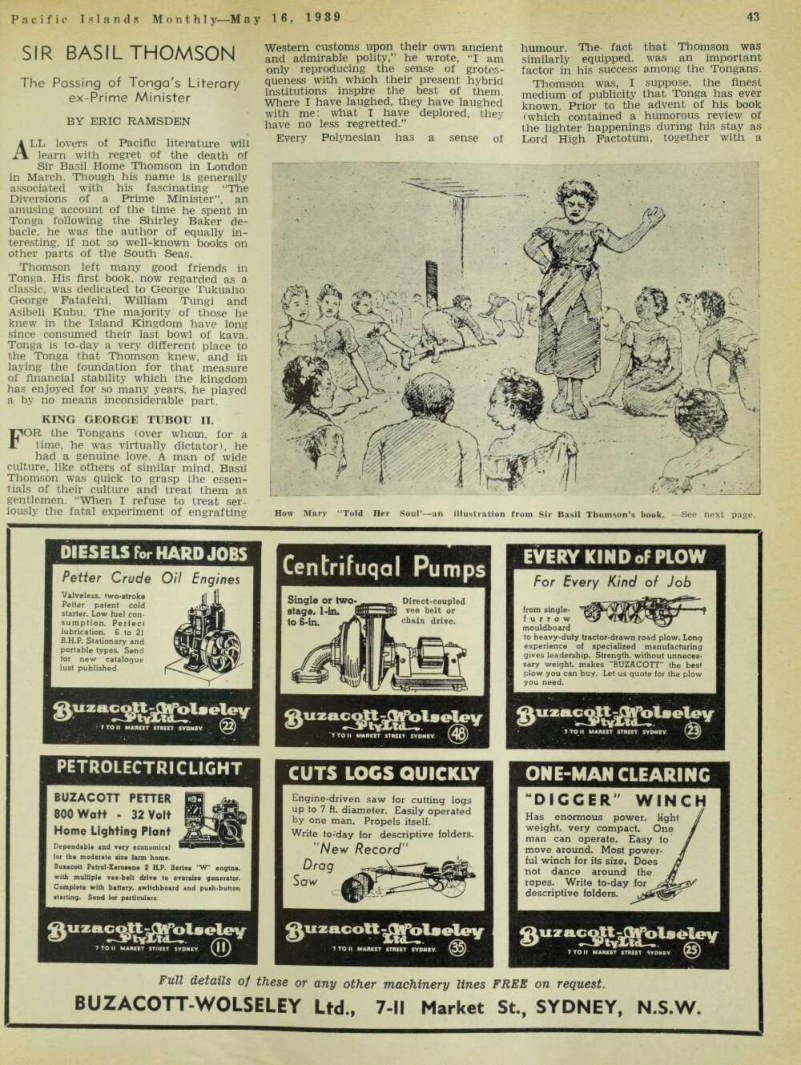
How Mary “Told Her Soul’-an illustration from Sir Basil Thomson’s book, —See next page.
recital of history that is of invaluable importance to-day), the reputation of the kingdom abroad was not of the best, Scandal had succeeded scandal. Shirley Baker, for all his undoubted ability, had made the name of Tonga a by-word for corruption throughout the Pacific.
The English Administrator directed the eyes of the world towards the Tongans.
While he was in no way blind to their defects, he succeeded in arousing sympathy for their own institutions, and
showed that they were in every way the equals of other and perhaps better known members of the great Polynesian family.
His “South Sea Yarns” was also pub lished in 1894, and is a book much sought after by collectors. “The Discovery of the Solomon Islands” appeared in 1901, and the following year he published “Savage Islands” (which contained an amusing ac count of his return visit to Tonga). “The Fijians” appeared in 1908. Thomson also produced several works of fiction, accounts
of the prisons in England of which he was later governor, and a recital of his experiences in the British Secret Service.
“The Story of Scotland Yard”, which ap peared as recently as 1935, was his last book.
Civil Servants Paid
WHEN Thomson left Tonga he had re vised the Code, and provided suffi cient money to meet all immediate liabilities. For the first time for many months the civil servants had been paid.
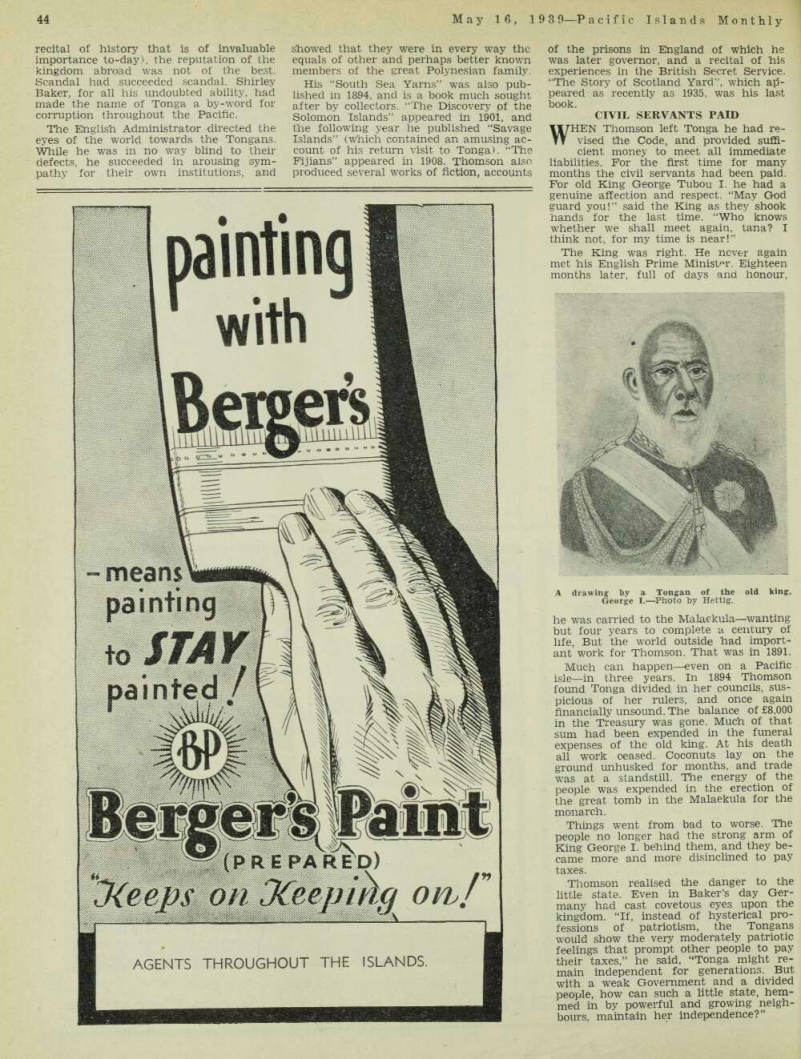
For old King George Tubou I. he had a genuine affection and respect. “May God guard you!” said the King as they shook hands for the last time. “Who knows whether we shall meet again, tana? I think not, for my time is near!”
The King was right. He never again met his English Prime Minister. Eighteen months later, full of days and honour,
he was carried to the Malaekula —wanting but four years to complete a century of life, But the world outside had import ant work for Thomson. That was in 1891.
Much can happen—even on a Pacific isle —in three years. In 1894 Thomson found Tonga divided in her councils, sus picious of her rulers, and once again financially unsound. The balance of £B,OOO in the Treasury was gone. Much of that sum had been expended in the funeral expenses of the old king. At his death all work ceased. Coconuts lay on the ground unhusked for months, and trade was at a standstill. The energy of the people was expended in the erection of the great tomb in the Malaekula for the monarch.
Things went from bad to worse. The people no longer had the strong arm of King George I. behind them, and they be came more and more disinclined to pay taxes.
Thomson realised the danger to the little state. Even in Baker’s day Ger many had cast covetous eyes upon the kingdom. “If, instead of hysterical pro fessions of patriotism, the Tongans would show the very moderately patriotic feelings that prompt other people to pay their taxes,” he said, “Tonga might re main independent for generations. But with a weak Government and a divided people, how can such a little state, hem med in by powerful and growing neigh bours, maintain her independence?”
A drawing by a Tongan of the old king, George I.—Photo by Hettig.
Missionary Influence
FORTUNATELY, the rule of the good natured George Tubou II was suc ceeded in 1918 by that of his daughter, Queen Salote. Mission inter ests, which had always been strong in Tonga, have become increasingly power ful. Whether that is entirely advisable— either for themselves or the Tongans — is another matter. But the mission in fluence, however much criticised, has un doubtedly been a factor in placing the Tongans where they are to-day. It must not be forgotten, however, that behind all has been British counsel, wise and able, and those who have followed in the footsteps of Basil Thomson are en titled to credit, too.
Few books written on any Polynesian people have ever had the human appeal contained in Thomson’s “The Diversions of a Prime Minister”.
Who can forget, for instance, the story of how Mary told her soul? It is one of the most amusing accounts of the burlesque of the bolotu ever penned.
Mary Butako, long past her first youth, had shown signs of repentance for a life of sin. The author depicts the anxiety of the men of her village as bolotu after bolotu passes, and though urged to do so, Mary refrains from “telling her soul”. At last came a night when, enthus iasm passed all bounds, and as Mary rose to tell her story, man after man slunk out to spread the dire tidings among comrades in distress. As Thomson says: “A terrible and damning history fell from the lips of this penitent Phryne of the South Seas.”
Neither can be forgotten his descrip tion of the sanctum sanctorum of Baker, his predecessor in office. Into this office no Tongan had been permitted to enter in Baker’s day. Like Timothy, “Misa Beka” had advocated the use of a little wine for his stomach’s sake (though the Tongans were unaware of that fact!).
There, in his sanctum, was the mute evi dence of that habit.
Incidentally, among the vouchers, he found one entered under the heading of “assassination”. For a time Thomson was puzzled. At last it dawned upon him that it was for payment to an Aucklander for repairs on a generous scale to. the carri age occupied by Baker when his life was attempted by several goaded young Tongans.
Again and again one reads with in terest his descriptions of ceremonies associated with the Tongan Court. George I, a sombre figure in black, the one digni fied person at the opening of his Parlia ment. A sovereign who had wielded abso lute power after his ninetieth year was no longer interested in pomp and circum stance. But his aides-de-camp. George Finau and Taufaahau, his great-grand son, certainly were. The former donned the uniform of a British admiral, while the latter appeared as a colonel of the Defence Forces.
On one such occasion it had been ar ranged that a portrait of the King should be unveiled. But as soon as the Speech from the Throne had been delivered, the monarch rose and strode out as he had come—“with the air of a man who has loyally discharged an irksome duty”. The band dashed recklessly into the triumphal march from “Tannhauser”, and the sena tors streamed away to disrobe. The por trait was never officially unveiled, though it can still be seen by any interested visitor to Nukualofa.
Thomson had departed. His subsequent
career in England, though full of pro mise for a time, became clouded. Never theless, he performed important service at Scotland Yard and in the Intelligence Branch during the war years. As re cently as 1937 he was invited to Siam to reorganise the police force there.
After a long experience of a gaol governor, he, not unnaturally, became an expert on prison administration. But it was his association with the Pacific, and particularly Tonga, that provided the most colourful aspect of his life.
Son Of Archbishop
THIS son of a former Archbishop of York, who had passed through Eton and Oxford and had been called to the English bar, always retained a sincere affection for the Tongan people. In his last address to the Tongan Parliament he spoke of the vicissitudes of life that threw men into close companionship for a common work, and then separated them perhaps for ever.
“I saw that they as well as I were overcome with emotion. It was hard to part with men who had been such staunch comrades in a hard fight, know ing that in the ordinary course of the world I should never see them again.”