Across Pacific In An Outrigger
p. 10 · Read in the full issue
Remarkable Performance of Young Czech. Canoeist
From Our Own Correspondent.
Rabaul, May 4.
A YOUNG Czecho-Slovakian, Rudolf Cikanek, aged 26, arrived in Rabaul harbour on April 24, after having travelled by outrigger canoe from the Philippines. He left that group towards the end of December, 1937, and he eventually made his way south by easy stages and hugging the coastline, until he beached his canoe beside the old. burned N.D.L. wharf, in Rabaul, New Guinea.
Never have I seen such interest shown in any one white man by the natives.
Scores of Rabaul natives followed the traveller wherever he went, until at last native police had to be detailed to pre
vent the natives from making a nuisance of themselves.
For years, certain tribes in Buka and Bougainville have been waiting for “a white man to come out of the sea”. Word travelled around that this wonder-man had at last arrived.
Dozens of Buka natives, locally employed, gathered outside the house wherein the Czech was staying, and gazed for hours at the verandah, in the hope of catching sight of the newly arrived god.
Cikanek comes originally from Vienna, though his par ents are Czechs; he speaks French, German, Czech and very good English. Deeply sun tanned, he is the embodiment Df health and clean-living. He neither smokes nor drinks, and has an attractive sense of humour.
He made light of his travels. It was more congenial that living in Europe during these trying times. When he left the Philippines, his own country had not yet been taken by Germany. He realised that changes had come about as soon as he called at the Rabaul Post-Office, and found there were no letters for him—no money; no word of his mother, and con cerning her he was anxious.
Modestly, he described his journey from the southern end of the Philippines, across to the Celebes, and then over to the Moluccas, and from there to Dutch New Guinea; along the northern coast line until he entered the Mandated Terri tory at Wanimo; and from there on, he said, he reckoned he had called al nearly every village along the coast. Not once, he added, had he experienced any trouble with the natives; nor had he been refused food or assistance. News of his journey preceded him down the coast; for hundreds of miles ahead the natives were on the look-out for him. News travels
quickly along the New Guinea coast where the wooden drums beat out iheir messages.
Hospitality greeted him everywhere from the dark races. It was not until he arrived amongst men of his own color that he was looked upon askance by some, and assistance withheld by others.
The magnitude of the Czech’s perform-
ance was not realised by the motor-riding people. Only the natives appreciated the effort. Had they themselves not battled for days against head-winds and strong tides in one-man canoes? Had they not experienced the dangers of a swamped, frail bark when the nor’-west seas and winds beat upon them?
The achievements of Marconi, Curie, Edison, Kingsford-Smith are nothing to the primitive native. But for a white man to excel them at their own game—navigat ing a canoe over open waters for months —was understood, and he was credited with supernatural powers.
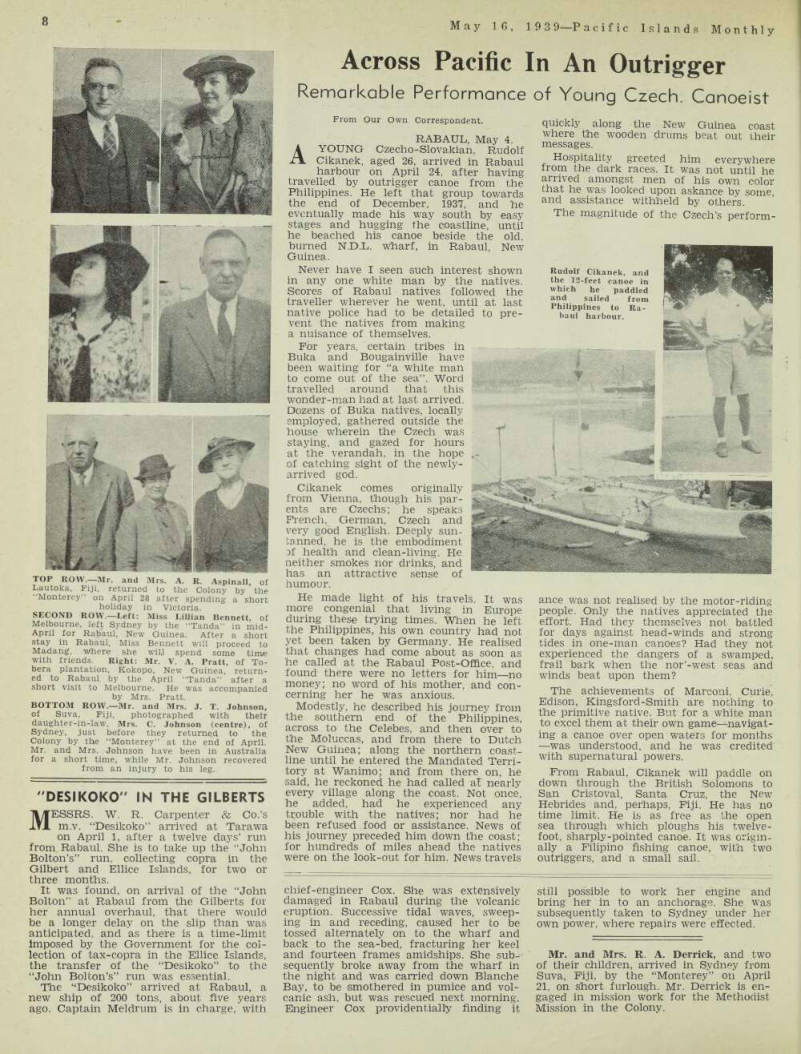
From Rabaul, Cikanek will paddle on down through the British Solomons to San Cristoval, Santa Cruz, the New Hebrides and, perhaps, Fiji. He has no time limit. He is as free as the open sea through which ploughs his twelve foot, sharply-pointed canoe. It was origin ally a Filipino fishing canoe, with two outriggers, and a small sail.
Rudolf Cikanek, and the 12-feet canoe in which he paddled and sailed from Philippines to Ra baul harbour.