Japanese Spy Organisation
pp. 7-8 · Read in the full issue
In Hawaii
American Agents Secure Some Startling Evidence
By John Williams
Honolulu, Apr. 7.
DRAMATIC proof of Japanese spy technique in the Pacific area has been unearthed by the United States b°een ter d£cove?ed eS in “nawaTfan If America's defence outpostT,i™t thi Orient 1 g 4 aggression from the Orient.
Japan’s agents have been tapping U.S. navy and army wireless messages; in ocean-going fishing trawlers and sampans, they have shadowed the high seas movements of American warships; and, in the most recent instance, they have
brazenly flaunted U.S. laws governing the public sale of stocks and bonds.
Japan’s agents were caught red-handed selling (behind the scenes, of course) Japanese “China Incident” Emergency Bonds among the 150,000 Japanese living in Hawaii.
Here are some of the facts compiled from confidential U.S. counter-espionage files:— Hawaii is not all that i* is thought to be. For example, most outsiders think of Hawaii as the exotic land of aloha and the sensual hula-hula and moonlit romance on the beach at Waikiki—but to defence-conscious Americans, who live on the spot, Hawaii is the keystone of America’s gigantic Pacific defence scheme.
There is moonlight on Waikiki Beach, sure enough; but the same moonlight peeps down upon monstrous 16-inch coastal guns, upon batteries of anti-air craft guns and detectors, upon vast Pearl
Harbour navy base; upon, in o:her words, the greatest array of military and navy striking power in the Pacific outside of Japanese waters.
In Hawaii’s skles ' hundreds of the Iat ‘ est navy and army patrol bombers tire ‘ lessly prowl, and their manoeuvres al way/ concentrate on the west.
TTAWAII., next to California, has the XI biggest Japanese outpost under the American flag. There are 150,000 of them in a watertight community. Two-thirds were born in Hawaii, and therefore, ac
cording to U.S. law, are U.S. citizens. But they are not so regarded by Japan.
All these Japanese, much to the dis tress of sentimental thinkers for brother nood and democracy, persist in living in an environment of their own making, and choosing that which is Japanese, even down to the grass mats upon which many of them sleep.
This Japanese community has its own language schools and daily newspapers, wireless broadcasts,, churches, theatres, banks, chamber of commerce, hospitals, shops (which feature made-in-Japan goods carried to Hawaii in Japanese steamers) and so on.
From the American community the Japanese studiously take only those ma terial aids and comforts which they need.
One authority has written: “ . . . The Japanese have maintained themselves as a separate community with national con tacts, ancestral customs, celebrations of national holidays, and living as though
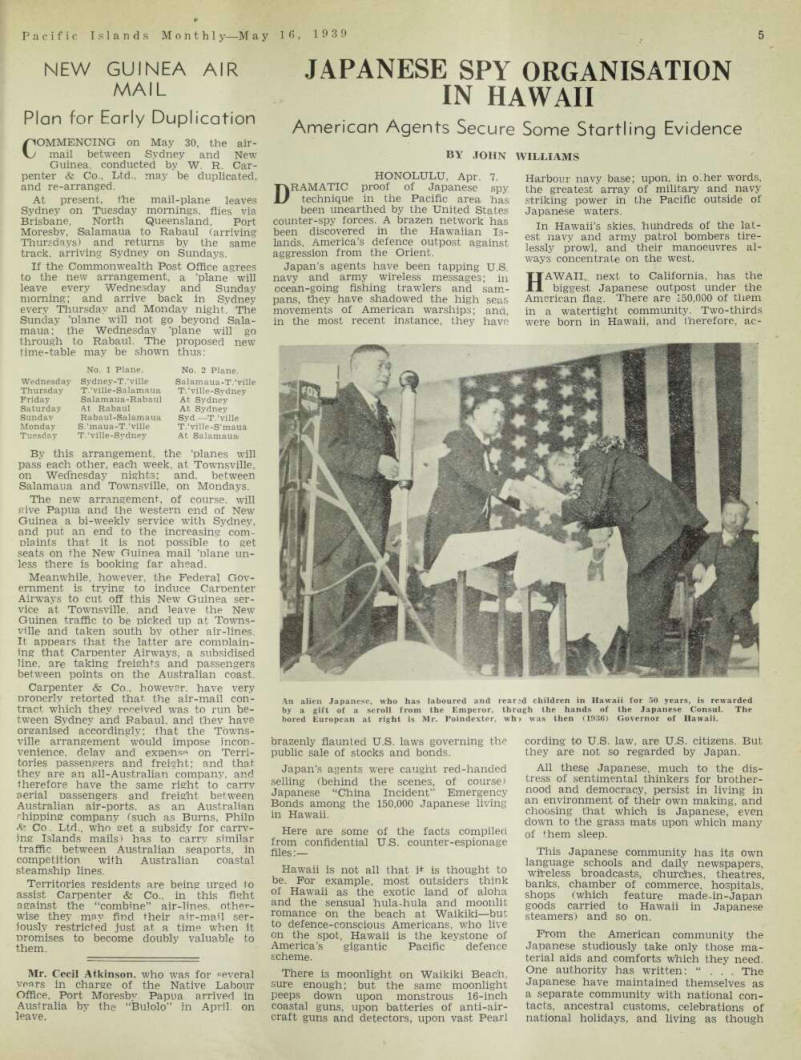
An alien Japanese, who has laboured and reared children in Hawaii for 50 years, is rewarded by a gift of a scroll from the Emperor, thrugh the hands of the Japanese Consul. The bored European at right is Mr. Poindexter, who was then (1936) Governor of Hawaii.
they still were in Japan. They are dir ectly under the thumb of their consul general, who represents the Emperor of Japan, and with whom their marriages and children are registered . . .”
Now we may see how true are these words in the light of actual facts dug out by Uncle Sam’s investigators; All the Japanese in Hawaii are or ganised into so-called associations, which in turn are subject to the control of a central group, most potent of all. A sort of inner cabinet. They function best of all on the biggest island of the group, the island of Hawaii, of which the main town is Hilo. Hilo is a little Tokio.
The U.S. agents discovered the exist ence of more than 150 Japanese associa tions on the island of Hawaii, inter locked by a “mobile” force of 200 hand picked Japanese, all alien born, who are contacts between the Japanese consul general, the Japanese banks and the Japanese community at large. These 200 sub-consular agents (as the American investigators have come to call them) in o 'her words police and discipline the Japanese community with totalitarian thoroughness. If Hilo is a little Tokio, then the Hawaii islands are a little Japan.
LATE in 1938, American agents routed under cover Japanese war-bond salesmen from California. It was obvious that the salesmen next would tackle the Japanese in Hawaii. The Ameri can agents watched the Japanese vern acular newspapers in Hawaii. Sure enough up bobbed the illegal bond sales men with their patriotic appeals.
Mass meetings of Japanese (alien and U.S. bom) were held, and the Hawaii Shima Aikoku Obo Kosai Doshi Kai (Hawaii Patriotic Bond Subscription Society) was one of the activities set going.
Reporting upon this momentous meet ing. the alien-owned and edited “Nippu Jiji”, leading Japanese newspaper of Hawaii, said (in Japanese); “ . . . The meeting was called to discuss the public loan subscription campaign for the Fatherland . Added the patriotic paper; “ . . . The mass meeting began at 9.30 am., and the several hundred re presentatives of various districts showed such a keen desire and loyalty to help the Fatherland that the meeting lasted until 4 p.m. Officers were elected to guide the association in raising 1,000,000 yen within six weeks . . .”
America came into action. Investiga tors (according to the Government files) started with the cable companies; all the messages between a Japanese bank in Hawaii and Japan were subpoenaed and decoded. During this involved work it be came necessary to secure men with a good knowledge of the Japanese language.
Logically, the U.S. agents turned to American-bom and educated Japanese; i.e., U.S. citizens. These youths professed allegiance to America, and they were set to work; but careful U.S. agents shadowed them, and tapped telephone lines. This vigilance was soon rewarded.
The Japanese-Americans were seen and overheard contacting Japanese leaders and protesting that, although ostensibly they were working with the American agents, their sympathies, in reality, were with “the Fatherland”.
Then the U.S. agents discovered an other brazen angle: somewhere in Hawaii, at locations now being discovered, the
Japanese for a long time have been op erating secret wireless units, which are continuously manned to pick up all the U.S. army and navy messages sent by air from Washington and other centres.
These Japanese outposts even are equip ped with the latest highspeed “Mux” automatic machines, which handle three messages instantaneously and garble the code, so that the messages at the receiv ing end must be slowed down for trans lation by automatic receivers.
This Japanese interception of vital American messages has created a sen sation in U.S. official circles here, and. as these words are being typed, squads of specially assigned agents are compiling a history of damaging evidence against the spies.
So far as the American public is aware, the only outcome of the illegal sale of the Japanese bonds in Hawaii was the pleading guilty of 24 Japanese to charges filed in the U.S. District Court at Hono lulu.
To-day, the U.S. investigators are carrying on with the leads the bond case gave. Trails are leading into unsuspected places, from Hawaii to the U.S. mainland, to Alaska, back to Japan, and down into the South Seas.
The next instalment of this story will take the lid off more astonishing facts, and will make revelations about Japan ese activities in the mandated islands that lie between the U.S. and British Empire spheres of influence in the Pacific.