How Shall We Treat The Natives
pp. 53-56 · Read in the full issue
Of New Guinea?
Australia's Problems In Her Pacific Territories
(An address by Mr. J. R. Halligan, of the Australian Prime Minister’s Department, read before the Anthro pological Section of the Scientific congress, held in Australia in Janu ary. Mr. Halligan is virtually the liaison officer between the Australian Government and the Administrators of Papua and New Guinea.) THE natives of New Guinea are dis tributed in relatively small linguis tic groups throughout practically the whole of the main island and the archi pelagoes. Their regular habitations have been found at altitudes between sea level and 8,000 ft., and sometimes even higher.
I have no definite figures as to the population in Dutch Territory; but the enumerated native population (under Government control) of the Mandated Territory on June 30, 1938, was 581,342.
In addition, it is estimated that there are more than 200,000 natives inhabit ing the great plateau country south of the Bismarck Ranges, between the head of the Ramu River and Mt, Hagen.
These people, who were discovered in 1933, have been visited frequently since that date, and a number of administra tive posts have been established at var ious places on the plateau. A great many of the natives of the area may now be considered partially under control, and in two or three years, it is probable that they will be enumerated.
Similar additions will also be made to the census of Papua, which in 1937 was 231,000, when many of the numerous groups discovered in that Territory dur ing the last four years will have come sufficiently under control to be recorded on the census.
The New Guinea peoples vary greatly in type, language and culture. Ethno logists, especially Seligman, speak of them as Papuasians.
Differing so widely from one another, they present many complicated problems to the Administrations. Their diversities of type, language, social organisation, material culture, religious beliefs and fears of magic, present a wide range of problems which require to be closely studied by officials charged with the responsibility of the administration and development of the Territories.
Dual Responsibility
THE Administrations have a dual re sponsibility, i.e., the welfare and up lift of the native inhabitants and the economic development of the area.
The blending of these objectives pre sents an absorbing study.
The Mandate under which New Guinea is held by Australia enjoins that the Mandatory Power shall promote to the utmost the material and moral well be ing and the social progress of the in-, habitants of the Territory. The Common wealth Government at all times is alive to the serious obligations it accepted with the Mandate, and its policy in re gard to the treatment of the natives has always aimed to carry out to the fullest degree its trusteeship. This policy makes provision for the safeguarding of the natives in all circumstances— namely:
The natives in their primitive state.
The natives in their villages.
Native labourers.
The task of bringing natives from savagery to control is one of the most important functions of the Administra tion and one that requires much skill and patience upon the part of the officials entrusted with the work.
In the initial stages of contact, homi cidal activities, such as head-hunting, cannibalism, immolation of widows, in fanticide, and inter-tribal warfare, which exist in some form or other in country not under control, have to be suppressed before the Administration can proceed successfully to lay down an organisation.
These practices disappear as the people gradually merge into avenues that lead to development upon lines formulated by the Administration.
This, however, produces new problems that require the most careful direction by the Administration officers. It may be said that the work of officials is never done. The adjustment of to-day creates the problem of to-morrow, and right throughout the two Australian Territories officials are faced with a never-ending variety of human problems, ranging from the primitive activities opposed to European standards, to struggles for ad justment in the new conditions where natives are expected to take their pan in the administration of their own groups and changing economics.
Before The Government Came
BEFORE the coming of the Govern ment and the establishment of con trol, the natives lived in a state of constant inter-group warfare. Even now, in uncontrolled areas, one may sometimes see spearmen, or bow and arrow-men, hotly engaged in the no-man’s land be tween the villages. In uncontrolled coun try, the villages are either perched in the most inaccessible places, or are situated at strategic points, for protection against attack. Usually they are surrounded by
high . stockades, and are guarded by spear-pits, or their approaches are sown with sharp bamboo stakes, so skilfully hidden that they are invisible to the stranger. Many native police have their feet pierced by these stakes, when patrols are approaching villages in uncontrolled country.
In the old days some of the tribes stoutly resisted the advance of Europeans, and attacked them when they penetrated beyond Government control.
All coast-lines are now considered safe, but there are still many parts of the interior, which the Government will not allow Europeans to enter, until officials now engaged in exploring them, have established an adequate measure of con trol.
Most of the past attacks on trading vessels, or trading stations, were probably for loot. Europeans travelling in districts not thoroughly under control, have still to be on their guard against looting. A European party carries so many things, tomahawks, knives, etc., of use to natives, that it is just tempting providence to dis play them unnecessarily. Many Govern ment patrols know what it is to have such things snatched from the hands of their carriers while passing through crowds of otherwise friendly natives waiting for them on the tracks; it is al ways a very difficult and delicate busi ness t(x get them back again without trouble. Most of the experienced native police and carriers know this, and if thev have any valuables at all, they usually keep them out of sight, when passing through districts not under control as none know better than they, not long removed from savagery themselves, what a steel tomahawk or large knife means to a native who has only a stone tool to work with.
Apart altogether from reasons of loot, Europeans have always to be careful in travelling through districts not entirely under control. These natives are fighters, and there is always something happening in the villages to upset them. They are saturated with fears of sorcery and attri bute all sickness and distress to someone’s magic. They regard strangers with sus picion and are likely to relieve their dis turbed feelings by attacking them especi ally if their social and religious codes re quire some pressing act of ritual homi cide, just at the time strangers are pass ing through.
Language Difficulty
THE presence of all these diverse tribes in New Guinea, is one of the great ethnological problems of the world.
Why are there so many languages for instance? Trained investigators, especi ally missionaries, are working on the languages, but so far little is known of their origin or development.
There appears to be no doubt that suc cessive movements of immigrant peoples have influenced New Guinea. The pre sence of the loom, the blow-gun and dart, betel-chewing, cremation, the linguistic influences and various other things prove that, and it is equally certain that the introduction of these cultures was accom panied by racial mixture as well. But a great deal more research will have to be made before we can hope to lift, even partly, the veil of the past.
As already stated, the diversity of natives and the native culture, though extremely interesting to the traveller and the scientist, set up many complicated problems for the Administration. The chief difficulty is that of language. How are we to communicate with these widely
different groups? How are they to com municate with one another when the whole country is under control?
The missions are attacking this prob lem in various ways. Frequently, it is necessary for each missionary to study the language of the people among whom he is working and as none of these languages has a very wide distribution, the question is full of difficulties especi ally as it affects mission literature. The Lutheran Missions of the Morobe Dis trict have concentrated on two main languages, one of the so-called Melanesian languages of the coast and one of the so-called Papuan languages of the bush.
These two languages are now used in mission publications and are being taught in the mission schools throughout the whole districts.
In the New Britain and New Ireland districts the Roman Catholic and the Methodist Missions are printing and us ing the language spoken by the natives of the Rabaul district.
Use Of “Pidgin” English
FOR the purpose of contact between the natives and Europeans, how ever, the most widely used method of communication is “pidgin” English, which has become a “lingua franca” throughout the Mandated Territory for there are very few villages in areas pene trated by Europeans where the require ments of ordinary contact cannot be ex pressed in “pidgin”.
Miners, recruiters, planters and Govern ment officials would find it impossible to transact their business if it were not for “pidgin” English. Native labourers from different parts use it in conversation with one another, and on their return to their villages, they spread it far and
wide. The tribes, as a rule, know very little of the language of their neighbours and the distribution of “pidgin” has been of great value to them as well. It is also the common medium of communication between Europeans who do not under stand the languages of one another.
The “pidgin” English vocabulary in cludes many words from various New Guinea languages and other languages as well as English. It has a workable grammatical structure and with usage is improving as a means of communication for the ordinary, everyday things of life.
It is spreading daily and anyone who can speak it has little difficulty in mak ing himself understood for ordinary pur poses in most of the villages which have been visited by Europeans.
System Of Administration
THE Australian Government realised the extreme difficulties of developing these numerous varieties of primi tive peoples who differ so widely from us, and so widely from one another as well, and in 1921 an important step was taken in native administration when the Lieutenant-Governor of Papua, Sir Hubert Murray, appointed a Government Anthropologist to conduct researches and advise the Administration in regard to native problems. A few years later, the Commonwealth Government subsidised a school of Anthropology in the University of Sydney for the training of officials and missionaries taking part in native development and simultaneously created a cadet system in New Guinea for the training of officers charged with native administration.
Under this system, young officers with a suitable background of education and character are carefully selected and ap pointed on probation to the district ser vices of the Mandated Territory. After 21 months’ training in district work under experienced officers, during which time the cadets are able to decide whether the service itself and the conditions of the country offer a suitable career and the Government is able to determine whether they are likely to be the type for work among the natives, the success ful cadets are sent to the University of Sydney for a specially arranged course in Anthropology and other subjects likely to be of use during their service. On their return to the Territory they become per manent officers of the Administration and with the rank of Patrol Officer take a responsible part in the administration of the natives of the Territory.
From this position they may rise to Assistant District Officer, District Officer, and other positions available to officers of their training and experience.
This system was established in 1925 and 79 have been appointed of whom there are now 62 officers in the service. The quality of the work being performed by these officials has proved ample justifi cation for the establishment of the system.
Native Policy
Fundamentally, there is no differ ence between the native policy of the Mandated Territory of New Guinea and the Papuan Administration, the basic purpose of which is the moral and material improvement of the natives of the Territory. For intensive Admini stration, each Territory is divided into administrative districts, which in turn are further subdivided for closer control.
Each district is in charge of a district officer who is responsible to the head of the Department of District Services and Native Affairs.
These men have magisterial powers and are stationed in a suitable place accessible to the natives under their authority. Each district station also has a force of armed native constabulary, the noncommissioned ranks of which are filled by volunteers of suitable physique and character recruited from various villages throughout the Territory and trained in drill musketry and other duties.. The general responsibility of the district officer consists of patrol work during which new territories are gradually pene-
trated and the inhabitants pacified and brought under control, together with in numerable duties connected with their welfare and development once they come within administration influence, Associated with the district officers in this work of native welfare, is the Health Department which has hospitals and staff on each out-station. The iiiedical officials make regular patrols throughout their district, mapping out morbidity and carrying out treatment. By the system
of -patrol work and intensive administratum, district officers and medical officers are kept in suitable touch with hie, health and progress in the villages.
By a policy of appointing suitable natives nominated by the villagers themselves to accept responsibilities in village administration, the European officers have established liaison which keeps them in touch with the health and problems of the community and enables them more easily to introduce ideas and activities of value to their progress.
An important phase of administration is the supervision and control of natives who elect to work on plantations, in the mines, and in other commercial activities conducted by Europeans.
The essence of the native labour policy is that it must he voluntary an P d /o
forced labour is permitted. The system under which such labour is made avail able is regulated by the Native Labour Ordinance which provides safeguards during all phases of the native labourer’s existence—i.e.:— Recruitment.
Medical examination.
Execution of contract.
Transport to the scene of work.
Period of labour i maintenance of hours of relaxation).
Termination of contract.
Repatriation.
Recent Exploration
THE discovery, in 1926, of rich gold fields in New Guinea and the ex pansion of plantation areas through out the Territory, created a demand for a larger supply of native labour and
led to the penetration of new districts, and districts hitherto only partially known. Simultaneously, an intensive system of patrol work was introduced in the great central ranges in the main land between Mt. Chapman and Mt Hagen.
By 1933, most of the villages between Mt. Chapman and the Kratke Mountains of the Mandated Territory had been visited on more than one occasion and friendly contact established with many of the groups inhabiting them.
In 1932, a Government post was estab lished on plateau country at the head of the Ramu River and in 1933 an Assist ant District Officer of the N.G, Admini stration carried out an extended patrol westerly between the Ramu Station and Mt. Hagen, where a population of ap proximately 200,000 people was discovered.
Additional stations were subsequently established at Bena Bena and Chimbu for the continuing intensive work and last year a third station was established at Mt. Hagen itself.
Extensive patrols were also made in the Sepik and Madang districts of the mainland where friendly contact was established with many thousands of peoples who had not before been visited by Government patrols. A patrol, especi ally organised to examine the country between Mt. Hagen and the Dutch bor der has been operating since March, 1938 and has now reached its objective.
It is interesting to note that Central New Guinea is probably one of the last unexplored regions of the earth.
In Bougainville, the unknown interior was successfully penetrated in many parts and to-day there is scarcely a por tion of this large island which is not known to the Government.
Patrols In Papua
IN Papua, special patrols operating in the head-waters of the Fly, Strick land and Kikori Rivers during the past few years have discovered numerous groups of interesting peoples hitherto unknown to the Administration. One pat rol which proceeded to the head of the Strickland River in 1934 discovered at Tari Puroro large numbers of people who resembled in type and culture the people of Mt. Hagen, 100 miles to the south west, discovered by N.G. officers a year before.
The work of exploration and gradual penetration is steadily proceeding in both Territories and there is every rea son to believe that within the next few years practically all of the native groups of the two Territories will have been visited by Government officers.
Area Under Control
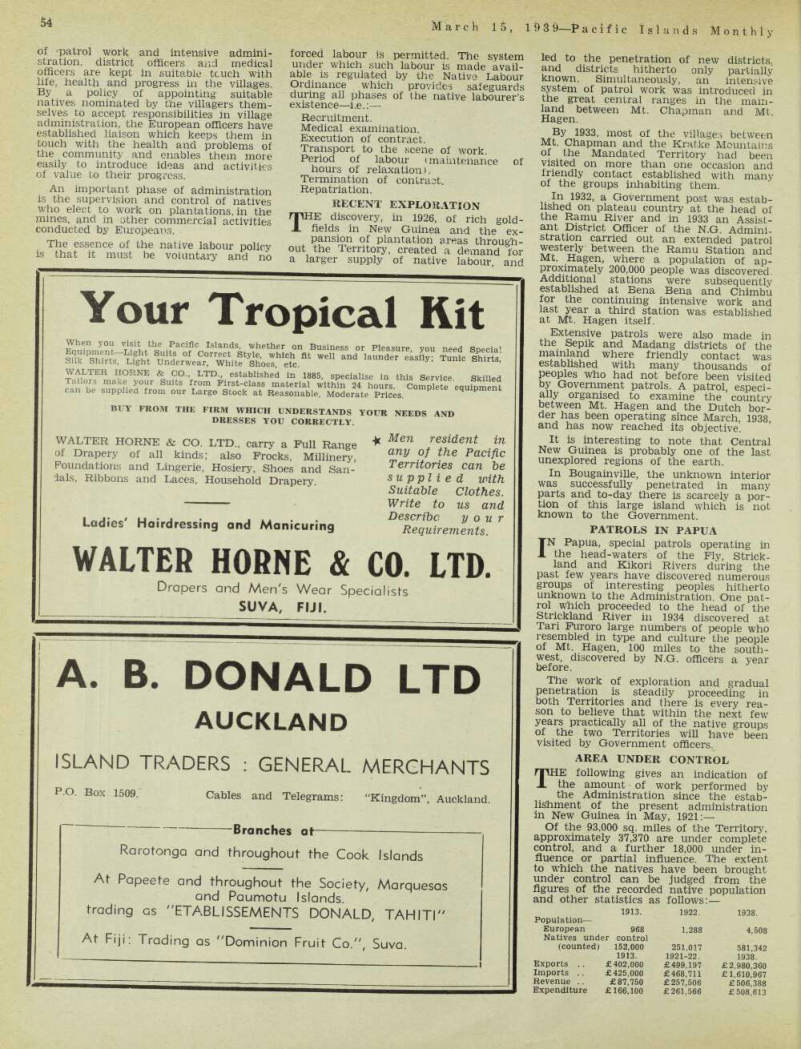
THE following gives an indication of the amount of work performed by the Administration since the estab lishment of the present administration in New Guinea in May, 1921; Of the 93,000 sq. miles of the Territory, approximately 37,370 are under complete control, and a further 18,000 under in fluence or partial influence. The extent to wiiich the natives have been brought under control can be judged from the figures of the recorded native population and other statistics as follows:
1913. 1922. 1938.
Population— European 968 1,288 4,508 Natives under control (counted) 152.000 251,017 581,342 1913. 1921-22. 1938.
Exports £402,000 £499,197 £2,980,360 Imports .. £425,000 £468,711 £1,610,967 Revenue .. £87,750 £257,506 £506,388 Expenditure £166,100 £261,566 £508 613