Purple Days In Old Samoa
pp. 45-47 · Read in the full issue
How Sailor-Men Found Entertainment In Apia Fifty Years Ago
GEORGE E. L. WESTBROOK (a descendant of an East Anglian family, which claimed descent directly from Henry VIE, through the Earl;: of Bridge water) died in Samoa on January 31, aged 18. Sailor, trader, merchant, writer and politician, he was one of the few men left who remember the Central Paci fic Islands as they were before the European nations fastened codes of laws upon them. In this article, which he sent to the “P.1.M.” about five years ago, Mr.
Westbrook draws a vivid picture of Old Apia, as he saw it when he settled down there in the ’eighties.
WHEN I first visited Samoa, there were many people still living who could tell very interesting and amusing stories of their early days there, when the township of Apia was called the “Sailor’s Paradise”.
Many of the notable characters floating around in those days were always called by their nicknames.
“Cranky Jack” was an Englishman of good family. “Gentleman Jack” was also an Ehglishman, and the grand son of a bishop. Then there were “Monkey Jack”, “Three-fingered Jack”, “Whistling Jack Smith”, “Scandalous Jack Smith”, “Lying Jack Smith”, and “Ugly Jack Smith”. Petersen” was a Dane.
“Charley Squarehead” and “Charley the Russian” both claimed Heligoland as the land of their birth. This brought them under the control of the British Consul, giving them both the dignity of being classed as British
subjects, although one was really a Russian and the other a German. It was the custom in those days, before Heligoland was exchanged with Ger many for some concession in Africa, for many foreigners shipping in Eng lish ships to say that they came from the small one-mile-square rock in the North Sea, at the mouth of the Elbe.
“Charley the Rooster” was another queer kind of individual, and was nicknamed the Rooster from a habit he had, when walking down the street, of putting his head forward, and beating his elbows against his sides.
There were also the two Mikes, Spanish Mike and Irish Mike. “Flash Harry” had a habit of showing sailors around, and pointing out to them certain properties on the beach of which he said he was the owner.
There were a number of other people, all of whom were never called by any
thing other than their nicknames, such as “Billy Bones”, “Paunchy Bill”, “Dinkum Dunlop”, “Crooked-eyed Bill”, “Sweet William”, and “Billy the Steward” (William Lowther), who hailed from Pimlico, London.
Billy, who kept a diary, which he first started when he as a boy ran away to sea, and had been recording nearly everything that had happened during his adventurous life, was a man worth listening to, and, when re lating a story regarding himself would produce a volume of his diary, and prove by day and month that he was not romancing. His diary would have filled a fair-sized book-shelf. He made several voyages with Bully Hayes, and afterwards settled down in the Gilbert Islands, where he died, a very old man, more than 20 years ago. What became of his diary, no body knows. It was very carefully written in a fine, legible hand.
IN those days, Samoa had a big, floating population, and the town ship of Apia must have had a bigger white population than it has now. It was certainly not the calamitous place it is as at present, governed by New Zealand, under the Mandate from the League of Nations, nor was it over staffed with officials, nor top-heavy with by-laws and taxation without re presentation.
The place in those days was appar ently well governed by the Samoans themselves, in accordance with their own manners and customs,
(Continued Overleaf.)
L 1 Li . f e was free and easy. Many of the so-called “lawless” characters and South Sea rovers made Apia a regular call, where they could have a ifi° ( fbQ^ ie KniTfi ey wer ? more ’ after all, than boisterous, ebullient persons, On account of this, the harbour of Apia was crowded with shipping of all kinds. There were fine Aucklandbuilt schooners and brigantines, fitted
out with trade rooms in charge of supercargoes. Sydney traders fitted out the same way. Whaleships with very motley crews aboard, hailing from all the countries under the sun. Most of these whalers were under the American flag, sailing out of Nan tucket, Martha’s Vineyard. and Eastern ports. There were also a number of whalers sailing out of
Kcbart Town, Sydney, New Zealand, and the Hawaiian Islands, under the old Hawaiian flag.
In addition to this there were the blackbirders”, such as the “Carl” brig and the schooner “Daphne”. The “blackbirders” in those days, were to an extent slavers, making good money by “inducing” Melanesians and any natives they could get hold of to take service on the plantations of Hawaii, Queensland and Fiji.
VyiTH such a big floating population it was only natural that there were a fair number of sailors’ board ing houses and places where men could get an honest drink. These were kept mostly by darkies, who had found their way to Samoa and settled down by marrying Samoans. The darker strain of their descendants can still be seen in some of the Samoans to day. “Black Tom”, “Bill Henry”, “George Washington”, “Bill Williams”, “Bruce the Fiddler”, and “Old Bob”, were negroes in full colour and char acteristics.
There being no European Govern ment, no taxes or customs dues were collected, drinking saloons paying no license. A case of Green gin could be purchased in those days for three Chilian dollars (about 8/- English money), all liquors being cheap in proportion, and were sold at 10 cents per nip, out of which the dispenser made a rattling good profit.
All that was necessary at the time to start a drinking saloon was the purchase of a few dozen glasses and a case or two of grog. Get hold of a girl who could play “Champagne Charley” or some other topical airs of the day on the accordeon, and every thing would be set, and the guests would flock in.
Even in those days it was con sidered best not to give the Samoan males drink, and they were never al lowed to enter the bar rooms. With the women, of course, it was different, and there were quite a number of them who made it a practice to visit the various saloons at night and en tertain the sailors. They were not all Samoans, but included Hawaiians, Gil bert and Marshall islanders, also a number of Tongans and Rarotongans.
Some of the women also had nick names, such as “Ugly”, “Fatty”, “Venus”, “Pretty”, “Greasy”, “Sissy”.
The sailors, however, addressed them by their nicknames, till such times as they knew them all as “Mary”.
The American Consular Agent was very obliging in those times (depend ing upon his fees) and would marry any of those who thought they were in love with their duskv sweethearts for the sum of 5 dollars cash, and for double that amount would grant them a divorce at the same time, which proved that those who married in haste were in those days not com pelled to repent at leisure.
THERE were two native damsels, one a Samoan, and the other a Hawaiian, who, I suppose on account of their bewitching looks and pleasant manners, were regularly married and divorced to some newcomer, every two or three weeks. The class of
sailors who then visited Apia must have made their money easy, and, therefore, spent it freely, buying all kinds of fal-de-lals for the girls they admired.
The first thing was to give their newly-wedded bride an outfit, which she, nothing loth, accepted, so as to dress in harmony with the white ladies, and would obtain from her new hubby a long skirt, as worn in those days, a pair of corsets, shoes and stockings, and a large hat trimmed
with feathers of Gainsborough pro portions.
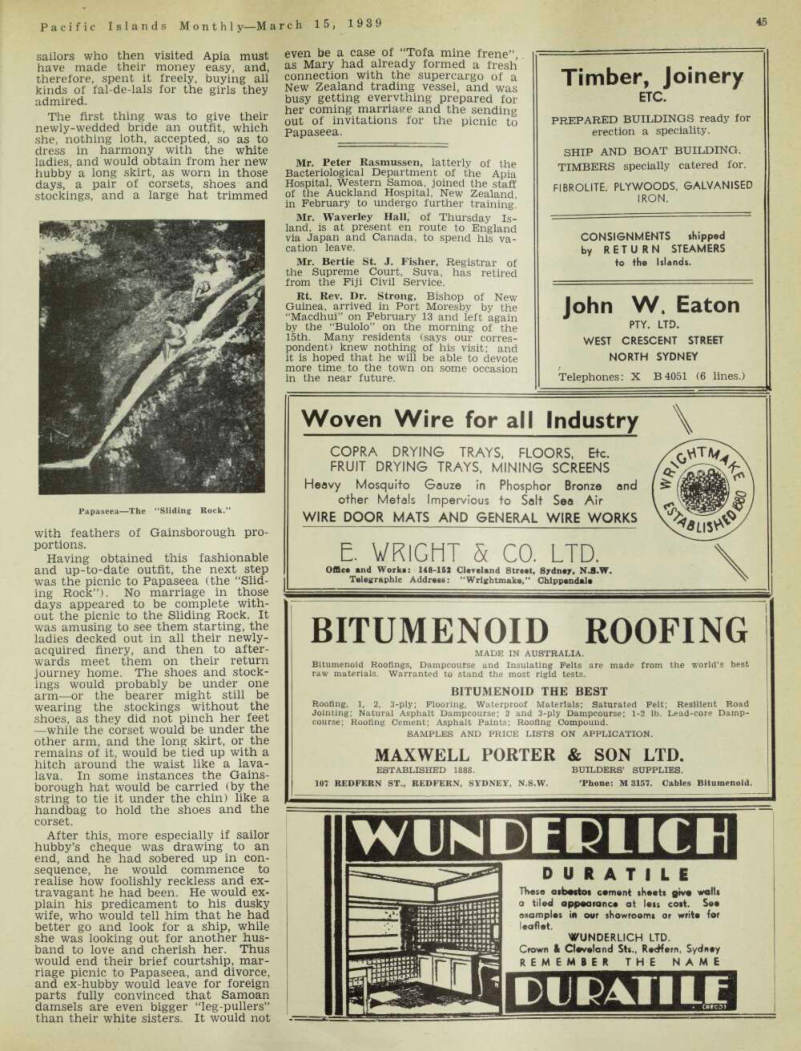
Having obtained this fashionable and up-to-date outfit, the next step was the picnic to Papaseea (the “Slid ing Rock”). No marriage in those days appeared to be complete with out the picnic to the Sliding Rock. It was amusing to see them starting, the ladies decked out in all their newly acquired finery, and then to after wards meet them on their return journey home. The shoes and stock ings would probably be under one arm—or the bearer might still be wearing the stockings without the shoes, as they did not pinch her feet —while the corset would be under the other arm, and the long skirt, or the remains of it, would be tied up with a hitch around the waist like a lava lava. In some instances the Gains borough hat would be carried (by the string to tie it under the chin) like a handbag to hold the shoes and the corset.
After this, more especially if sailor hubby’s cheque was drawing to an end, and he had sobered up in con sequence, he would commence to realise how foolishly reckless and ex travagant he had been. He would ex plain his predicament to his dusky wife, who would tell him that he had better go and look for a ship, while she was looking out for another hus band to love and cherish her. Thus would end their brief courtship, mar riage picnic to Papaseea, and divorce, and ex-hubby would leave for foreign parts fully convinced that Samoan damsels are even bigger “leg-pullers” than their white sisters. It would not
even be a case of “Tofa mine frene”, as Mary had already formed a fresh connection with the supercargo of a New Zealand trading vessel, and was busy getting evervthing prepared for her coming marriaere and the sending out of invitations for the picnic to Papaseea.
Mr. Peter Rasmussen, latterly of the Bacteriological Department of the Apia Hospital, Western Samoa, joined the staff of the Auckland Hospital, New Zealand, in February to undergo further training!
Mr. Waverley Hall, of Thursday Is land, is at present en route to England via Japan and Canada, to spend his va cation leave.
Mr. Bertie St. J. Fisher, Registrar of the Supreme Court, Suva, has retired from the Fiji Civil Service.
Rt. Rev. Dr. Strong, Bishop of New Guinea, arrived in Port Moresby by the “Macdhui” on February 13 and left again by the “Bulolo” on the morning of the 15th. Many residents (says our corres pondent) knew nothing of his visit; and it is hoped that he will be able to devote more time to the town on some occasion in the near future.
Papaseea—The “Sliding Rock.”