The "Tin-Can
pp. 58-59 · Read in the full issue
Mailman"
New Book By C. S. Ramsay
A GOOD many years have passed since the "P.1.M.” first told the story of "The Tin-Can Mailman”—Charles Stuart Ramsay, of Niua Fo’ou Island, in Tonga.
Since then, "Tin-Can Island” and its mail service have become world-famous.
So many stamp-collectors desired the Niua Fo’ou post-mark that the mail which went ashore there in sealed bis cuit-tins, in later years, grew to mons trous proportions—though the craze has died down, now.
And now we have a new book —“Tin- Can Island”, by C. S. Ramsay and C.
P. Plumb, just published by Hurst and Blackett, Ltd., of London, at 15/-. Writ ten in attractive fashion, and profusely illustrated with photographs and maps, it tells the story of C. S. Ramsay’s 20 years in the Tongan Islands, mostly on Niua Fo’ou. It was the kind of life that thousands of world-weary men dream about, but never achieve. Ramsay loved it all —the rich beauty of his lonely island, the song of trade-wind and the shriek of the hurricane, lazy days of swimming and fishing, long hours with the kindly, intelligent Tongans, the throb and colour of village romance.
It is hard to believe that life on little Niua Fo’ou could have provided so much incident; but here, packed into 320 pages, there is feasting and fighting, ship wrecks and elopements, a hurricane, a royal visit, an eruption, a solar eclipse.
A most readable and not over-exagger ated story of half a lifetime in the South Seas. And, of course, running through all the pages, as the high-light of ad venture, there is the “Tin-Can Mail”.
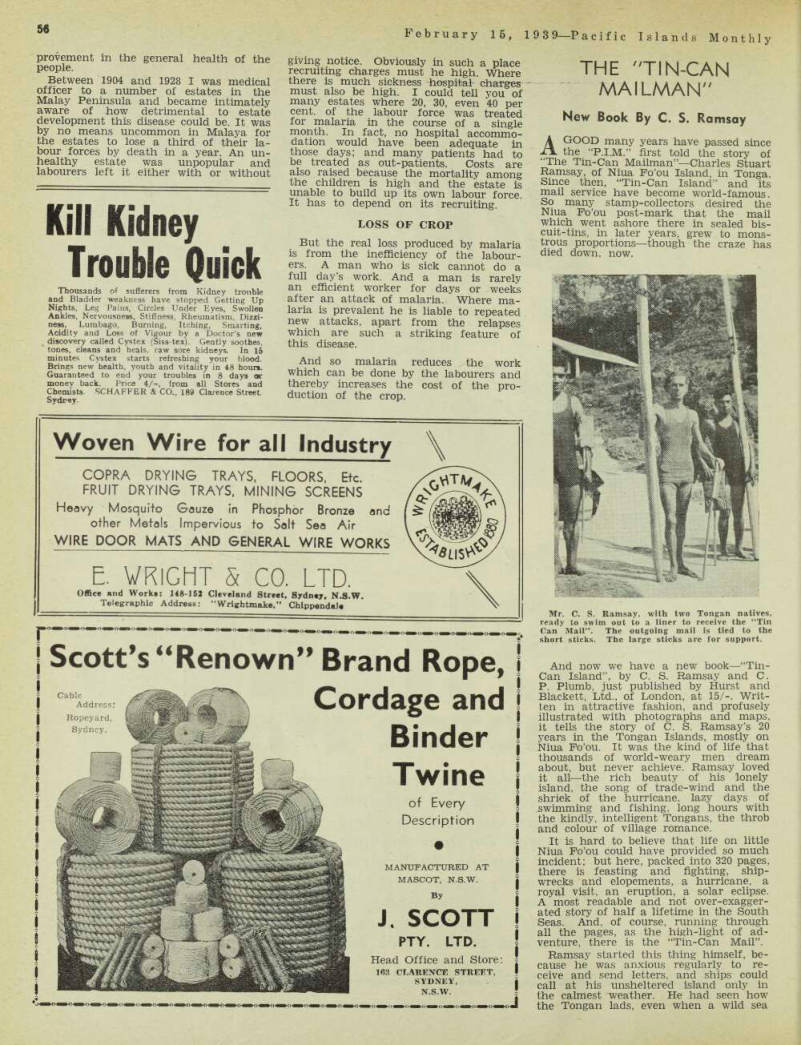
Ramsay started this thing himself, be cause he was anxious regularly to re ceive and send letters, and ships could call at his unsheltered island only in the calmest weather. He had seen how the Tongan lads, even when a wild sea
Mr. C. S. Ramsay, with two Tongan natives, ready to swim out to a liner to receive the “Tin Can Mail”. The outgoing mail is tied to the short sticks. The large sticks are for support.
was breaking, went out fishing; they waited for a certain kind of backwash, then from the high rocks threw in their swimming-poles of light fau wood, and followed immediately themselves, catch ing their poles out in the unbroken water.
So he decided to try the system when the monthly steamer then the “Tofua”, commanded by Captain Davey—came along. Only, instead of fishing-gear, he attached to his pole a watertight packet of mail. Getting out was comparatively simple—just a timely dive—but getting back, across the rocks through a raging sea, was a different matter.
However, the system worked, and Ram say’s swim out to the steamer, usually with a couple of Tongans, but some times alone, became a fixed institution.
Captain Davey co-operated. The incom ing mail was soldered into a biscuit-tin, so that Ramsay easily could push it ashore: and the captain, appreciative of this unusual arrangement, always had his passengers on the qui vive, to see the “Tin-Can Mailman”.
Several times, the nautical mail-car riers nearly lost their lives. Once, the steamer came along at night, failed to see the swimmers, and went on again, and they could not find their way back to the landing. Another time, also at night, an unexpected current swept them miles away, along the coast. Once, they were within inches of being drawn into the steamer’s propellers. And there were sharks.
The arrangement continued for years, and Ramsay must have made his fa mous swim many scores of times, until the depression came, and not only caus ed the withdrawal of the steamer ser vice, but also compelled Mr. Ramsay to seek a livelihood elsewhere. But he re turned to Tonga, later; and the “Tin- Can Mail” still goes on. When this writer was along there, not long ago, the ship, en route from Apia to Suva, stopped off Niua Fo’ou. and a biscuit-tin of mail was lowered overside. But it was receiv ed by natives in an outrigger canoe —
Ramsay swims no more.
R.